Mango
When the gopis, out of their minds with separation, rush about the night forest and ask the trees on the bank of the Yamuna after Krishna, the mango sounds among them twice – under two names at once, chuta and amra. In Vraja it is the tree of spring: its juicy buds turn the heads of the cuckoos, and its blossom the poets count among the five arrows of the god of love. And the same image Ramananda Raya raises highest of all: devotion to Krishna itself is the mango bud that the cuckoo-devotees taste.
The Tree in Vrindavan
In the thirtieth chapter of the Tenth Canto of the Bhagavatam the gopis, having lost Krishna in the midst of the rasa-lila, wander the forest and ask every living thing after Him: first the great trees, then the flowering ones, then the tulasi and the jasmine vines – and last of all the fruit trees on the bank of the Yamuna:
cūta-priyāla-panasāsana-kovidāra-
jambv-arka-bilva-bakulāmra-kadamba-nīpāḥ
ye 'nye parārtha-bhavakā yamunopakūlāḥ
śaṁsantu kṛṣṇa-padavīṁ rahitātmanāṁ naḥ
“O chuta, priyala, panasa, asana and kovidara, O jambu, arka and bilva, O bakula and amra, O kadamba and nipa – and all you others who live on the bank of the Yamuna for the welfare of others: we have lost our minds, so show us the path by which Krishna has gone!”
Chuta and Amra
One and the same tree is named here twice: chuta at the beginning of the verse and amra at the end. The commentators agree that both words are about the mango, but how the two differ they explain in three ways. Sridhara Swami speaks simply of two kinds of one tree. Srila Sanatana Gosvami, Vamshidhara Pandita and Narayana Bhatta Gosvami tell them apart by the taste of the fruit – sour and sweet. And Srila Jiva Gosvami, Srila Vishvanatha Chakravarti and Baladeva Vidyabhushana by their form: the chuta twines as a vine, the amra grows as a tree; Jiva Gosvami adds that the poets do not apply the word “vine” to the amra, and that in Madhyadesha, the middle country of India, chutas are indeed seen in the form of vines1.
The mangoes of Vraja grow to a huge size. In the Vraja-riti-chintamani of Srila Vishvanatha Chakravarti Thakura a separate verse is given to their measure:
āmrādikānāṁ kva ca pañcaśa yā
ūrdhvena śākhādibhir apy anyūnāḥ
tā nātiriktāḥ sukha-kṛtrimā kiṁ
puṣpāvalīnām api tādṛśās tāḥ
“Where else are there flowers equal to the flowers of the mangoes of Vraja? Where will one find trees of such height as the huge five-branched mango trees that grow here? Even to carve a statue of a tree so tall on purpose would be beyond one's power.”
In Vraja the mango serves both as a mark of a place and as food on the table. In the Govinda-lilamrita of Srila Krishnadasa Kaviraja Gosvami a frightened doe runs out from the foot of a mango tree straight to the door of the kunja where Radha and Krishna have hidden. And on the river bank Krishna feeds the cowherd boys rice with mango pickle; in the Brihad-bhagavatamrita, on Goloka too, He treats them in any season to ripe mangoes dripping with juice.
Spring, Cuckoos and the God of Love
The season of the mango in Vraja is spring. As soon as a warm wind blows, the buds swell at the tops of the trees, and the first to lose their heads are the cuckoos. Srila Jayadeva Gosvami in the Gita-Govinda pauses on that moment:
kiṁ ca snigdha-rasāla-mauli-mukulāny ālokya harṣodayād
unmīlanti kuhūḥ kuhūr iti kalottālāḥ pikānāṁ giraḥ
“Sakhi, look! The cuckoos are loudly singing kuhu-kuhu in mellifluous voices. They are jubilant on seeing the tender and tasty mango buds.”
The Five Arrows of Kamadeva
The cuckoo and the mango bud are an inseparable pair of the poetry of spring. Further on in the same poem the heroine, seeing the flowering branches of the mango, pines in separation: the tips of those branches, says the commentary, have become rasala, “the very essence of rasa”. And in the Vrindavan of Srila Prabodhananda Sarasvati the spring does not end at all: there the drunken bumblebees hum over the mango shoots, the cuckoos sing without ceasing, and in the midst of that garden stands Krishna Himself2.
The fragrant mango bud stands among the five flower arrows of Kamadeva as well. The Sanat-kumāra-saṁhitā, which Srila Vishvanatha Chakravarti Thakura quotes in his Mantrārtha-dīpikā, gives each letter of the kāma-bīja, the syllable klīṁ, its own flower: ka – the mango bud (āmra-mukula), la – the ashoka, i – the mallika, the crescent ardha-candra – the madhavi, the dot bindu – the bakula. There is another five as well, the lexical one: the Amara-koṣa names aravinda (lotus), ashoka, cūta (mango), navamallika and nilotpala (blue lotus)3. The lists do not quarrel: one counts flowers, the other reads a mantra.
Under the shade of a mango Srila Rupa Gosvami in the play Lalita-Madhava sets the scene as well where Krishna in the dusk takes a phantom form for the true Radha, standing at the very root of the tree4. And in the Stava-mala he prays that the mango tree of his own heart, sprinkled by the pastimes of Krishna in Gokula, may pour out a river of prema everywhere5.
Chaitanya Mahaprabhu
The very verse with which the gopis called out to the mango on the bank of the Yamuna, Sri Chaitanya Mahaprabhu repeated centuries later. In Jagannatha Puri the same separation would seize Him, and He addressed the trees and vines of the garden in those same words: “O chuta, O amra… show us the path by which Krishna has gone!”6
And in the conversation on the bank of the Godavari, Ramananda Raya made the mango an image of devotion itself:
arasa-jña kāka cūṣe jñāna-nimba-phale
rasa-jña kokila khāya premāmra-mukule
“Those who are devoid of all transcendental mellows are like the crows that suck the juice from the bitter fruits of the nimba tree of knowledge, whereas those who enjoy mellows are like the cuckoos who eat the buds of the mango tree of love of Godhead.”
The spring picture – a cuckoo on a flowering branch – turns into a parable: to the bitter fruit of speculation is opposed the sweet bud of the prema-amra, and to taste it is given only to one who has the voice and the heart of a cuckoo.
From the same place, from the words of Mahaprabhu in separation, comes one more mango image: the form of Krishna, once it has sunk into the heart, sticks to it for ever, “like mango resin”, which nothing can scrape off.
The Fruit for Offering
The mango is offered to the Lord as well, and the Hari-bhakti-vilasa sets this fruit high: whoever offers a mango to Sri Hari gains the merit of a whole horse sacrifice7. Mangoes are put into the offering to Jagannatha too, and mango pickles of every kind – amra-kashandi, amsi, ama-khanda, tailamra – Raghava Pandita and his sister prepare year after year and send to Mahaprabhu in Puri.
There is another mango story in the Chaitanya-charitamrita, no longer about the fruit but about the one who offers it. Kalidasa brings mangoes to the house of Jhadu Thakura, a Vaishnava of the bhunimali caste. The host offers the fruits to Krishna in his mind and eats them with his wife, and Kalidasa afterwards secretly gathers up the discarded skins and stones: what he needs is not the mangoes but the remnants of a Vaishnava's meal.
Ayurveda
In the Ayurvedic compendia the mango (Mangifera indica) is a tree with a whole scattering of Sanskrit names: amra, sahakara, rasala. Its taste (rasa) is astringent, and in the ripe fruit sweet-sour; its potency (virya) cold, its quality light, its post-digestive effect (vipaka) pungent. The ripe fruit is held to be good for the heart, nourishing and pacifying to vata; the bark and the leaves with their astringent taste go against pitta and kapha; the unripe fruit kindles digestion, and the flowers and the stone are used for diarrhoea – already in the Madhavachikitsa (7th c.) the mango is named a remedy for atisara, diarrhoea.
Botany
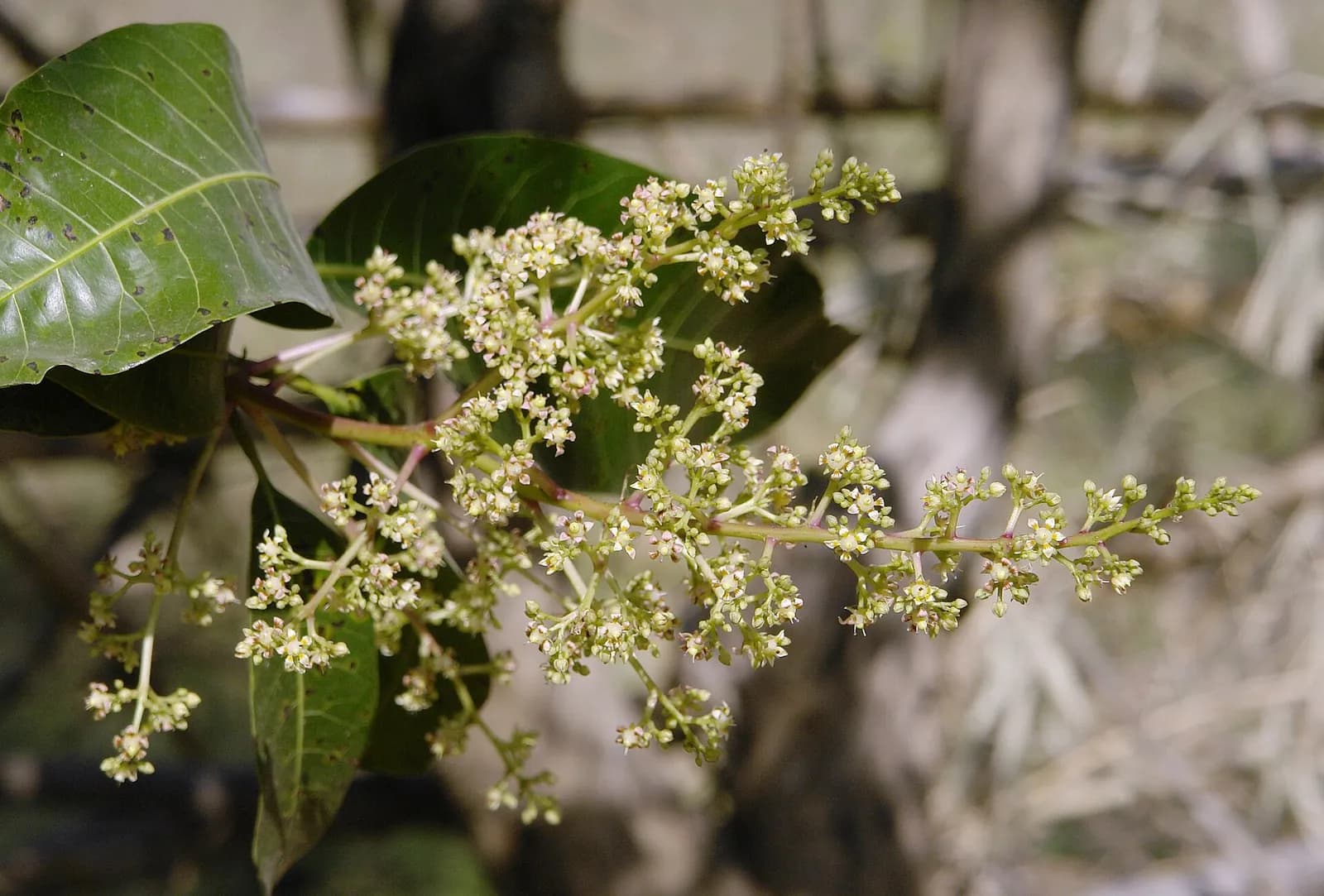
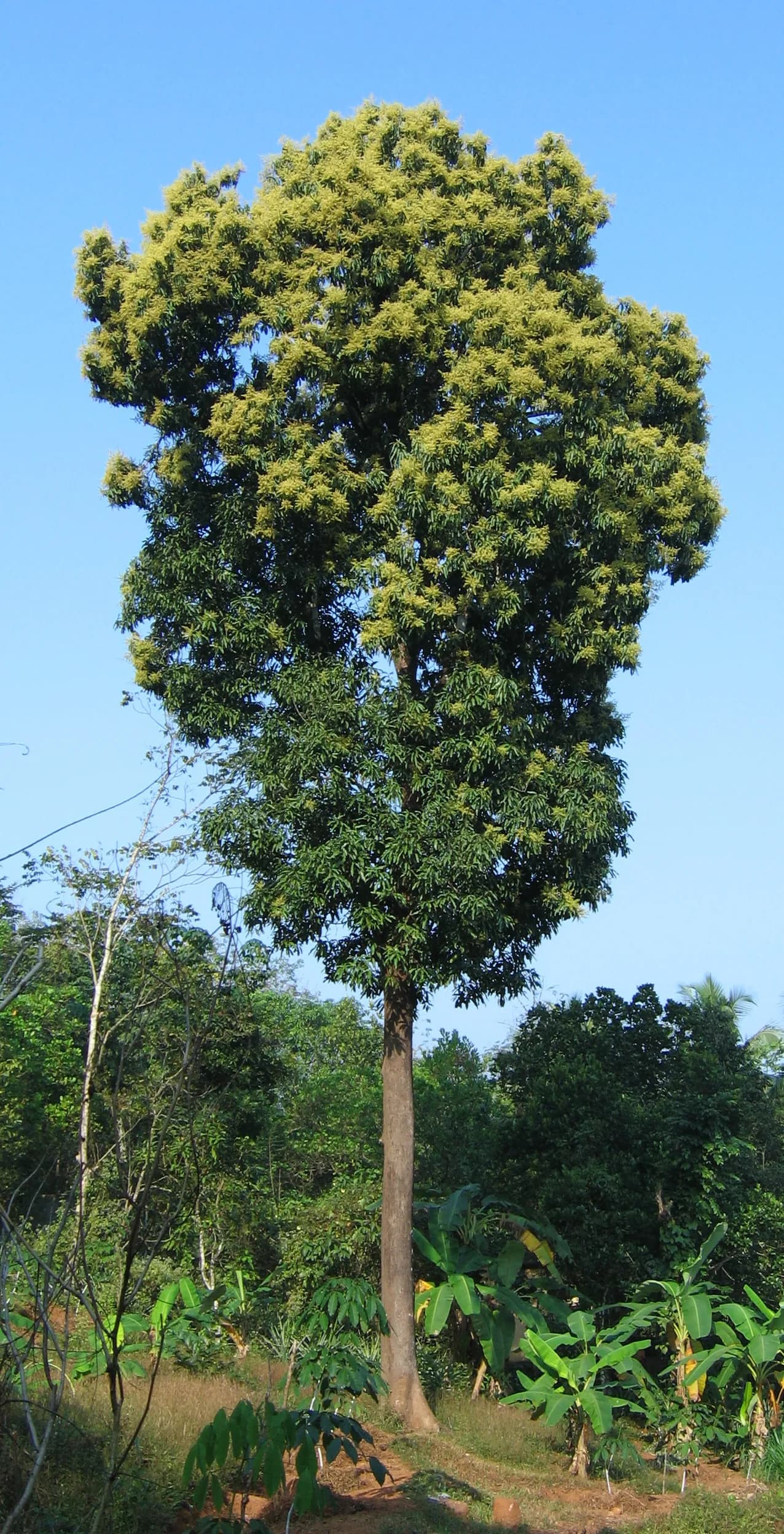
The home of the mango is not the whole subcontinent, as one might think, but its north-eastern corner: botanists call Assam, the Eastern Himalayas, Myanmar and Thailand its native range, while across India itself the tree is counted as cultivated. Its crown is broad and dense; the leaves are alternate, crowded at the ends of the branches and hanging in narrow ribbons on thin stalks.
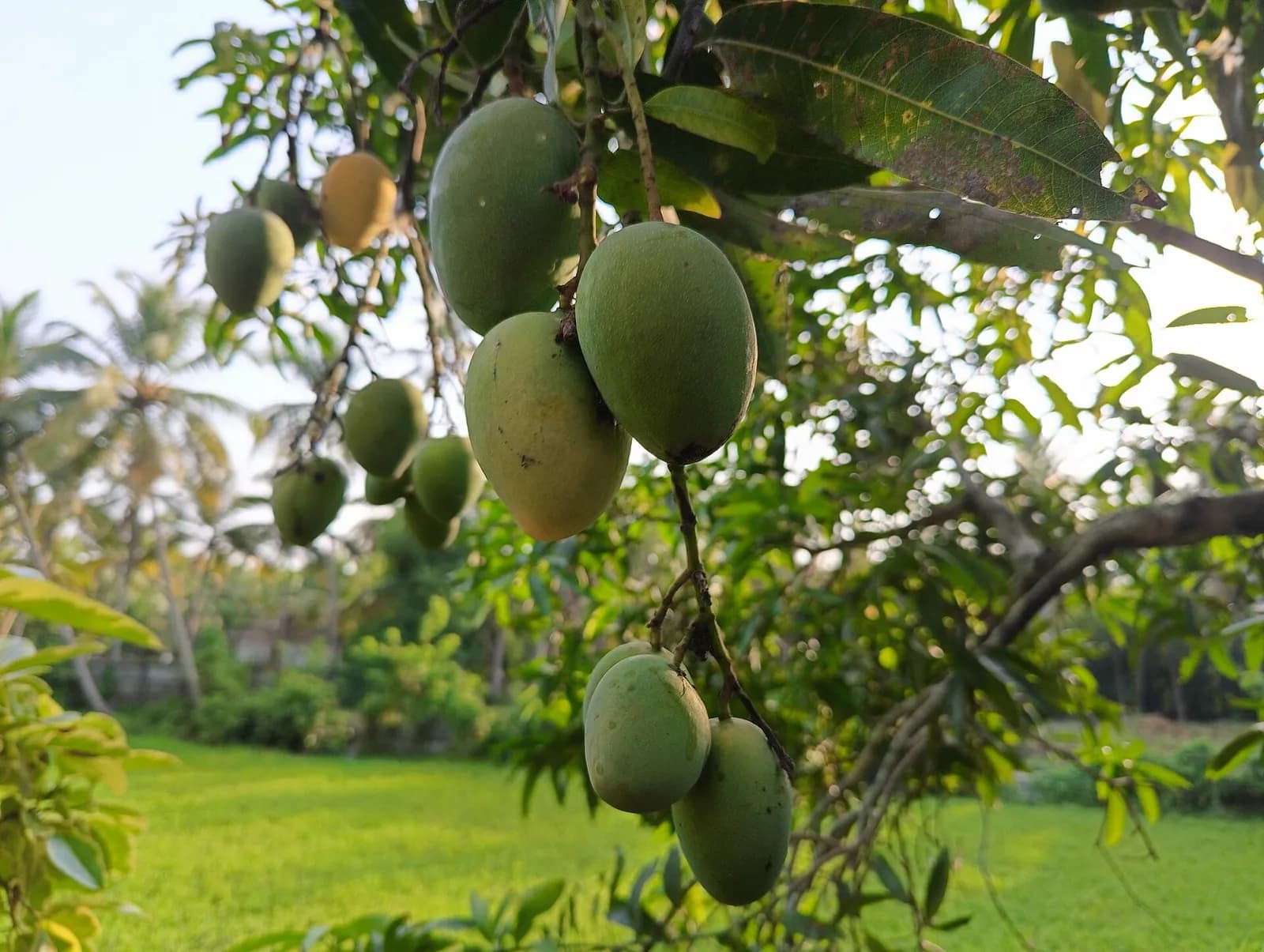
The mango flowers in a wave, from south to north: in December the south comes into flower, in January Bengal, in February eastern Uttar Pradesh and Bihar, and only then, in February and March, the north, where Vraja stands too. The flowers are gathered into erect pyramidal panicles; most of them are male, and only the bisexual ones set fruit – that very mango drupe, the “king of fruits” of India.
In different regions the tree is called differently: am in Hindi, amba in Marathi, mamidi in Telugu, ma in Tamil. From there comes the European name of the fruit as well: the Tamil man-kay – man “the mango tree” and kay “fruit” – gave the Malay mangga and the Portuguese manga, and from the 1580s the English mango.
Mango: the tree and the leaf
Sources
We build Vrajapedia together – with stories, verses, photographs and parikrama experience. If you know something more, tell us and it will appear on this page.


