Bel
There is a leaf that all India knows as the leaf of Shiva: the three-lobed leaf of the bel, bilva-patra, which is laid by the million on the linga of Mahadeva. But this tree has a second life as well, in Vraja. Krishna and His friends played with its hard round fruits in the forest as with balls, and a whole grove of bel, Bilvavana, stands tenth among the twelve forests of Vraja. And that same leaf of Shiva the Vaishnava scriptures turn toward Govinda: whoever offers it even once becomes an eternal servant of Krishna.
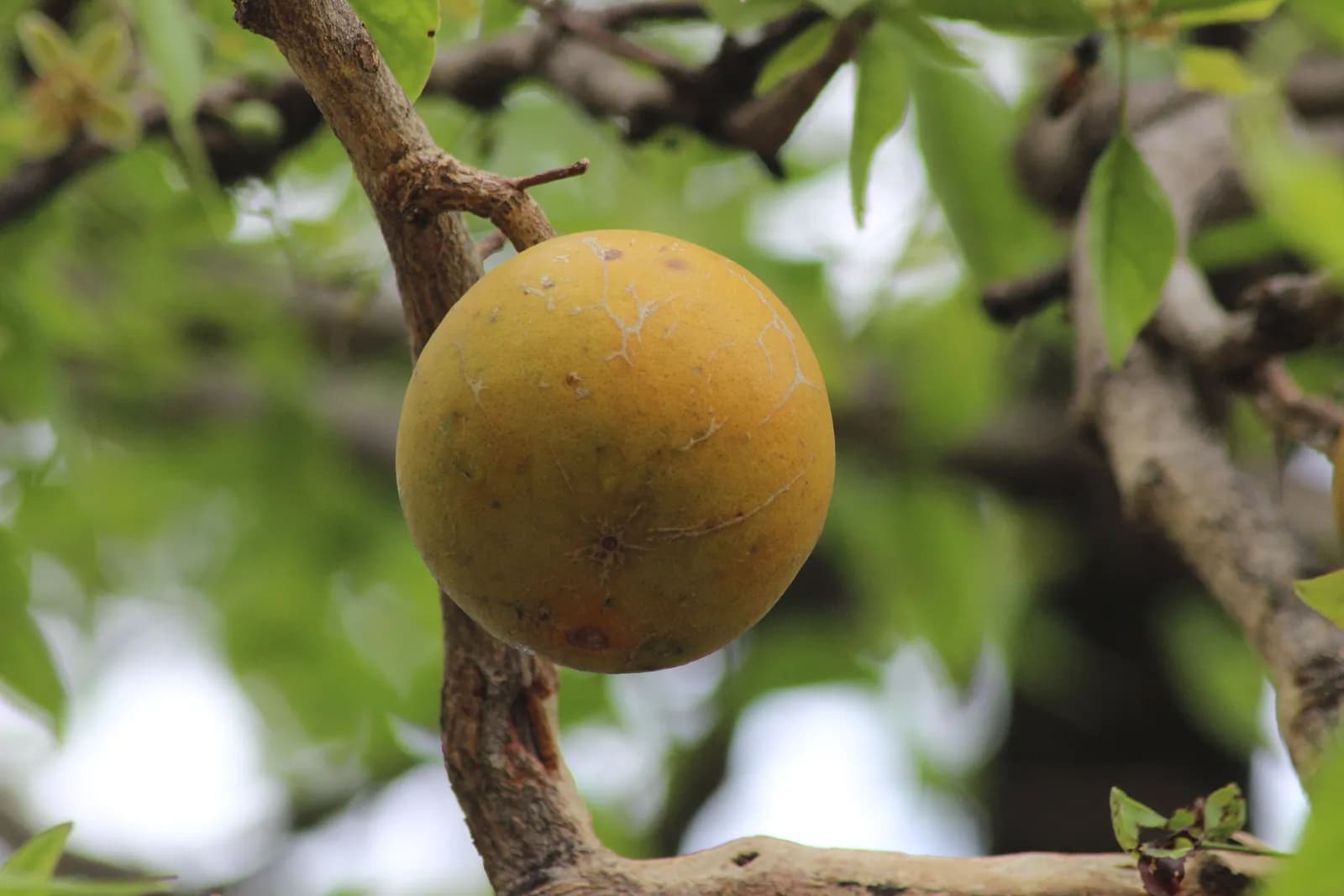
The tree in Vraja
In Vraja the bel is first of all the tree of forest games. When the Bhagavatam lists the amusements of Krishna, Balarama and the cowherd boys, the fruits of the bel are named first:
kvacid bilvaiḥ kvacit kumbhaiḥ kvacāmalaka-muṣṭibhiḥ
aspṛśya-netra-bandhādyaiḥ kvacin mṛga-khagehayā
Sometimes the cowherd boys would play with bilva or kumbha fruits, and sometimes with handfuls of āmalaka fruits. At other times they would play the games of trying to touch one another or of trying to identify somebody while one is blindfolded, and sometimes they would imitate animals and birds.
Srila Vishvanatha Chakravarti Thakur explains the game itself: one bel fruit was tossed into the air and another was thrown to knock it down. Vallabhacharya writes that they simply threw them like balls. With the same fruit, the commentators add to another scene, the brothers shot from slings. So the round, tough bel became the ball of Krishna’s childhood games.
A whole forest bears its name as well: the tenth of the twelve forests of Vraja is called Bilvavana. The Mathura-mahatmya of Srila Rupa Goswami singles it out:
vanaṁ bilva-vanaṁ nāma daśamaṁ deva-pūjitam
tatra gatvā tu manujo brahma-loke mahīyate
The forest named Bilvavana, worshipped by the demigods, is the tenth forest; a man who goes there is glorified on Brahmaloka.
A silent witness of separation
The Chaitanya-charitamrita names Bilvavana too, listing the forests that pilgrims walk around to this day. It lies on the eastern bank of the Yamuna, beside Bhadravana and Lohavana.
And when, after the night of the rasa-lila, Krishna disappears and the gopis, out of their minds with separation, wander along the bank and call out to the trees, the bel is among those named. “O jambu, O arka, O bilva, O bakula…” – they beg the trees that “live for the good of others” to show the path of their departed Beloved1. The trees on the bank do not stir, and the gopis think they merely remember the Lord. The bel is one of these silent witnesses.
Worship
The leaf of the bel has another service too. All over India it is the leaf of Shiva, yet the Hari-bhakti-vilasa, the code of Vaishnava practice, lays it again and again at the feet of Vishnu and Krishna. Sanatana Goswami ranks the leaves there by worth – from apamarga and bhringaraja upward through shami, durva, kusha and amalaki – and the leaf of the bel comes out almost at the very top: only tulasi stands above it.
tasmād āmalakaṁ śreṣṭhaṁ tato bilvasya patrakam
bilva-patrād api hares tulasī-patram uttamam
“…the amalaki leaf is higher than the kusha leaf, the bilva leaf is higher than the amalaki leaf, and for the worship of Hari the tulasi leaf is higher even than the bilva leaf.”
And the scriptures are not sparing in what they promise to whoever offers this leaf to Govinda. Once is enough: the offerer gains a fruit unattainable even by a thousand sacrifices, and in the month of Kartika such worship leads to liberation. But another promise goes further than all: the leaf of Shiva, offered to Krishna, makes a man not merely liberated but an eternal servant of the Lord:
sakṛd abhyarcya govindaṁ bilva-patreṇa mānavaḥ
mukti-bhāgī nirātaṅkaḥ kṛṣṇasyānucaro bhavet
“A man who has honoured Govinda even once with a bilva leaf attains liberation, becomes fearless, and is made an eternal companion and servant of Krishna.”
Not the leaf alone. The flower stands high as well: according to the Hari-bhakti-vilasa, a single bel flower is worth more than a thousand shami flowers, and it is named among the twenty-five forest flowers of which, by the Lord’s own word, He once wove His garlands. The fruit of the bel the same book counts among the favourite fruits of Vishnu: whoever offers them rises to the higher worlds. And the commentators on the Bhagavatam quote a saying: bel leaves offered to the Lord bestow the wealth that is Sri, while leaves of the ashvattha bestow health2. So the tree gives Krishna everything it has – leaf, flower and fruit.
The bel in the poetry of Vraja
In the verses of Vraja the bel appears through its fruit. In the Govinda-lilamrita of Srila Krishnadas Kaviraja Goswami, Krishna roams the forest and loses his composure at the sight of the ripe fruits: pomegranates, citrons and bels seem to Him the breast of Radha3. The same image is in the Stavavali of Srila Raghunatha das Goswami: the breast of Radha, it says there, is firmer than bel fruits and all other fruits4. So the hard round fruit became, in the poetry of Vraja, the standard against which the beauty of Radha is measured.
The bel has a place among the sacred marks as well. On the palms of Radha and Krishna the Govinda-lilamrita distinguishes an auspicious sign – the shri-vriksha, “the tree of Sri”, and the commentator reads it as the bilva tree5. The names agree: the sign is called “the tree of Sri”, and the fruit of the bel is shriphala, “the fruit of Sri”, that is, the fruit of Lakshmi. The tree of the goddess of fortune becomes one of the seals on the hand of her Lord.
Beyond Vraja
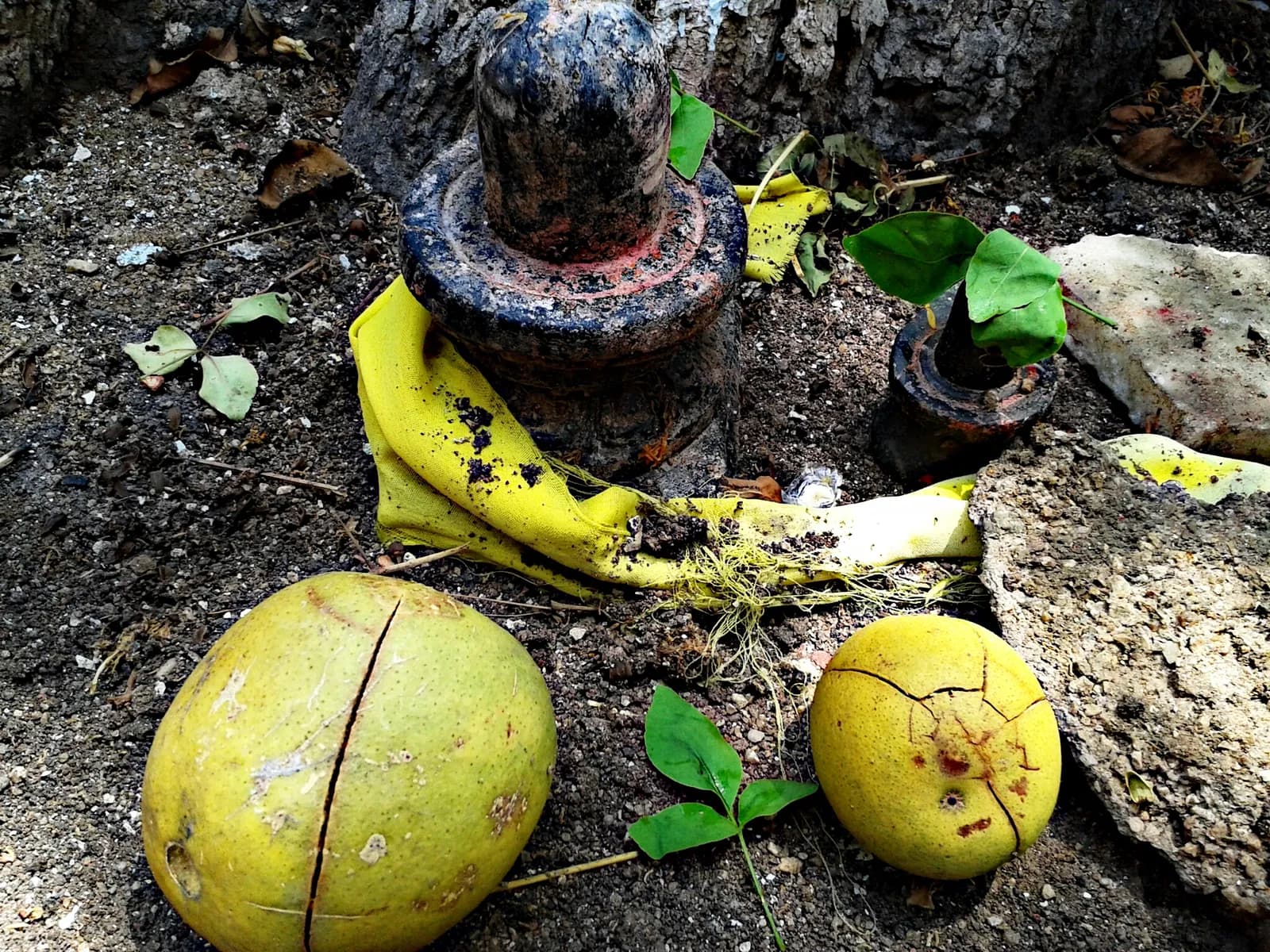
Outside Vraja the bel is first of all the tree of Shiva’s temples. Its three-lobed leaf is seen as an image of the trishula, and the bilva-patra is an indispensable offering to Mahadeva; hence one of the tree’s names, shivadruma, “the tree of Shiva”. Its fruit, meanwhile, is linked with Lakshmi, the goddess of fortune and abundance.
The bel grows in the heavenly gardens of the scriptures too: with it, among kapittha and jambira, is covered Mount Trikuta, where the pastime of Gajendra took place.
From the bel comes a name dear to the Gaudiya Vaishnavas as well: Bilvamangala Thakur, the author of the Krishna-karnamrita, which Sri Chaitanya Mahaprabhu so loved to hear, is called Bilva-mangala – “the blessing of the bel”.
Ayurveda
In Ayurveda the bel is above all a medicine for the belly. Its unripe fruit is astringent and slightly bitter in taste (rasa – kashaya and tikta), warming in potency (virya – ushna): it kindles the digestive fire and binds (grahi), which is why it became the classic remedy for diarrhoea and dysentery. The ripe fruit, on the contrary, is sweet and fragrant: its pulp is mixed with water and sugar to make bel sharbat, the favourite cooling drink of the Indian summer.
The root of the bel is one of the dashamula, the “ten roots” – the compound used to treat fever and the disorders of the wind, vata; the bark pacifies vata, while the leaves are used for ailments of the heart, for diabetes and for oedema. Charaka and Sushruta speak of these properties, and later the Madhava-chikitsa places the tree in its chapters on the treatment of fever and diarrhoea.
Botany
The bel is Aegle marmelos, a tree of the rue family, kin to the citruses and the only species in its genus. Its branches are slender and drooping, and straight sharp thorns sit on the grey-brown bark. The young leaf is pinkish green, the mature one dark. The fruit can sometimes be cracked only with a hammer, and inside it are eight to twenty fragrant orange segments of pulp with seeds. The bel grows in the dry open forests of the plains and low hills of the Indian subcontinent, hardy in heat and in cold alike. The very name of the tree says the same: bilva is derived from the root vil, “to split” – that which has to be cracked open.
Bel: leaf, flower, fruit
Sources
We build Vrajapedia together – with stories, verses, photographs and parikrama experience. If you know something more, tell us and it will appear on this page.


