Palash (Kimshuka)
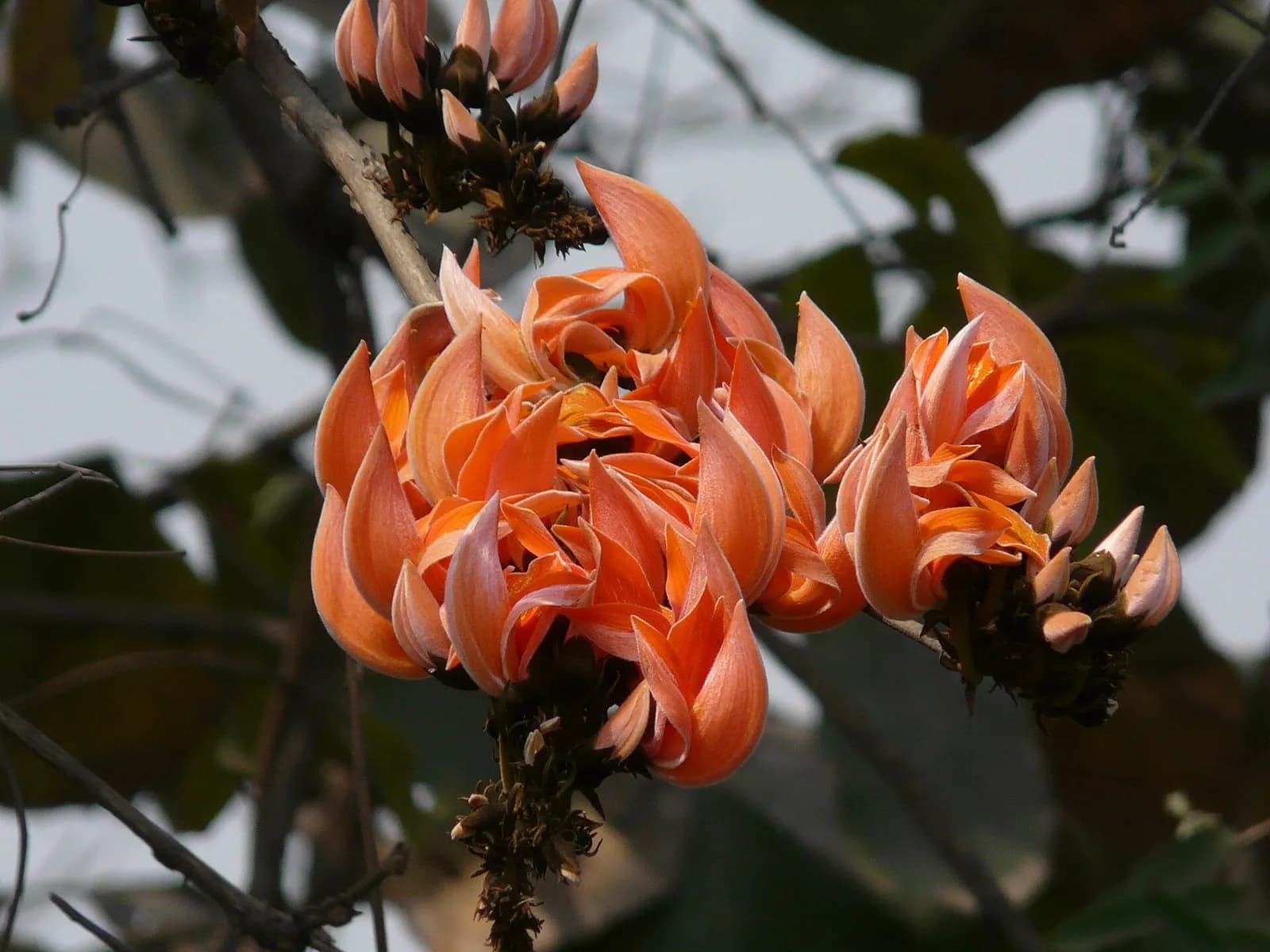
Towards the end of winter, when the foliage falls in Vraja, the palash bursts into flower: the bare branches are covered all over with fiery scarlet blossoms, and the tree burns like a torch above the dry forest. For this it is called the “flame of the forest”. But the poets saw in that flame not fire but marks: the curved flowers of the palash resemble the nail marks left on the bodies of lovers. The whole flowering tree became for them a “net” of such marks, left by the nails of Kamadeva.
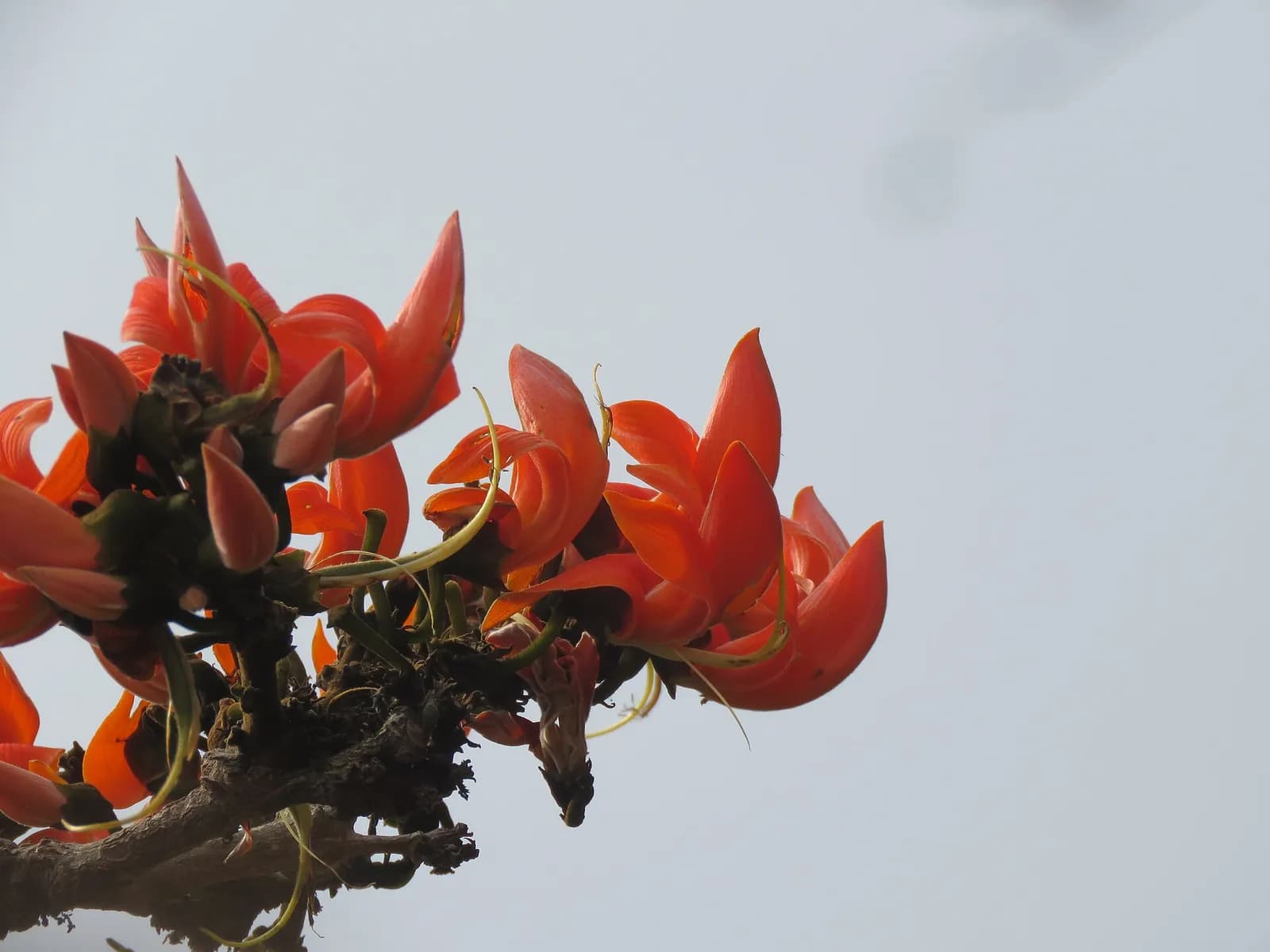
The Tree in Vrindavan
Its chief image the palash received from Srila Jayadeva Gosvami. In the first canto of the Gita-Govinda, painting the spring in which Krishna dances with the young cowherd girls, the poet pauses on the flowering palash:
mṛgamada-saurabha-rabhasa-vaśaṁvada-nava-dala-māla-tamāle
yuva-jana-hṛdaya-vidāraṇa-manasija-nakha-ruci-kiṁśuka-jāle
viharati harir iha sarasa-vasante
“The tamalas, clothed in young foliage, spread the scent of musk on every side. Sakhi, look! These shining kimshuka flowers are like the nails of Kamadeva – as though the king of love had scratched with them the breasts of young lovers. Here, in the sweet spring, Shri Hari plays.”
A Net of Nail Marks
The kimshuka here is the same tree. The Amarakosha sets four of its names in one row: palāśa, kiṁśuka, parṇa, vāṭapota – and in the verses it is called now one, now another.
Half of these names recall the leaf: palāśa and parṇa also mean simply “leaf”, and parṇa Monier-Williams considers the older name, describing the palash as “a large-leaved sacred tree whose wood is used for sacred utensils”. And the word kiṁśuka he takes apart into kiṁ, “what?”, and śuka, “parrot”: the flowers of the palash are the colour of a parrot’s beak.
And the comparison with nail marks rests on the same curve: the flower, sharply bent like a parrot’s beak, resembles in shape and colour the mark that lovers leave on each other’s bodies. And a whole tree in such flowers reads as a jāla, a “net” of countless red marks. Hence the sight of a flowering palash, explains Srila Bhaktivedanta Narayana Gosvami, wounds the hearts of those in separation: the spring seems already scratched by passion, and the beloved is not there.
The palash grows in the bowers of Vrindavan as well. In the Govinda-lilamrita of Srila Krishnadasa Kaviraja Gosvami the forest is described as a succession of trees, each entwined with its own vine, and the palash stands there paired with the patali vine:
te'śokāḥ svarṇa-yūthī-tatibhir iha lasat-kiṁśukāḥ pāṭalībhir
vāsantībhī rasālāḥ sita-śata-dalikā-śreṇibhiḥ keśarāś ca
“…the ashokas – with the golden yuthi, the shining kimshukas – with the patali vines, the mangoes – with the madhavi, and the nagakesharas – with the white shatapatrika.”
In the Bowers and in the Forest
Of such pairs the kunjas are made up, the living bowers where Radha and Krishna rest. In the Krishna-bhavanamrita of Srila Vishvanatha Chakravarti Thakura the palash is counted among the trees of Vrindavan which, like householders, do their duty, giving alms of fruits and flowers without measure1.
And when Krishna disappears from the forest and the gopis, out of their minds with separation, look for Him, they put their questions to the palash as well: “O ashvattha tree, O kapittha, O kimshuka, O banyan – has the son of the king of cowherds not passed this way?”2
The Arrow of Kama and the Fire of Separation
To the same image Jayadeva Gosvami returns in the last canto of the Gita-Govinda. In the morning, after a night of love, Krishna looks at Radha and sees on Her body five signs of the past intimacy, and each turns into an arrow of the god of love. Which flower stands behind which arrow the commentary tells, and the palash comes first in it:
tasyāḥ pāṭala-pāṇijāṅkitam uro nidrā-kaṣāye dṛśau
nirdhauto ’dhara-śoṇimā vilulitāḥ srasta-srajo mūrdhajāḥ
“Her breast has flushed with the marks of nails, Her eyes have reddened from a sleepless night, the scarlet of Her lips has been washed away by long kisses, and the garland woven into Her braid has withered… By these five arrows of Kama the mind of Krishna was pierced again at dawn.”
Five Arrows by the Signs
Discussing the verse, Srila Bhaktivedanta Narayana Gosvami names the flower of each arrow: Radha’s breast with the marks of nails – the arrow of the palash flower, the reddened eyes – the arrow of the lotus, the bared lips – the arrow of the bandhuka, the withered garland – the arrow of the malati, the loosened belt – the golden arrow of Kama3. This list is of a particular kind: the five arrows of Kamadeva are usually named by flowers, while here they are read by the signs on Radha’s body – and the palash opens them all by that same scarlet colour of the mark.
The dress of Radha, too, is compared with the palash. Srila Rupa Gosvami in the Stavamala glorifies the Divine Couple through the colour of Their garments – golden for Krishna, red for Radha: Her robes, he says, outshine even the radiance of the kimshuka flowers4.
And in separation that same fiery colour turns cruel. In the Gopala-champu of Srila Jiva Gosvami the gopis, languishing in the spring without Krishna, see around them not spring but a conflagration: the bees are to them clouds of smoke, the cuckoos live coals, the pollen of the flowers ashes, and the tongues of that flame are heaps of blazing kimshuka flowers – and even the gentle touch of a palash flower causes them pain5.
Worship
The flowers of the palash are offered to the Lord as well. Srila Sanatana Gosvami quotes in the Hari-bhakti-vilasa the words of the Vishnu-rahasya and at once explains in his commentary that kiṁśuka is precisely the flowers of the palash:
agastya-sambhavaiḥ puṣpaiḥ kiṁśukaiḥ sumanoharaiḥ
samabhyarcya hṛṣīkeśaṁ janma-duḥkhād vimucyate
“Whoever worships Hrishikesha with the beautiful kimshuka flowers is freed from the sufferings of birth.”
The leaf too is put to use: listing from the Puranas the vessels for naivedya, Sanatana Gosvami places the palash leaf beside the lotus leaf – both are “very dear to Vishnu”6.
The Tree of Brahma and the Sacrificial Fire
The palash has a deity of its own: it is called the tree of Lord Brahma. In the same Hari-bhakti-vilasa, speaking of the custom of eating from broad leaves in the month of Kartika, Sanatana Gosvami quotes a verse: “The palash is the tree of Brahma, and its leaves are the sons of Brahma”, and adds that “the palash grants all desires”7. Hence the Sanskrit name of the tree, brahma-vṛkṣa; the lexicons, however, give that name to the udumbara as well.
With the sacrificial fire the palash has been linked since Vedic times. Out of a whole leaf, without a single hole, the sruk and sruva are made, the sacrificial ladles with which ghee is poured into the fire8, while the logs of the palash serve as samidh, the sacred firewood for the homa, together with the udumbara, the ashvattha, the apamarga and the shami9.
An echo of this is heard in the lila of the appearance of Lord Ramachandra as well: in the Laghu-bhagavatamrita of Rupa Gosvami it is said that out of the sacred araṇi wood of Ayodhya there blazed up a fire of unheard-of power, to burn the “palash fuel” – and that fuel is a whole host of demons10.
Beyond Vraja
The palash grows far from Vraja as well. In the Srimad-Bhagavatam the kimshuka is named among the trees of the garden Ritumat on Mount Trikuta – there where the elephant king Gajendra was gathering lotuses before his fight with the crocodile11. And in the description of the austerity of the sage Atri it is said that he stood for a hundred years on one leg “in a grove of flowering palash and ashoka trees, filled with the noise of the river Nirvindhya”12.
Ayurveda
In the different parts of the palash Ayurveda finds different natures. The bark and the root are pungent, bitter and astringent in taste (rasa), hot in potency (vīrya), pungent after digestion (vipāka); they dry and reduce kapha and pitta. The flower is just the opposite: cold in potency and sweet after digestion, it quells the heat of pitta and the overheated blood.
A medicine is found in almost every part of the tree. The flowers are astringent and stop diarrhoea, the seeds have long been given against intestinal worms, and the red gum that seeps from the bark and hardens on it (it is called “Bengal kino”) is taken for bleeding. The leaf has not been passed over either. All over India disposable plates, pattal, are still sewn from palash leaves, and food from such a plate counts in Ayurveda as a medicine in itself: it pacifies kapha and vata, cures the chronic catarrh pīnasa, improves the taste and nourishes.
Botany
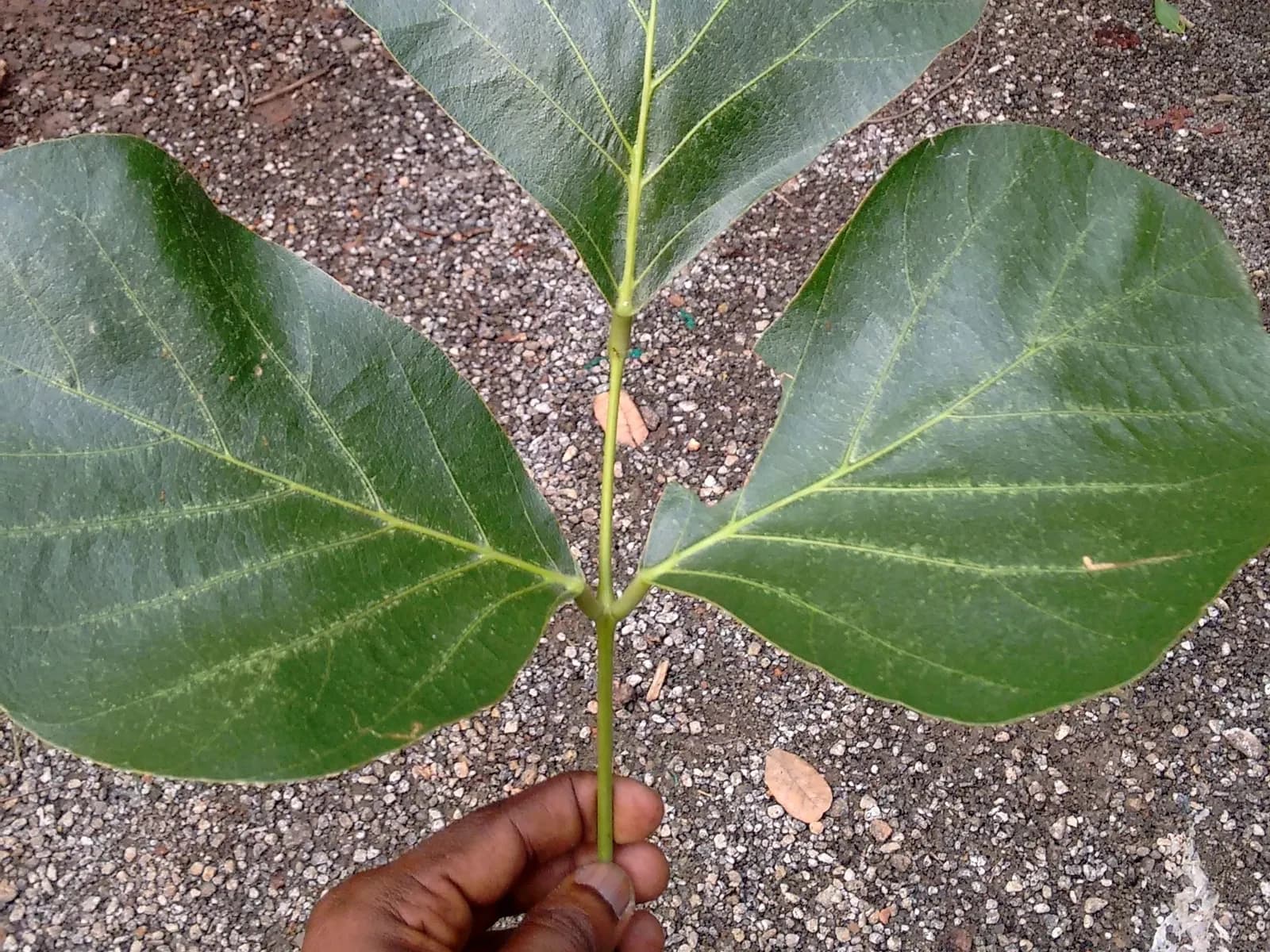
The palash is Butea monosperma, in Hindi dhak or tesu. Its trunk is crooked and gnarled, the bark grey; the leaves are trifoliate, of three large leaflets ten to twenty centimetres each – it is for them that Hindi recalls “the three leaves of the dhak”. By December and January the tree sheds its foliage and stands bare, and then the whole crown flares up with dense clusters of flowers; the handbooks give different seasons – January–March, February–April, March–May.
Each flower has five petals: the standard, two wings and the keel, sharply curved like a parrot’s beak. It sits in a dark, velvety green calyx, and against that dense background the stiff bright petals stand out especially sharply. The fruit is a flat pod in short brown hairs, and the seed in it is single, at the very tip: for this the species is named monosperma, “one-seeded”. From the flowers an orange dye is made for the festival of Holi, and the leaf goes into plates. The palash grows all over India and further through tropical Asia.
Palash: the flame of the forest
Sources
We build Vrajapedia together – with stories, verses, photographs and parikrama experience. If you know something more, tell us and it will appear on this page.


