Punnaga
A coastal tree with white fragrant flowers, the punnaga became famous in Vraja not for its flower but for its own name. Pun-nāga is made up of puṁ, “man”, and nāga, “elephant”: literally “an elephant among men”, that is, any outstanding person. And the commentators read in this the puruṣottama, “the best of men”, that is, Krishna. Hence the name of this tree has a double bottom in the poetry of Vrindavan: when a friend of Radha says “I madly desire only this fragrant punnaga tree”, she is naming the One whom her whole heart is seeking.
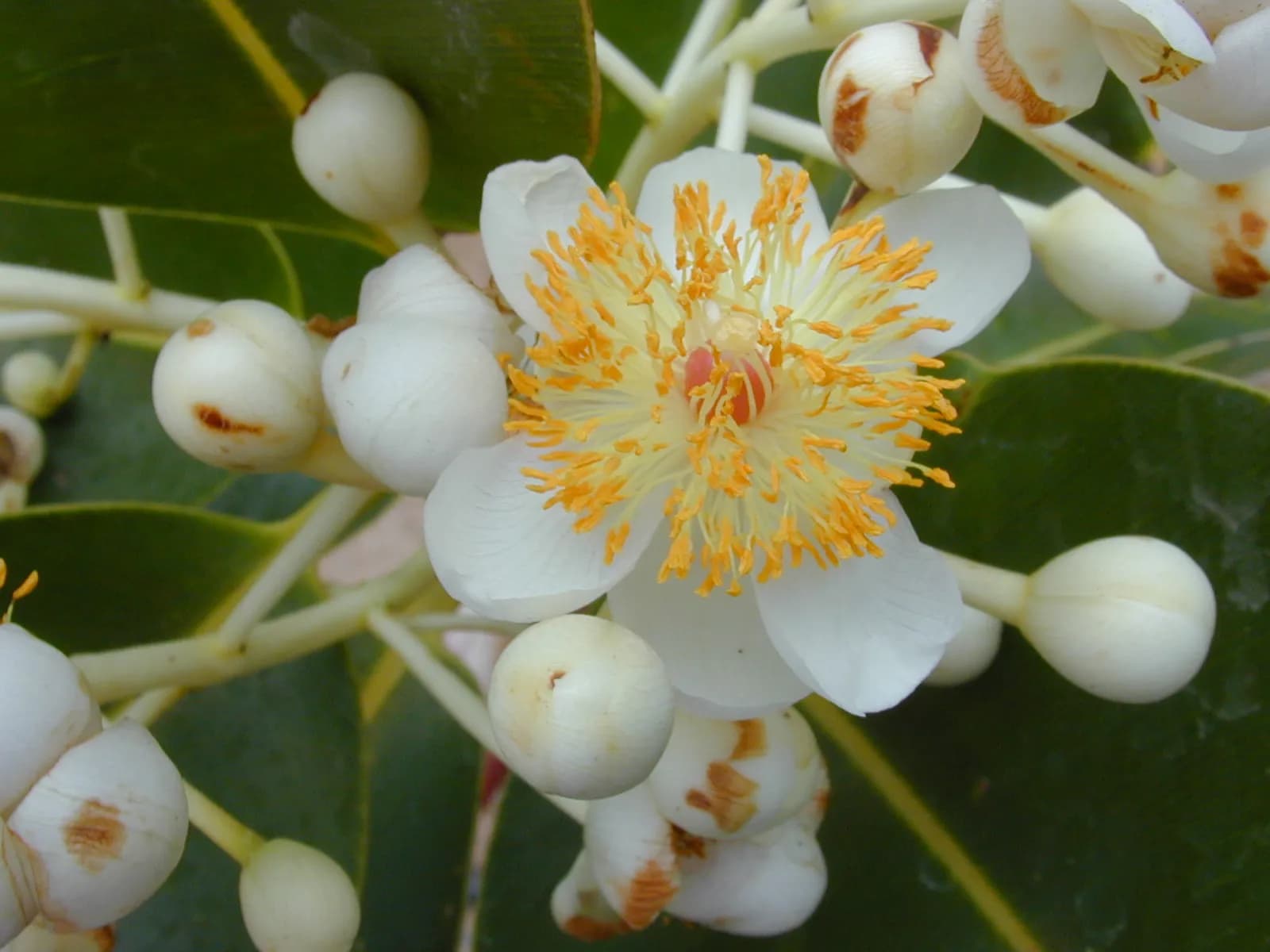
The Tree in Vrindavan
The night of the rasa-lila has ended, and Krishna has vanished. The gopis, maddened by separation, wander the forest and, finding no trace of the Beloved, begin to ask the trees themselves. The ashvattha, the plaksha and the banyan do not answer – and then the girls turn to those that stand in flower; the commentators call these trees openhearted: they give nectar to their guests, the bees.
kaccit kurabakāśoka-nāga-punnāga-campakāḥ
rāmānujo māninīnām ito darpa-hara-smitaḥ
“O kurabaka, ashoka, naga, punnaga and champaka – has the younger brother of Balarama passed this way, whose smile knocks the pride out of all haughty women?”
The Five Arrows of the God of Love
The choice of trees is not accidental. Narayana Bhatta Gosvami calls these five trees – the kurabaka, the ashoka, the nagakeshara, the punnaga and the champaka – the five arrows of the god of love directly, and Vallabhacharya explains why the gopis ask precisely these: Kama takes the flowers of these trees for his bow, and whoever breathes in their fragrance loses his head. And Vamshidhara Pandita singles out the punnaga among the five: it is tuṅga, “tall”, it sees further than the rest – so it is for it to answer. But the gopis find fault even with the names: “naga” means “snake” or “elephant”, and “punnaga” is that very “elephant among men”, in the commentaries even a “bull-elephant”; the names are frightening, ill-omened1.
So the punnaga enters the memory of Vraja as a tree called upon in longing. And it is also called the favourite tree of Krishna. In the play Vidagdha-Madhava of Srila Rupa Gosvami the elder guide Paurnamasi speaks up for the girls before Him: “Why are Radha and the gopis now criminals? They will only steal a few flowers from Your favourite punnaga tree”2. Behind the jest the second meaning already glimmers – the flowers plucked “from the punnaga” are plucked from Him Himself.
And in the poems of the Gosvamis the whole of Vrindavan is planted with punnaga. Its rows, the punnāga-vīthī, stretch along the path that leads from the slope of Govardhan to the Yamuna3, bowers of punnaga stand on the bank of the river, and in the kunjas, where trees and vines grow in pairs, embracing one another, the punnaga is given a flowering vine for its pair – the madhavi or the malati4.
A Name with a Double Bottom
Punnāga is both a flowering tree and “the best of men”, the puruṣottama, that is, Krishna. On this consonance, the śleṣa, a whole layer of the poetry of Vraja rests, and Srila Jiva Gosvami with Vishvanatha Chakravarti unfold it in their commentary on the Ujjvala-nilamani. There a friend of Radha, sending away an insistent vine, speaks with a hint:
āhūyamānāsmi kathaṁ tvayālināṁ
svanaiḥ sva-puṣpāvacayāya mālati
āmoda-pūrṇaṁ sumanobhir āśritaṁ
punnāgam eva pramadena kāmaye
“O malati vine, why do you call me with the humming of bees – to gather your flowers? I madly desire only this fragrant punnaga tree.”
The Play That Fills the Poetry
“The punnaga,” explains Vishvanatha Chakravarti, “is both the tree and Krishna, the best of men. And then Krishna appears: ‘O sakhi, I have heard your wish – come, I will show you the punnaga tree,’ – takes her by the hand and leads her to a bed of punnaga flowers.”
The Govinda-lilamrita of Srila Krishnadasa Kaviraja Gosvami is full of the same play. Now Radha seems to reach for a bud on a punnaga branch, while in fact she embraces Krishna. Now Lalita drops an ambiguity: it befits the madhavi vine to entwine the punnaga tree, the best of men, and not the other way round – it is the vine that holds to the tree5. And at last the vine and the tree are named outright:
praphulla-punnāga-kṛtāśrayā sadā
praphullitāṅgī madhusūdanāśrayā
āmoda-pūrṇā vara-patra-bhaṅgikā
vṛndāvane'sau lasatīha rādhikā
“In Vrindavan this Radhika shines – having found shelter with the flowering punnaga tree (with Madhusudana, the best of men), herself ever in bloom, giving shelter to the bee, full of fragrance, all in fine patterns.”
And Srila Prabodhananda Sarasvati builds a whole little scene on this play. In his Vrindavana-mahimamrita, Radha stops on a forest path: “Look, friend, at the wondrous beauty of this punnaga tree!” – and her companions argue whether it is a tree she means at all: “She spoke of the flower of the punnaga; do you think she means someone else? Radha is not saying what you fancy”6.
Worship
The flowers of the punnaga are brought to the altar as well. The instruction to meditate on Vrindavan, which Srila Sanatana Gosvami quotes in the Hari-bhakti-vilasa, opens its list of the sacred trees of the abode with the punnaga precisely: “let him contemplate Vrindavan with the trees punnaga, naga, panasa, kanchana, bakula, bilva…”7 And in the list of flowers with which Hari is honoured, the punnaga stands beside the mallika, the malati, the jati, the ashoka and the champaka: whoever offers them with love is credited with the merit of giving ten gold coins for each flower8. And in Goloka itself, as Sanatana Gosvami paints it, the cowherd friends weave garlands for Krishna in which, among the flowers, are the naga, the punnaga and the champaka, and He puts them on and gives them out to His friends9.
Beyond Vraja
The punnaga grows on Vaikuntha itself as well. When the four Kumara sages enter the spiritual kingdom, they see there gardens of these same trees: mandara and kunda, kurabaka and champaka, punnaga, nagakeshara, bakula, parijata. All of them are fragrant, and yet they glorify not themselves but the tulasi – she whose garland the Lord wears upon His chest:
mandāra-kunda-kurabotpala-campakārṇa-
punnāga-nāga-bakulāmbuja-pārijātāḥ
gandhe ’rcite tulasikābharaṇena tasyā
yasmiṁs tapaḥ sumanaso bahu mānayanti
“Although the mandara, the kunda, the kurabaka, the utpala, the champaka, the arna, the punnaga, the nagakeshara, the bakula, the lily and the parijata are full of transcendental fragrance, they all honour the austerity of the tulasi, for the Lord shows her evident preference, adorning Himself with her leaves.”
In the spiritual world there is no envy even among flowers: the trees rejoice that not they were preferred but one who is more worthy. And Vishvanatha Chakravarti reads a quiet longing here as well: the trees of Vaikuntha, understanding by what the tulasi was exalted, would themselves wish to go to the land of Bharata and repeat her feat.
The punnaga stands in other sacred regions too: it adorns Kailasa, the abode of Shiva, and grows on the shores of the mountain lake on Trikuta, where the Lord saved Gajendra, the king of elephants10.
Ayurveda
Ayurveda knows the punnaga as a tree of coolness. Its taste (rasa) is astringent and sweet, its qualities light and dry, its potency (vīrya) cooling, its aftertaste (vipāka) sweet; by this it pacifies pitta and kapha.
The punnaga is taken for skin ailments and disorders of the blood, for burning and inflammations, for diarrhoea and dysentery, and the oil of the seeds is rubbed in for joint pain; a decoction of the bark, a powder and the oil are used. The classical compendia know it too: the Kaiyadeva-nighantu in the section on medicinal plants, the Raja-nighantu in the chapter named after the karavira.
Botany
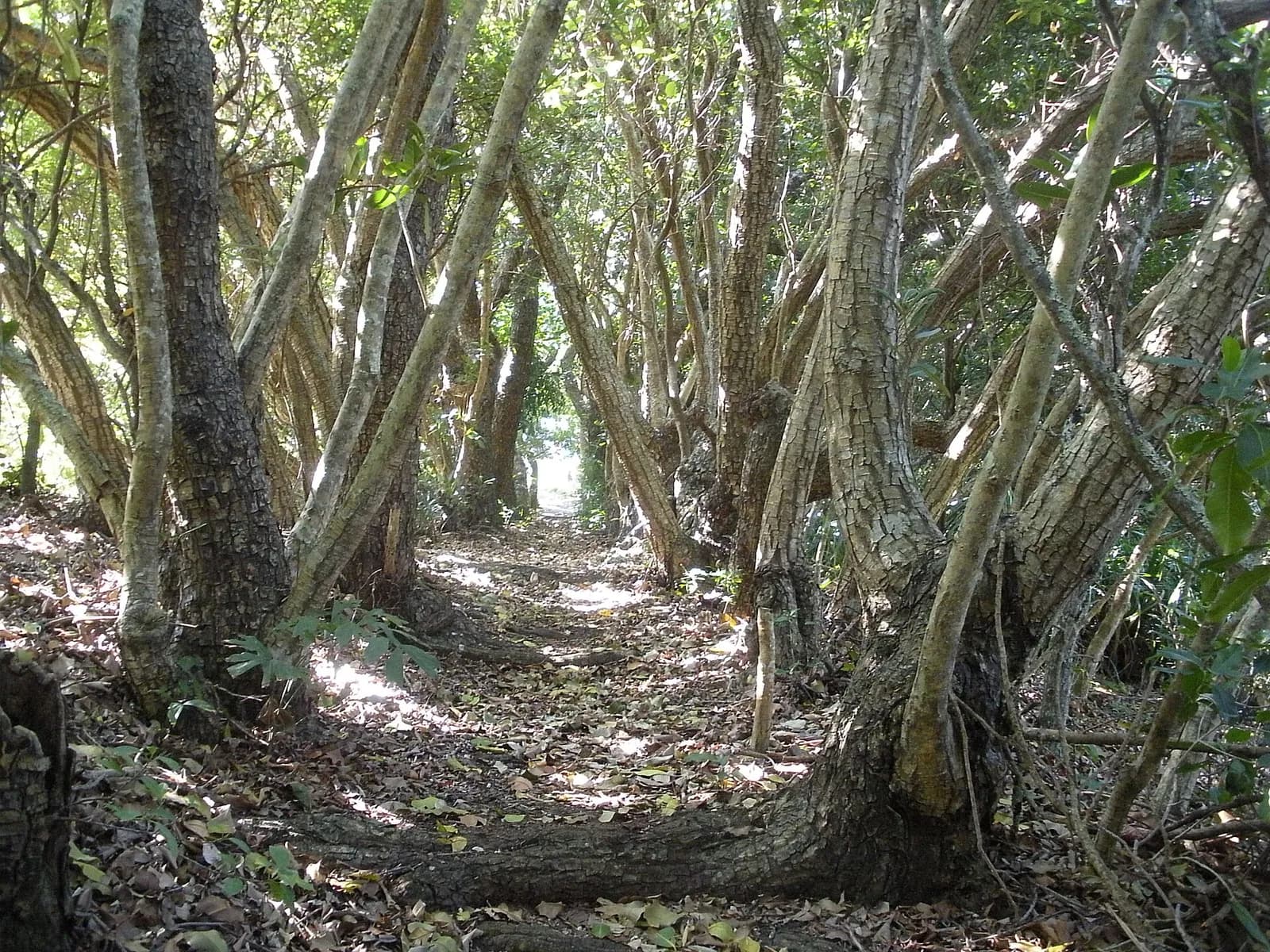
The punnaga is Calophyllum inophyllum, a relative of the nagakeshara. It grows on stony and sandy sea shores, just above the tide line, and bears both brackish groundwater and salt wind well. The tree branches low and grows slowly, its crown is broad and irregular, its foliage dense and glossy. The stamens in the flower are many, sitting in four bundles, and for their fragrance these flowers go into perfume. The fruit is a round green drupe, wrinkled at ripeness, from yellow to brownish red, with a single large seed from which tamanu oil is pressed. In the south of India the tree is called punnai, ponna, honne.
And here a qualification is needed. The Sanskrit lexicons under the name punnāga name in the first place not this tree but one “from whose flowers a yellow dye is made”, and give it the name Rottleria tinctoria (the Shabda-sagara, the same in Benfey). The name is an old one: in botany it was written Rottlera tinctoria and has fallen out of use, while the present POWO checklist counts it a synonym of Mallotus philippensis – a tree of the spurge family that grows all over India, including the Himalayas, and yields the orange-red kamala dye.
Monier-Williams gives both identifications at once: “a plant (Rottleria tinctoria or Calophyllum inophyllum)”. For the calophyllum speak the southern names of the tree and the Ayurvedic compendia; against it, that it is strictly maritime and in India keeps to the southern coasts, while Vraja lies far from the sea. Which of the two trees stands in the verse of the gopis, botany does not decide.
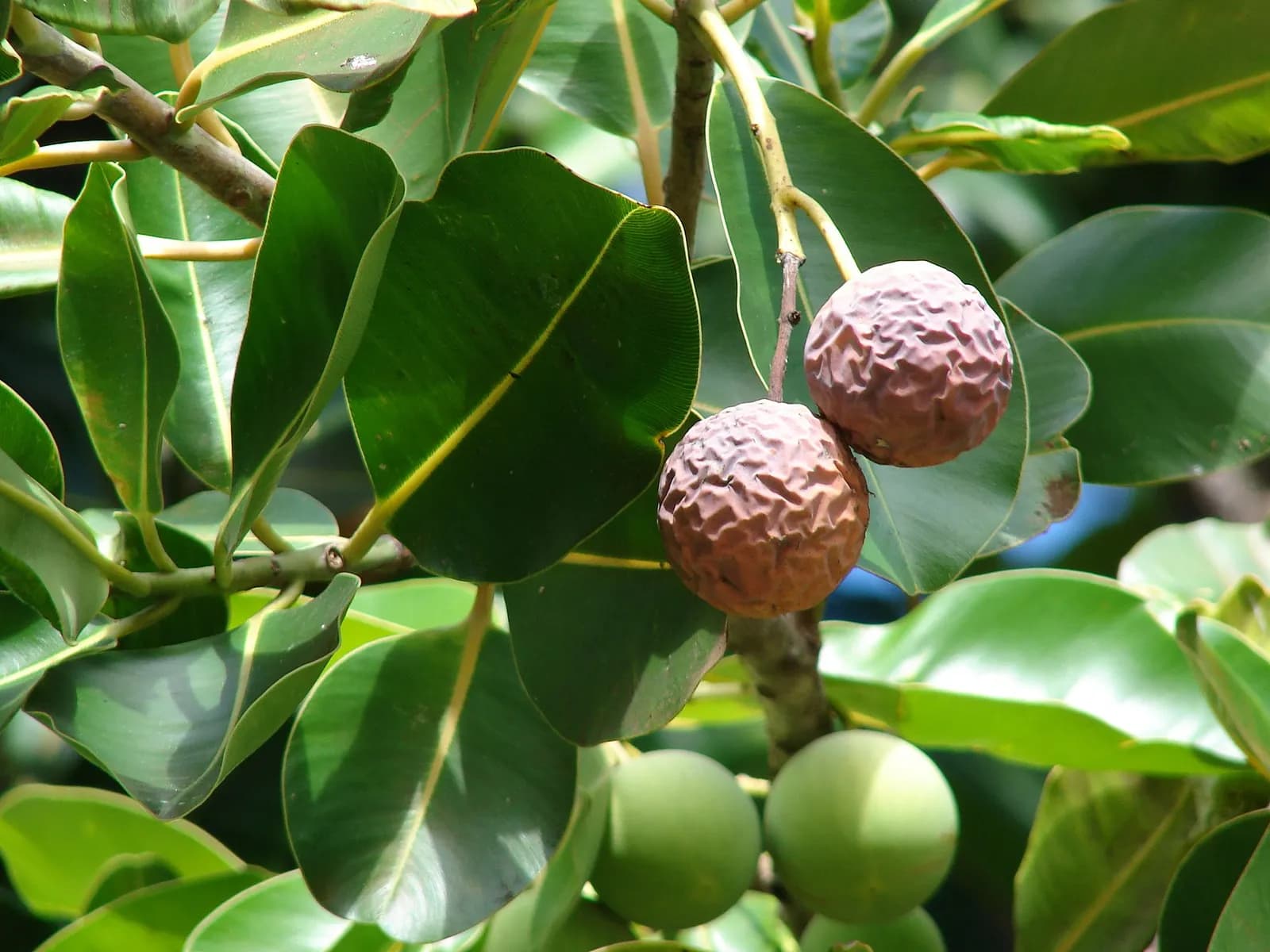
Punnaga: the flower, the fruit and the tree
Sources
We build Vrajapedia together – with stories, verses, photographs and parikrama experience. If you know something more, tell us and it will appear on this page.


