Nagakeshara
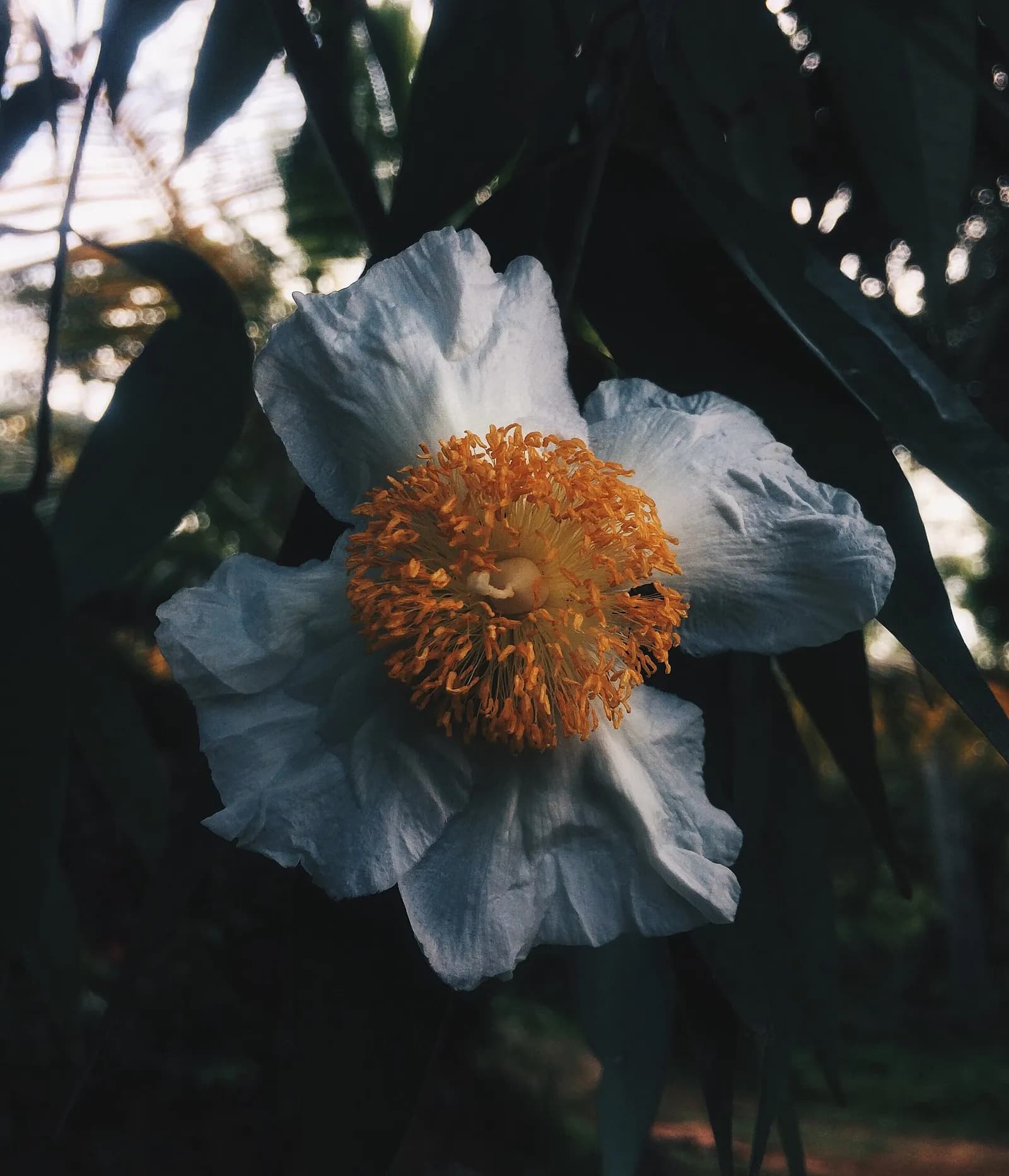
A forest tree whose name lives not in the petals but in the heart of the flower: naga-keshara means “the serpent's stamens”. In the shastras it stands among the trees of love: it is the tree the gopis, out of their minds with separation, ask where Krishna has gone, and out of its flowers Radha weaves a garland for her Beloved.
The Tree in Vrindavan
The night of the rasa-lila had ended, and Krishna had vanished. The gopis, out of their minds with separation, wander the forest and, finding no trace of Him, begin to ask the trees themselves. First the great ones: the ashvattha, the plaksha and the banyan; those do not answer. Then the gopis turn to others, to those that stand in flower:
kaccit kurabakāśoka-nāga-punnāga-campakāḥ
rāmānujo māninīnām ito darpa-hara-smitaḥ
“O kurabaka tree, O ashoka, O naga, punnaga and champaka, has Balarama's younger brother, whose smile removes the audacity of all proud women, passed this way?”
The Five Arrows of the God of Love
Behind the short name naga here stands the nagakeshara: nāgo nāgakeśaraḥ – so, in one and the same words, Srila Sanatana Gosvami, Srila Jiva Gosvami, Srila Vishvanatha Chakravarti, Baladeva Vidyabhushana and Vamshidhara Pandita explain it.
And the choice of trees is no accident. Narayana Bhatta Gosvami calls these five kinds outright – the kurabaka, the ashoka, the nagakeshara, the punnaga and the champaka – the five arrows of the god of love, while Vallabhacharya explains why the gopis ask precisely these: the flowers of these trees Kama takes for his bow, and whoever breathes their fragrance loses his head – who else should know where the thief of peace has gone1. Vamshidhara Pandita adds a subtlety of his own: the keshara of the nagakeshara are its stamens, thin as eyelashes; and if there are eyelashes there are eyes as well, and the tree could not have failed to see Krishna.
But the trees keep silent. A gust of wind swayed their crowns, and the gopis decided that they were shaking their heads: we do not know. They gave up on the “hard-hearted men of the forest” and went on.
So the nagakeshara enters the memory of Vraja as a tree called upon in longing. But it has a second, happy role as well. In the play Vidagdha-Madhava of Srila Rupa Gosvami, Krishna, seeking seclusion with His beloved, calls Her to just such a grove: “There ahead is a grove of nagakeshara – just right for Our pastimes; let us go there.” Radha answers Him in kind: “Enough of jesting – better show me where it is”2. The tree of separation turns into the shelter of a tryst.
In the kunja the nagakeshara does not stand alone. In Vrindavan the trees and vines grow in pairs, embracing each other, and Srila Krishnadasa Kaviraja Gosvami gives the nagakeshara the white shatapatrika, “the hundred-petalled”, for its pair3.
From such kunjas its flowers come to the Divine Couple. When the forest friend Narmada, at the word of Vrinda-devi, brings an armful of fresh flowers, among the jasmine, the bakula and the champaka lies the nagakeshara too, and Radha weaves from them the vaijayanti garland, “the banner of victory on the body of Krishna”:
mallī-raṅgaṇa-karṇikāra-bakulā'moghā-latā-saptalā
jātī-campaka-nāga-keśara-lavaṅgābjādi-puṣpoccayam
“Sent by Vrinda, the forest friend Narmada the garland-maker set before her mistress an armful of flowers – jasmine still half-open and surrounded by bees, and with it rangana, karnika, bakula, patala, navamallika, jati, champaka, nagakeshara, lavanga and lotuses.”
So the stamens that give their fragrance to the arrows of Kamadeva come to rest on the chest of Krishna. And the nagakeshara flowers in Vrindavan always: Srila Prabodhananda Sarasvati names it among the trees of the eternal forest that flower outside the seasons, and in Srila Kavikarnapura the Spring herself comes out in earrings of its flowers. In him too the gopis call out to that same tree again: “O nagakeshara, rasala, shola, devadaru, punnaga and champaka, you are pious after all – have you not seen Shyama?”4
Worship
The flowers of the nagakeshara are brought to Krishna in worship as well. Srila Sanatana Gosvami in the Hari-bhakti-vilasa, listing the Lord's favourite flowers, sets the naga in a row with the mallika, the malati, the ashoka, the champaka, the punnaga, the bakula and the lotus: whoever honours Hari with these flowers is credited with the merit of giving ten pieces of gold for every flower offered. In the verse of the gopis the short name is deciphered by the commentators; here it is not, but the neighbours of the naga are the same, the champaka and the punnaga, so the tree is most likely the same as well.
Beyond Vraja
The nagakeshara grows beyond the Vrindavan stories too – on Vaikuntha itself. When the four sages, the Kumaras, enter the spiritual kingdom, they see there gardens of those same trees: mandara and kunda, kurabaka and champaka, punnaga, nagakeshara, bakula, parijata. All of them are fragrant, and yet they glorify not themselves but the tulasi – she whose garland the Lord wears upon His chest:
mandāra-kunda-kuravotpala-campakārṇa-
punnāga-nāga-bakulāmbuja-pārijātāḥ
gandhe’rcite tulasikā-bharaṇena tasyā
yasmiṁs tapaḥ sumanaso bahu mānayanti
“Although flowering plants like the mandara, kunda, kurabaka, utpala, champaka, arna, punnaga, nagakeshara, bakula, lily and parijata are full of transcendental fragrance, they are still conscious of the austerities performed by tulasi, for tulasi is given special preference by the Lord, who garlands Himself with tulasi leaves.”
In the spiritual world there is no envy even among the flowers: a tree famed for its fragrance rejoices that another was preferred. And Srila Vishvanatha Chakravarti reads in this verse a quiet longing as well: the trees of Vaikuntha, understanding by what the tulasi was raised so high, would themselves wish to go down to the land of Bharata and repeat her feat.
Ayurveda
Ayurveda values in the nagakeshara above all the golden stamens – those same keshara. Their taste (rasa) is astringent and bitter, their qualities light and dry, their post-digestive effect (vipaka) pungent; the nagakeshara pacifies pitta and kapha. And about its potency, its virya, the handbooks disagree: some call it cooling, others warming. Its chief use is to stop bleeding: the stamens are given for haemorrhoids, heavy menses and nosebleeds, and also for thirst, burning, fever and skin ailments. In medicinal preparations the nagakeshara is put in place of costly saffron: with it the tree shares both the scent and the very name keshara. So it found its way into the kunkumadi-ghrita as well. Sushruta counts it in four medicinal groups at once, the Bhavaprakasha in the section of the fragrant ones; and it stands among the vishahara remedies, “those that draw off poison” – fitting for a tree with a serpent's name.
Botany
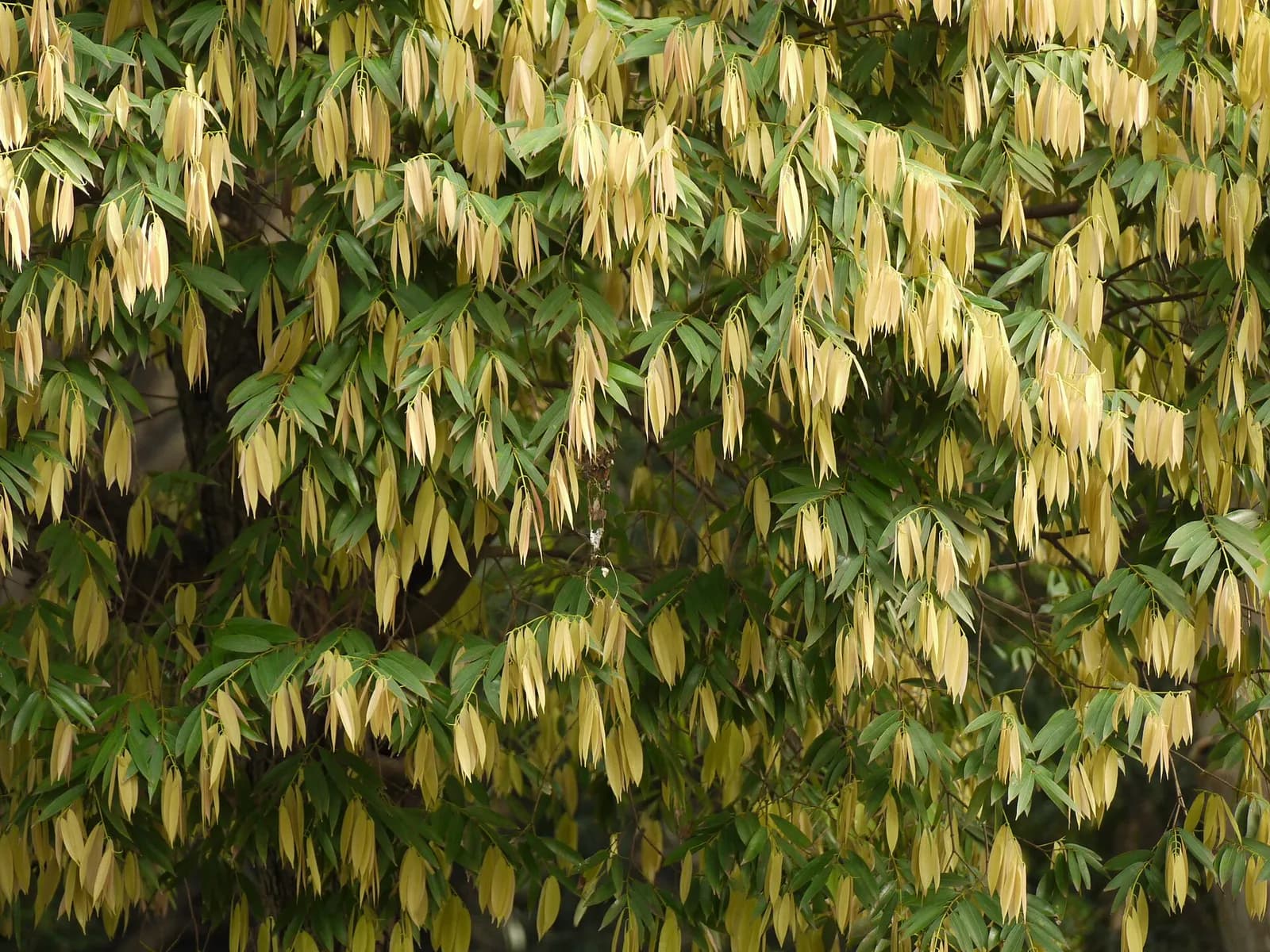
The nagakeshara is Mesua ferrea, the national tree of Sri Lanka. In the forest it rises high, in gardens it stays markedly lower; the trunk often has plank-like buttresses at the base, and the leaves are narrow, lance-oblong, with a bluish bloom underneath. It stops the eye twice over: by its young leaves, which come out red-pink and hang softly down as if the tree were tired, and by its flowers with their golden heart.
And the specific name ferrea, “iron”, is not about the flower but about the wood: it is heavy and so hard that it blunts saws. Hence the English name Ceylon Ironwood. And the second, Cobra Saffron, is almost a literal retelling of the Sanskrit naga-keshara: in Monier-Williams keshara means both “stamen” and “saffron”.
Nagakeshara: fruit, trunk, tree
Sources
We build Vrajapedia together – with stories, verses, photographs and parikrama experience. If you know something more, tell us and it will appear on this page.


