Bandhuka (Dupahariya)
There is a flower in Vraja you will never find open in the morning: its scarlet, almost flame-like corolla unfolds only toward midday, at the very height of the heat – and stays open all night, until the next dawn. That is why in Hindi it is called dupahariya, “the midday one.” Yet in the poetry of Vraja, bandhuka is famous for something else. The Gaudiya Vaishnava poets reserve its deep, warm scarlet for one image above all others – the lips of Srimati Radharani, which draw Krishna the way a flower draws a bumblebee. And in Jayadeva's poetry, this scarlet flower becomes one of the five flower arrows of Kamadeva, the god of love.
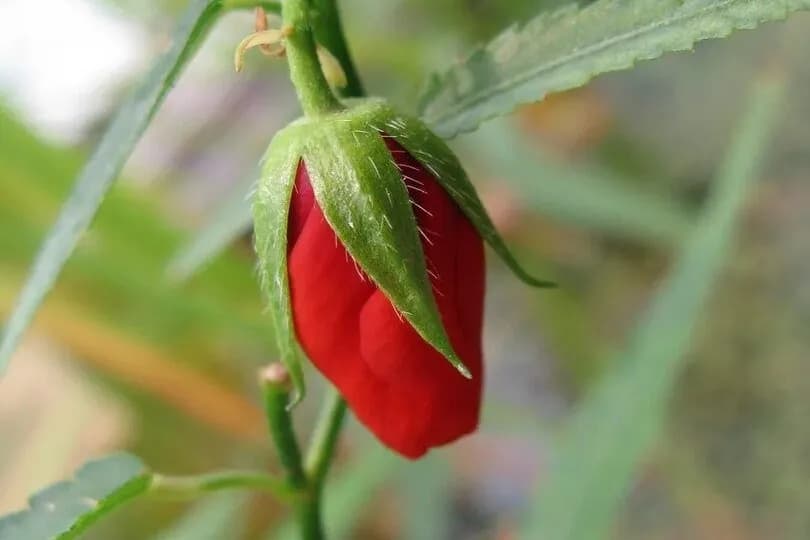
The Flower in Vraja
The poets of Vraja invoke the bandhuka above all for a single comparison – with Radha's lips. The flower's red is so close to the color of Her lips that the poets return to this comparison again and again, and almost always a bumblebee appears nearby – Krishna, drawn by the honey. In the Stavamala, Srila Rupa Gosvami describes Radhika's lips this way:
rādhikādhara-bandhūka-
makaranda-madhuvratam
daitya-sindhura-parīndraṁ
vande gopendra-nandanam
“I bow to the son of the king of the cowherds – he who, like a bumblebee, drinks the honey of the bandhuka flower of Radhika's lips, and who, like a lion, is a terror to the elephant-like demons.”
In Visvanatha Cakravarti Thakura's Radhika-dhyanamrita, Radha's lips do more than resemble the bandhuka – they eclipse its radiance, while the moonlight of Her smile turns Krishna into a chakora bird, which lives on moonbeams alone:
sphuṭad-bandhujīva-prabha-hari-danta-
cchadad-dvandvam abhāti tasyā yad-antaḥ
smita-jyotsnayā kṣālitaṁ yā sa-tṛṣṇaṁ
cakorī-karoty anv-ahaṁ hanta kṛṣṇam
“Her lips eclipse the radiance of a bandhujiva flower in full bloom; and with the moonlight of Her smile She turns the thirsting Krishna into a chakora bird.”
It also works the other way around. While it is usually the bumblebee Krishna who is drawn to the scarlet flower of Her lips, in Srila Raghunatha dasa Gosvami's Stavavali it is Radha's lips, scarlet as bandhuka, that in Her anger set Krishna's own lips trembling1. And in separation this same color plays tricks on the eyes: wandering through the deserted forest, Radha mistakes a dark tamala tree for Krishna, the humming of bees for the song of His flute, and a scarlet cluster of bandhuka for the gunja necklace on His chest, and only on coming to Her senses does She correct Herself2.
Radha's Adornment
The same scarlet color also serves to adorn Radha Herself. In Rupa Gosvami's Ujjvala-nilamani there is a scene where, the moment She catches sight of Krishna, Radha, with a hand that itself glows like a bandhuka flower, places a bright dot of sindura-tilaka on Her forehead – as though the love in Her heart had welled up to the surface in this drop of red:
sānandaṁ śarad-indu-sundara-mukhī sindūra-bindūjjvalaṁ
bandhūka-dyutinā kareṇa tilakaṁ gāndharvikā kurvatī
“Radha, whose face is as beautiful as the autumn moon, the moment She saw You, O one crowned with peacock feathers, at once began to apply a bright dot of sindura with a hand glowing like a bandhuka flower.”
Sometimes the flower itself serves as the sindura. Krishna adorns Radha with His own hands: He sets a bandhujiva flower in the parting of Her hair like a drop of scarlet, and with fresh petals He traces a design on Her cheek3. The gopis gather these flowers themselves: in Rupa Gosvami's Vidagdha-madhava, Radha and Lalita are picking bandhuka to carry the flowers to the bank of the Yamuna, but Krishna bars their way – “How can You take these flowers and simply walk away?”4
Kamadeva's Arrows
The bandhuka also has its place in the Gita-Govinda of Srila Jayadeva Gosvami. Krishna pacifies the angry Radha by praising the features of Her face one by one: all five are likened to the five flower arrows of the god of love, and the first, Her lips, to the bandhuka:
bandhūka-dyuti-bāndhavo 'yam adharaḥ snigdho madhūka-cchavir
gaṇḍaś caṇḍi cakāsti nīla-nalina-śrī-mocane locanam
nāsābhyeti tila-prasūna-padavīṁ kundābha-danti priye
prāyas tvan-mukha-sevayā vijayate viśvaṁ sa puṣpāyudhaḥ
“O angry one, Your scarlet lips are friends with the radiance of the bandhuka flower, Your cool cheeks have taken on the luster of the madhuka flower, Your eyes outshine the beauty of the blue lotus, Your nose is like a sesame flower, and Your teeth gleam like kunda. It seems that Kamadeva, the flower archer, having placed his five arrows in the service of Your face, has conquered the whole universe with them.”
In this verse each of Radha's features is named after its own flower, and the bandhuka lips here are that very akarshana-bana, the “arrow of attraction.” The Gaudiya poets speak the same language. In the Vrindavana-mahimamrita, Srila Prabodhananda Sarasvati maps all of Radha's beauty onto the flowers of an entire forest, and Her lips are once again the bandhuka:
vaktraṁ te cāru-padmaṁ daśana-tati-viyaṁ kunda-sat-kuḍmalāni
bandhūkaṁ danta-vāso dṛg api kuvalayaṁ pallavau pāṇi-yugmam
“Your face is a beautiful lotus, Your teeth are lovely kunda buds, Your lips are bandhuka flowers, Your eyes are white lotuses, and Your arms are tender young shoots.”
The scarlet of the bandhuka is recognized in Vraja even far from the lilas with Radha. In the Padyavali of Rupa Gosvami this color adorns the garments of Nanda Maharaja: “Obeisances to Nanda Maharaja, whose garments are scarlet like the bandhuka flower, whose beard is beautiful, whose body glows golden with sandalwood paste, and whose eyes are enchanted by the sight of Mukunda”5.
As for the arrows themselves, the commentary on the Gita-Govinda says that Kamadeva does not own them: he borrows them from Radha and conquers the universe only by Her mercy.
Worship
The scarlet flowers of the bandhuka also go into the service of the Lord. In the Hari-bhakti-vilasa, Srila Sanatana Gosvami gathered from the Puranas entire lists of flowers that may always be offered to Hari, and bandhujiva stands in these lists alongside mallika, kunkuma, jati, and kunda:
bandhu-jīvaka-puṣpaṁ ca kusumaṁ kuṅkumasya ca
jāti-puṣpāṇi sarvāṇi kunda-puṣpaṁ tathaiva ca
“The bandhujiva flower and the kunkuma flower, all kinds of jati and the kunda flower...” – among those flowers that may always be offered to Lord Hari.
The bandhuka also plays a special part in the morning lila – in the playful surya-puja, the worship of the Sun that the cowherd girls of Vraja perform each morning. In the Govinda-lilamrita of Krishnadasa Kaviraja Gosvami, Krishna, disguised as a priest, instructs Radha to “offer the deities of the nine planets the blossoming bandhuka flower of Your lips” – and thus, under the guise of the rite, steals kisses from Her:
adhara-nayana-gaṇḍoroja-bhālānanānāṁ
grahaṇam iha navānām aṅgakānāṁ grahārcā
yad api tad api teṣāṁ suṣṭhu-santoṣa-hetor
adhara-vikaca-bandhūkārpaṇaṁ teṣu kuryāḥ
“The worship of the planets consists in accepting nine parts of the body – the lower lip, the two eyes, the two cheeks, the two breasts, the forehead, and the face. And to satisfy these planets fully, offer them the blossoming bandhuka flower of Your lips.”
Vrindadevi
The bandhuka also appears in the Sri-Vrindadevi-ashtaka of Srila Visvanatha Cakravarti Thakura: in the very first verse, Vrindadevi's garments shine with the color of its flowers.
gāṅgeya-cāmpeya-taḍid-vinindi-
rociḥ-pravāha-snapitātma-vṛnde |
bandhūka-bandhu-dyuti-divya-vāso
vṛnde numas te caraṇāravindam ||
“O Vrindadevi, I offer my respectful obeisances to your lotus feet. You are bathed in your own splendor, which eclipses the flash of lightning and the golden champaka flowers, while the radiance of your wondrous garments eclipses the beauty of bandhuka flowers.”
Chaitanya Mahaprabhu
The bandhuka has found its way into Gaura-lila as well. When Srila Raghunatha dasa Gosvami in the Stavavali portrays Sri Chaitanya Mahaprabhu dancing in sankirtana – arms raised, His body covered with hairs standing on end – he says that the lips of the dancing Lord, which He bites in an excess of emotion, eclipse the luster of scarlet bandhuka flowers6. The same hue the poets gave to Radha's lips here rests on the lips of Him in whom, by the teaching of the Gaudiya sampradaya, Krishna and Radha are merged into one.
Beyond Vraja
Beyond Vaishnava poetry, the bandhujiva has long been known as a flower for the worship of Lord Shiva: the Shiva Purana prescribes offering it in abundance for the fulfillment of desires and for liberation, and the plant itself is mentioned as early as the Sushruta Samhita. The Hari-bhakti-vilasa, citing the Varaha Purana, notes a curious ritual detail: the bandhuka and the oleander (karavira) should never be planted at one's own home – flowers for offering are gathered elsewhere7.
Ayurveda
The bandhuka has no medicinal renown. The Sushruta Samhita names it as a well-known plant, yet the classical compendia record no rasa (taste), virya (potency), or vipaka (post-digestive effect) for it. The dictionaries, however, split its name in two: Monier-Williams identifies bandhuka with Pentapetes phoenicea, while the Shabda-sagara adds that the same word also denotes the scarlet ixora (Ixora coccinea). The second name settles the matter: both dictionaries reserve bandhujiva for the “midday flower” alone – prized above all for its brilliance, the very brilliance that made it a poetic emblem of scarlet.
Botany
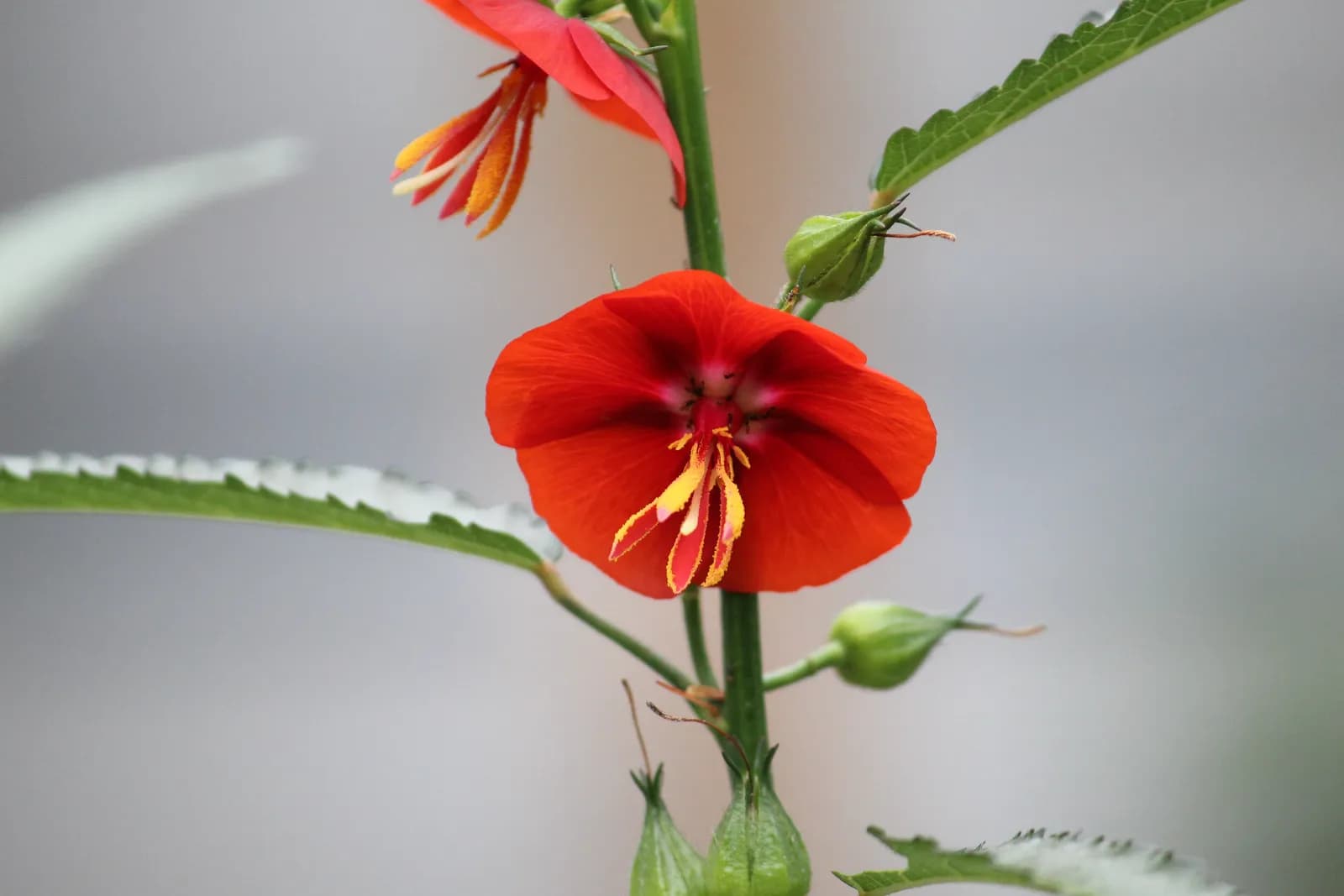
The bandhuka is Pentapetes phoenicea, a small erect subshrub of the Malvaceae (mallow family, family of hibiscus and cotton), with long spreading branches. The leaves are alternate, narrow, linear-lanceolate, six to ten centimeters long, with a serrated margin and a pointed tip; the flowers sit singly in the leaf axils. The hour of blooming gave the plant nearly all its names: the English Midday Flower, the Hindi dupahariya, the Sanskrit madhyadina – all of them mean “the midday one.” The second Sanskrit name points not to the time but to the plant's habit: bandhujiva – “living together (like kinsmen),” from bandhu, “kinsman,” and jiv, “to live”: the bandhuka grows not alone but as if among kin. The fruit is a rounded, downy capsule about a centimeter across, five-valved, with eight to twelve seeds in each locule. The plant is native to tropical Asia: from India and Sri Lanka through Indochina to southern China, Peninsular Malaysia, the Philippines, and New Guinea.
Bandhuka (Dupahariya) in bloom
Sources
We build Vrajapedia together – with stories, verses, photographs and parikrama experience. If you know something more, tell us and it will appear on this page.


