Malati
When the gopis, having lost Krishna in the night forest, ask after Him plant by plant, the jasmine vines come fourth in order – and the first of them the girls call to is the malati. From there this white fragrant vine has a path of its own in Vraja: the manuals of worship call it the best of all flowers, a bed is spread from it for Radha and Krishna, and in the subtlest verses Radharani Herself hides under its name. And it is also the name of one of the forest messengers of Vrinda-devi.
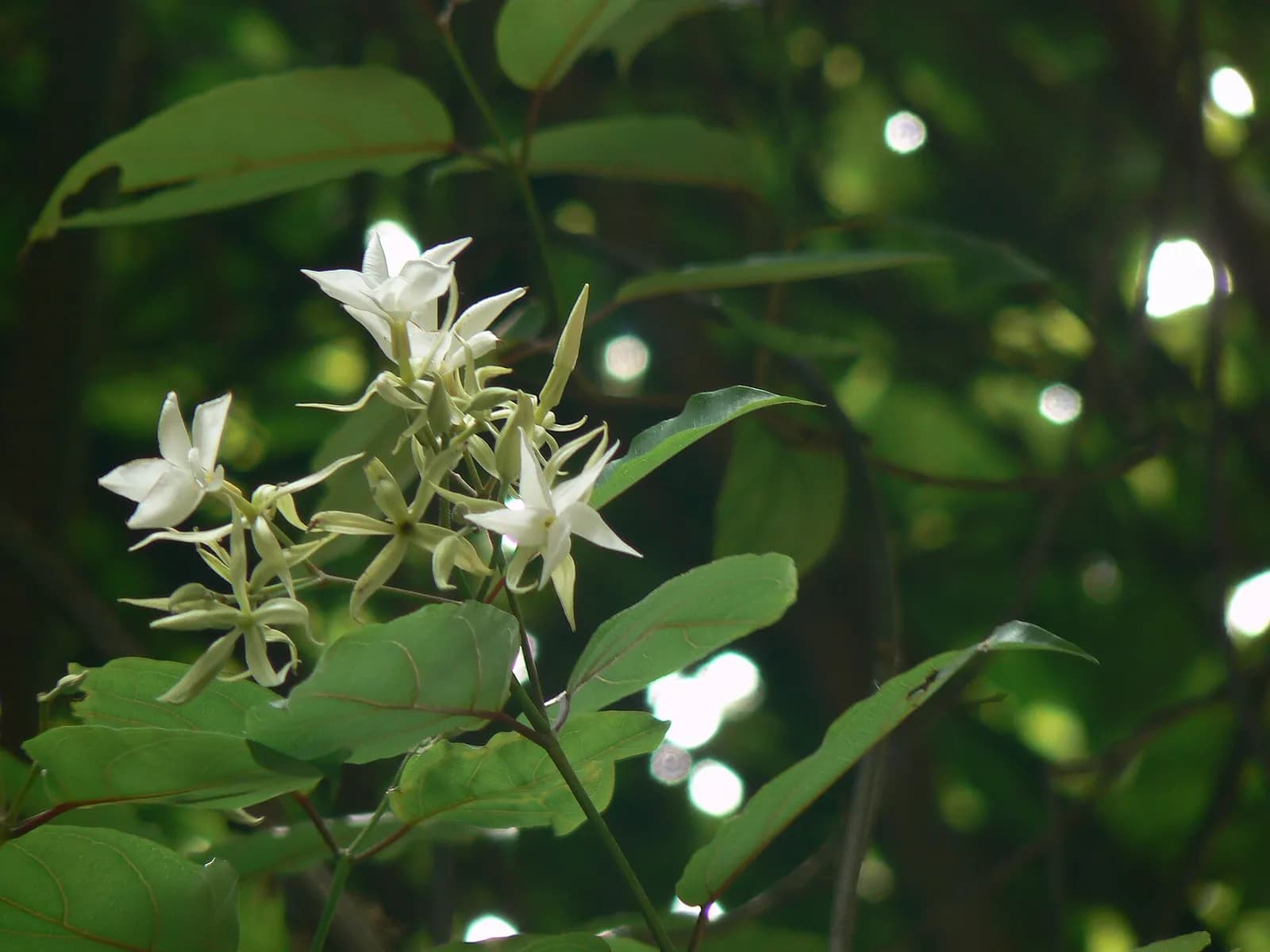
The Vine in Vrindavan
In the thirtieth chapter of the Tenth Canto of the Bhagavatam the gopis, out of their minds with separation, rush about the forest and ask after Krishna plant by plant. First come the great trees – the ashvattha, the plaksha and the nyagrodha, after them the kurabaka, the ashoka, the naga, the punnaga and the champaka, then the tulasi. And only then do the girls turn to the jasmine vines – and the first they call to is the malati:
mālaty adarśi vaḥ kaccin mallike jāti-yūthike
prītiṁ vo janayan yātaḥ kara-sparśena mādhavaḥ
“O malati, O mallika, O jati and yuthika, has Madhava gone by here, giving you pleasure with the touch of His hand?”
The Servant, the Jest and the Second Meaning
The gopis address the jasmines as fellows in service: the malati too gives Krishna her finest flowers, and so she is His maidservant, a sevika, just as the girls are, and there is no rival's pride in her. That is why the very name is taken apart for its sense: Vamshidhara Pandita reads malati as “she in whom lives rati, love, for Ma” – for Radha1. And the gopis noticed too that the branches of the vine had bowed to the ground – a sure sign that Krishna had touched them while picking the flowers. And if He touched them with His hand, He might in play have left a light mark of His nails as well, as one leaves it on the body of a beloved. The commentators name this turn accordingly – sershyam narma, “a jealous jest”: behind the gopis' question one hears jealousy.
There is a botanical observation attached to the verse as well: Vishvanatha Chakravarti and Baladeva Vidyabhushana note that the malati blooms more richly in autumn and the jati in the rainy season, and that both had flowered out of season because the hand of Krishna had touched them.
Srila Sanatana Gosvami goes further. “Madhava” in this verse can be understood simply as “the spring one” – so Srila Jiva Gosvami reads it. But in truth, says Sanatana Gosvami, ma here is Sri Radha Herself, and Krishna was picking the malati flowers to adorn Her. The gopis themselves were not looking for this second meaning, Sanatana Gosvami notes: it broke from their lips of its own accord.
On this reading – the malati as Radha – rests a verse of Srila Rupa Gosvami in the Ujjvala-nilamani as well:
śailas tuṅga-śirā virājati saras tasyottare vistṛtaṁ
tat tīre vanam unnataṁ tad-udare hārī latā-maṇḍapaḥ
tasya dvāri gabhīra-saurabha-bharair āhlādayantī diśaḥ
phullā te madhusūdanādya padavīm ālokate mālatī
“A mountain rises with its peak lifted high; north of it spreads a lake, on its shore a tall forest, and deep in the forest an enchanting bower of vines. At its gate, gladdening the quarters of the sky with deep waves of fragrance, the malati in full bloom watches today for the path of Madhusudana.”
Groves, Kunjas and a Bed of Malati
The verse reads two ways. “Madhusudana” is both the black bee flying to the fragrance and Krishna. The mountain here, Srila Vishvanatha Chakravarti explains, is Govardhana, the lake is Radha-kunda, and the malati at the entrance of the bower is Radha Herself, watching for the path of Her Beloved. Srila Jiva Gosvami adds a short gloss to the same verse: the malati is a vine, and in the second reading a certain girl of that name2.
The malati grows in Vraja not singly but in groves. Srila Prabodhananda Sarasvati in the Vrindavana-mahimamrita lists the jasmine forests of Vrindavan and names among them “the lovely new groves of malati”3. And in the kunjas themselves – the bowers where Radha and Krishna meet – the malati vines go straight into the walls and roofs; from its manjari flowers a bed is spread as well for the pastimes of the Divine Couple. Srila Raghunatha dasa Gosvami dreams aloud of serving at that bed:
ayi sumukhi kadāhaṁ mālatī-keli-talpe
madhura-madhura-goṣṭhīṁ bibhratīṁ vallabhena … tvām kadā vījayāmi
“O fair-faced one, when will I fan You on the bed of malati flowers, where You hold Your sweetest converse with Your Beloved?”
A Fragrance Stronger than the Flute
The malati remembers the dance itself as well. Srila Rupa Gosvami in the Uddhava-sandesha paints the place of the rasa-lila still shining with the malati vines that were trampled in the whirling – and says that one glance at them is enough for the mind to drown in bliss. And its fragrance is so strong that it hinders even Krishna Himself: in the Krishna-bhavanamrita of Vishvanatha Chakravarti His mind, stirred by that scent, cannot hold to the playing of the flute.
But even the malati is not the limit. Srila Prabodhananda Sarasvati has a verse where a certain bee in Vrindavan, he says, flies neither to the lavish mallika nor to the scent of the malati nor to the laughing vasanti – it circles only around the two lotuses at Radha's feet4.
Malati-sakhi
In Vraja the malati is also a name. In the Govinda-lilamrita of Srila Krishnadasa Kaviraja Gosvami it is what a forest messenger is called who runs from bower to bower with the messages of Vrinda-devi: it is she who brings Radha the word about the bower for a secret meeting, and through her Tulasi and Rupa-manjari send Vrinda-devi the remnants of Radha's meal. And in the Ujjvala-nilamani Malati stands in the list of Radha's close friends, beside Madhavi and Kama-lata.
Spring and Separation
In the verse of Vraja the malati is the flower of spring and of the season of love. Srila Jayadeva Gosvami in the Gita-Govinda paints the spring forest all in bloom: on the branches of the malati no free place is left, and nearby Krishna is dancing.
But most often the malati is recalled in another verse, one about separation. Srila Rupa Gosvami placed it in the Padyavali, and it is spoken by Radha, meeting Krishna after many years on the field of Kurukshetra:
yaḥ kaumāra-haraḥ sa eva hi varas tā eva caitra-kṣapās
te conmīlita-mālatī-surabhayaḥ prauḍhāḥ kadambānilāḥ
“That very personality who stole away my heart during my youth is now again my master. These are the same moonlit nights of the month of Chaitra. The same fragrance of malati flowers is there, and the same sweet breezes are blowing from the kadamba forest. In our intimate relationship, I am also the same lover, yet still my mind is not happy here. I am eager to go back to that place on the bank of the Reva under the Vetasi tree. That is my desire.”
Radha is beside Krishna, and still Her heart strains back, to that river bank under the branches of the vetasi. The malati here is a token of the former joy that cannot be brought back in a strange place.
One scene with the malati is not about lovers at all. Yashoda is churning butter; her arms are tired, sweat has come out on her face, and from her loosened braid malati flowers are falling:
svinnaṁ vaktraṁ kabara-vigalan-mālatī nirmamantha
“…with her face perspiring and the malati flowers slipping from her braid, [Yashoda] was churning the butter.”
Srila Rupa Gosvami quotes this little scene in the Bhakti-rasamrita-sindhu as a model of parental tenderness. And Srila Jiva Gosvami notes that the malati in Yashoda's braid is no accident: this jasmine flowers abundantly in the month of Kartika – and a flower dropped in passing names the season.
Worship
The malati is both offered to Krishna and set by the Vaishnava manuals above all other flowers. Srila Sanatana Gosvami gathered a whole selection about it in the Hari-bhakti-vilasa, out of the Skanda and the Garuda Purana. The reckoning there is a simple one:
varṇānāṁ brāhmaṇo yathā … suranāṁ tu yathā viṣṇuḥ puṣpanāṁ mālatī tathā
“As the brahmana is the best of the social orders, as the Ganga is the best of rivers, as Vishnu is the best of gods, so the malati is the best of all flowers.”
Then come the merits: one who worships Krishna with malati flowers is carried to His supreme abode; one who lays a garland of opened malati on the head of Sri Hari gains the fruit of a horse sacrifice; and for the one who in the month of Kartika builds a “flower house” of malati in the temple of Keshava the reward cannot be measured at all. The malati, tulasi, lotus, ketaki and kadamba, it is said in the same place, are dear to Keshava as Lakshmi or the Kaustubha stone5. Hence the second Sanskrit name of the malati – vishnuvallabha, “dear to Vishnu”.
Chaitanya Mahaprabhu
By that same verse in which the malati is named – “that very personality who stole away my heart during my youth” – Sri Chaitanya Mahaprabhu lived as well: the Chaitanya-charitamrita sets it at the very beginning of the account of the Lord's hidden mood and repeats it three times. And in His last years, in the seclusion of the Gambhira, Mahaprabhu in the divine madness of separation called out to the flowers Himself, as the gopis once did – with that same shloka about the malati, the mallika, the jati and the yuthika6. A trace of the malati is there in the Lord's own circle: one of the kirtana singers who danced before the chariot of the Ratha-yatra and tasted the foam from the lips of the dancing Mahaprabhu – Shubhananda – had lived before, according to the commentators, in Vrindavan as a gopi by the name of Malati.
In Ayurveda the Malati Is a Jasmine
In the Ayurvedic compendia another plant goes under the name malati – the true jasmine Jasminum grandiflorum, the Spanish or royal jasmine, a fragrant white flower that opens towards evening. Under the names malati and jati it appears in the Charaka- and the Sushruta-samhita, and in later compendia such as the Yogasara-sangraha as jatikusuma, in preparations for wounds, mouth ulcers and diseases of the eyes.
There is less confusion here than it seems: the name malati is held by the lexicons for two plants at once, and both are named aloud. Monier-Williams and the Shabda-sagara give the jasmine first, but mention at once “Echites caryophyllata” – and that is precisely the old name of the Vraja vine: at Kew the same name stands in the masculine, Echites caryophyllatus, and together with Aganosma caryophyllata is counted a synonym of Aganosma heynei. The same holds for the second name: vishnuvallabha the lexicons give both to the tulasi and to that same “Echites caryophyllata”. What is at odds here is not the sources but two plants that came by one name. The Vraja malati has no Ayurvedic profile of its own, and to ascribe to it the rasa and virya of the jasmine would be a stretch.
Botany
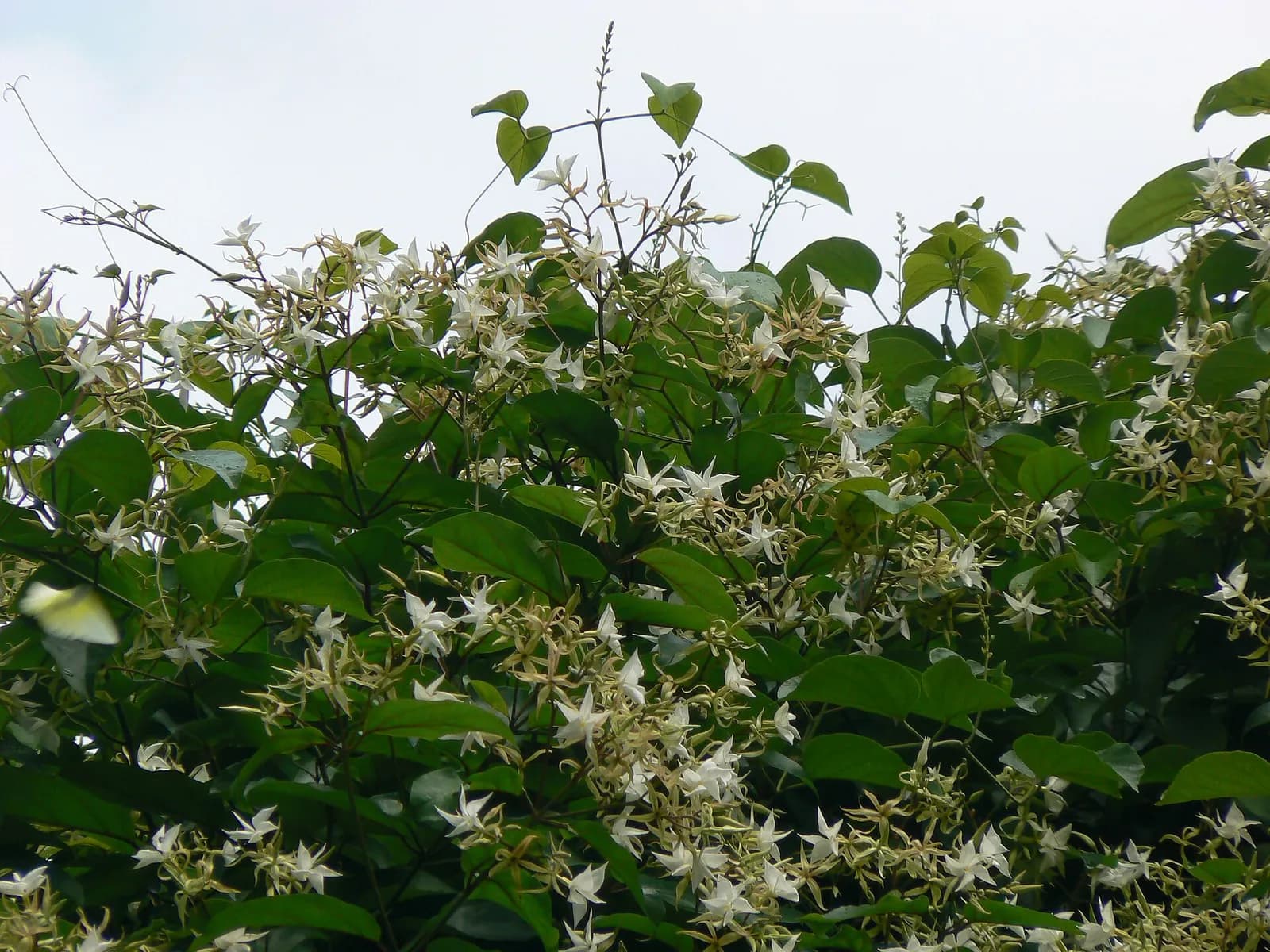
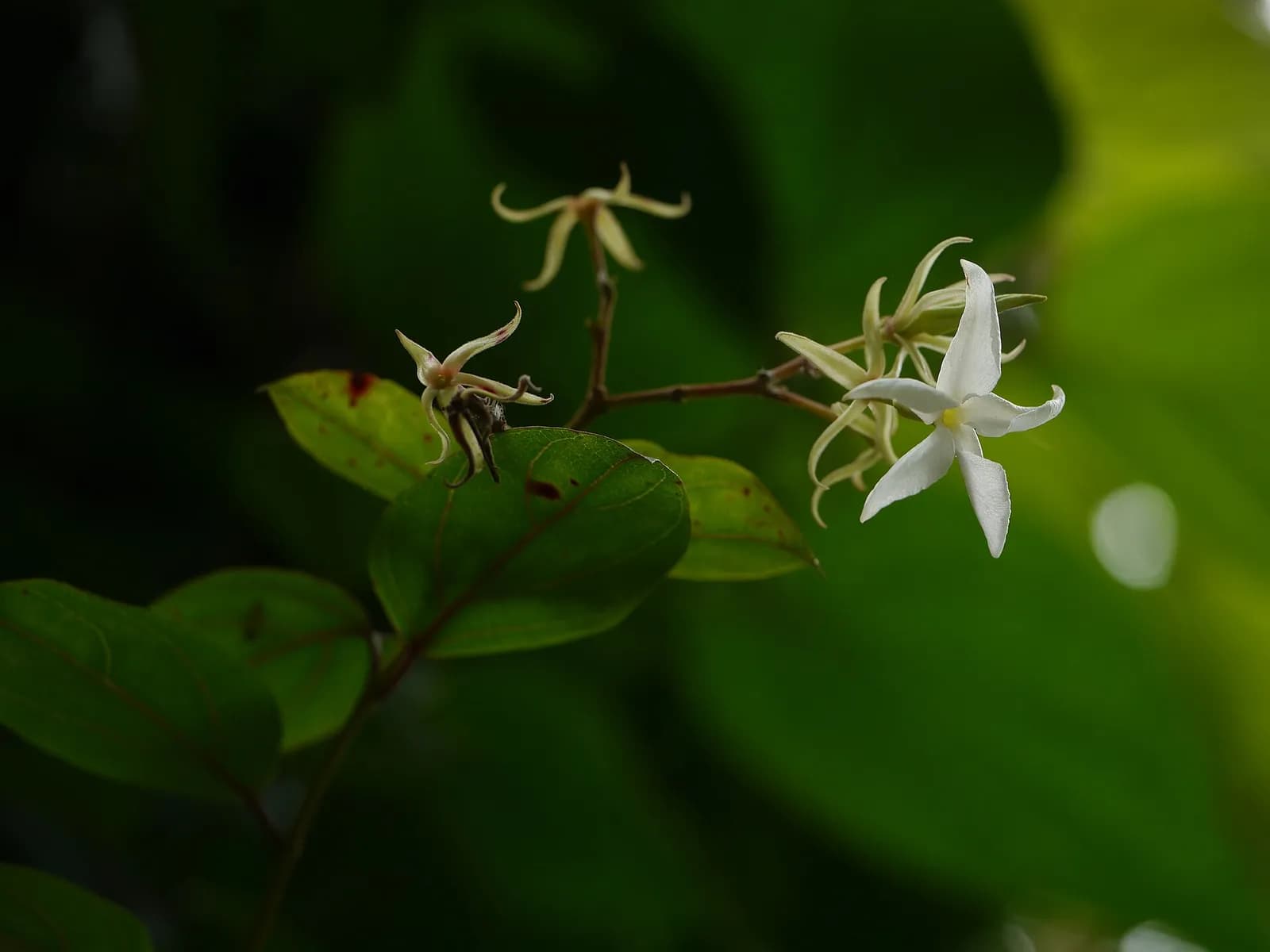
The malati of Vraja is not a Jasminum but Aganosma heynei: it is no kin to the true jasmine. The leaves are leathery, ten to twelve centimetres long, with a rounded or slightly heart-shaped base. The flowers are gathered in loose inflorescences at the ends of the shoots, as if in white felt. Their fragrance is spicy, of cloves – hence the English name “clove scented echites”; Echites here is the old generic name under which the vine stood in the books of the century before last. The malati is native to India. It should not be confused with the madhu malati – that is a different plant, with a different flower and a different history.
Malati: flower, bud, leaf
Sources
We build Vrajapedia together – with stories, verses, photographs and parikrama experience. If you know something more, tell us and it will appear on this page.


