Madhu Malati
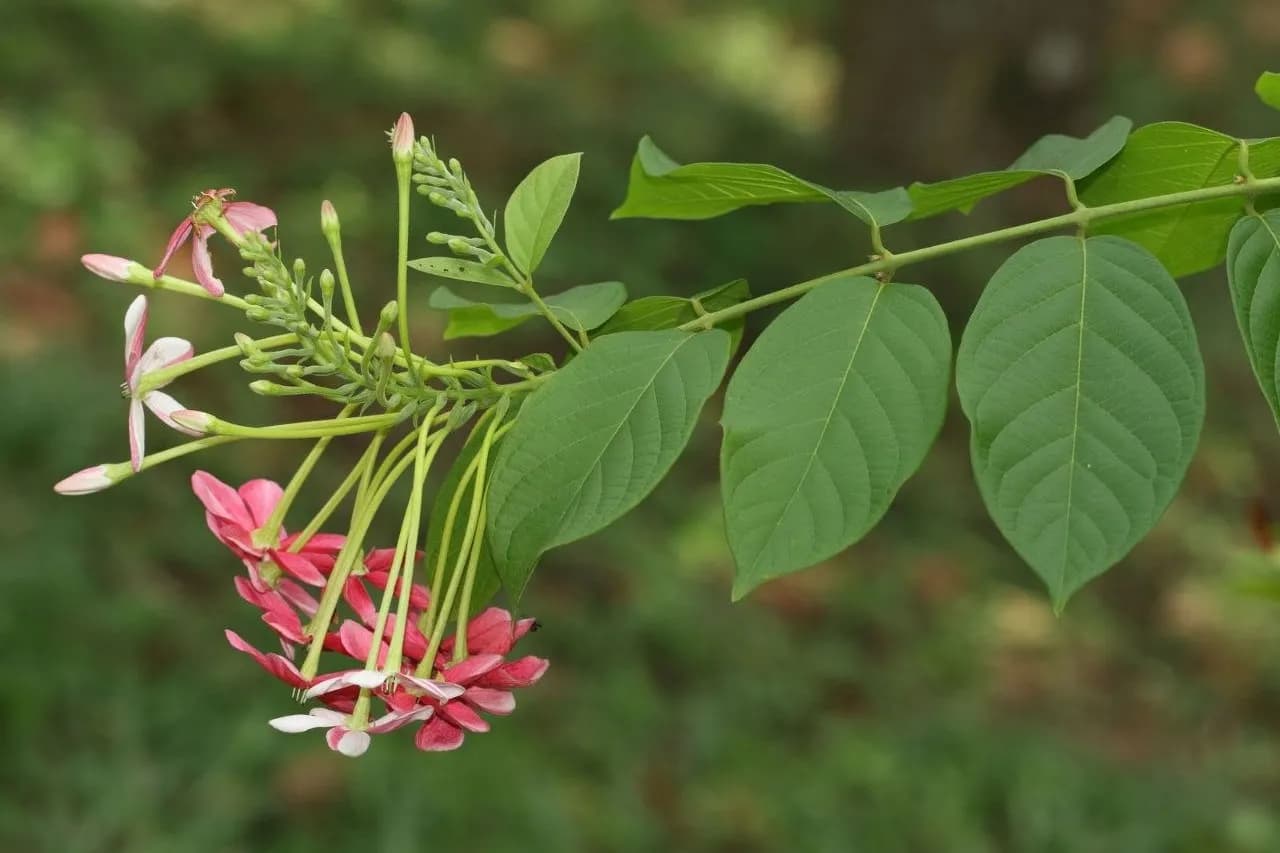
A vine whose name means “honey jasmine”: its flowers smell sweet, almost of honey, and, like jasmine, they open at dusk. It has a secret of its own as well: one and the same flower changes dress over three days — it opens white, turns pink the next day, and on the third goes scarlet, so that all three colours burn at once in a single cluster. The shastras do not know this name; it is late, and it comes from the garden. Yet in Vraja the vine is no stranger — it is one of the flowering vines out of which the kunjas are woven, the forest bowers of Radha and Krishna.
The Vine in Vrindavan
The old texts do not know the name madhu malati. It is a late garden name, “honey jasmine”: the vine was called so for its sweet scent, and because its flowers, like jasmine, open towards evening. In North India and in Marathi it is called the same; in Bengal it is madhumanjari, and in Karnataka and Kerala sandhyarani, “queen of the twilight”. The Sanskrit malati and madhavi, which turn up so often in the Goswamis, are other plants. And yet in Vraja madhu malati is not an outsider: it is out of just such flowering vines that the kunjas are woven — the bowers where Radha and Krishna meet.
A kunja in Vraja is not an ornament but the very stage of the pastime, and the vines in it are not a backdrop but participants. In the Yugala-gita the gopis sing of what happens to the forest when Krishna lifts the flute to His lips:
vana-latās tarava ātmani viṣṇuṁ vyañjayantya iva puṣpa-phalāḍhyāḥ
praṇata-bhāra-viṭapā madhu-dhārāḥ prema-hṛṣṭa-tanavo vavṛṣuḥ sma
“…the trees and creepers in the forest respond by becoming so luxuriant with fruits and flowers that they seem to be manifesting Lord Vishnu within their hearts. As their branches bend low with the weight, the filaments on their trunks and vines stand erect out of the ecstasy of love of God, and both the trees and the creepers pour down a rain of sweet sap.”
Creepers Are Wives, Trees Are Husbands
Srila Vishvanatha Chakravarti Thakur explains: the creepers of Vrindavan are wives and the trees are their husbands; the bent branches are a bow, the bark standing on end is the thrill of prema, the flowing honey is tears of love1. Madhu malati is one of those creepers.
That is why the gardener of these bowers is no human being. Vrinda Devi, who has charge of the groves of Vrindavan, bids the vines come into flower when Krishna wishes to play with Radha, and they burst into bloom all at once; and Krishna, breathing in their fragrance, says: “these fragrant flowering vines gladden My heart”2.
Uddhava, having seen the love of the gopis with his own eyes, wished to be born in Vrindavan as a bush or a vine — if only their feet might tread on him:
āsām aho caraṇa-reṇu-juṣām ahaṁ syāṁ
vṛndāvane kim api gulma-latauṣadhīnām
yā dustyajaṁ sva-janam ārya-pathaṁ ca hitvā
bhejur mukunda-padavīṁ śrutibhir vimṛgyām
“Oh, let me become anything at all in Vrindavan — a bush, a creeper, a blade of grass — that these gopis tread upon! For to reach the lotus feet of Mukunda, which even the Vedas search for, they gave up their own kin, so hard to give up, and the path of chastity as well.”
And that is the whole glory of madhu malati: not in a name, which the shastras do not have, but in a place — right down at the earth over which the gopis walk.
Folk Medicine
In medicine madhu malati is valued above all as a remedy against worms — krimighna: a decoction of the dried seeds drives out intestinal parasites. The leaves, flowers and petals are used externally, as a paste and in cooling compresses. The plant is credited with balancing vata and kapha in digestion, but it never became a major medicine: neither Charaka nor Sushruta describes it. Caution is worth remembering too: the seeds contain quisqualic acid, which in large doses is poisonous.
Botany
Madhu malati is Combretum indicum, a large woody vine of the combretum family; botanists long called it Quisqualis indica. It climbs to eight metres, and it holds on by a trick: the leaf stalk does not fall with the leaf but hardens and curves into a hook-like thorn, by which the vine grips its support.
The change of colour has a simple explanation: each day’s colour calls its own pollinator — hawkmoths by night and bees by day. The fruit is a dry spindle-shaped capsule about three centimetres long, with five narrow wings running along it: red while unripe, blackish brown when mature. The vine’s homeland is tropical Asia, from India to Malaya and the Philippines; today it is planted for its beauty throughout the warm countries. In southern India the name “Malabar madhu malati” belongs to a rare relative, Combretum malabaricum, but that one grows only in the Western Ghats.
Photographs of madhu malati
Sources
We build Vrajapedia together – with stories, verses, photographs and parikrama experience. If you know something more, tell us and it will appear on this page.


