Kadamba
The tree Krishna leans against when He takes up His flute. The kadamba drops golden balls of blossoms at the very height of the rains and fills the bank of the Yamuna with deep shade and a honeyed fragrance. It stands at every crossroads of Vraja's love stories: beneath it Krishna plays His flute, lovers meet in its shade, and He climbs it – to leap down upon the serpent Kaliya and to tease the cowherd girls at the water. No tree of Vrindavan is so closely bound to the flute and to lovers.
Contents
- 01The Tree in Vrindavan
- 02The Flute, the Garland, and the Rainy Season
- 03The Colors of the Couple
- 04Kaliya and the Theft of the Garments
- 05Krishna's Tree at Kaliya-hrada
- 06Separation and Poetics
- 07The Fragrance That Wounds
- 08Worship
- 09The Name Kadamba on the Map of Vraja
- 10Beyond Vraja
- 11Ayurveda
- 12Botany
- 13Sources
- 01The Tree in Vrindavan
- 02The Flute, the Garland, and the Rainy Season
- 03The Colors of the Couple
- 04Kaliya and the Theft of the Garments
- 05Krishna's Tree at Kaliya-hrada
- 06Separation and Poetics
- 07The Fragrance That Wounds
- 08Worship
- 09The Name Kadamba on the Map of Vraja
- 10Beyond Vraja
- 11Ayurveda
- 12Botany
- 13Sources
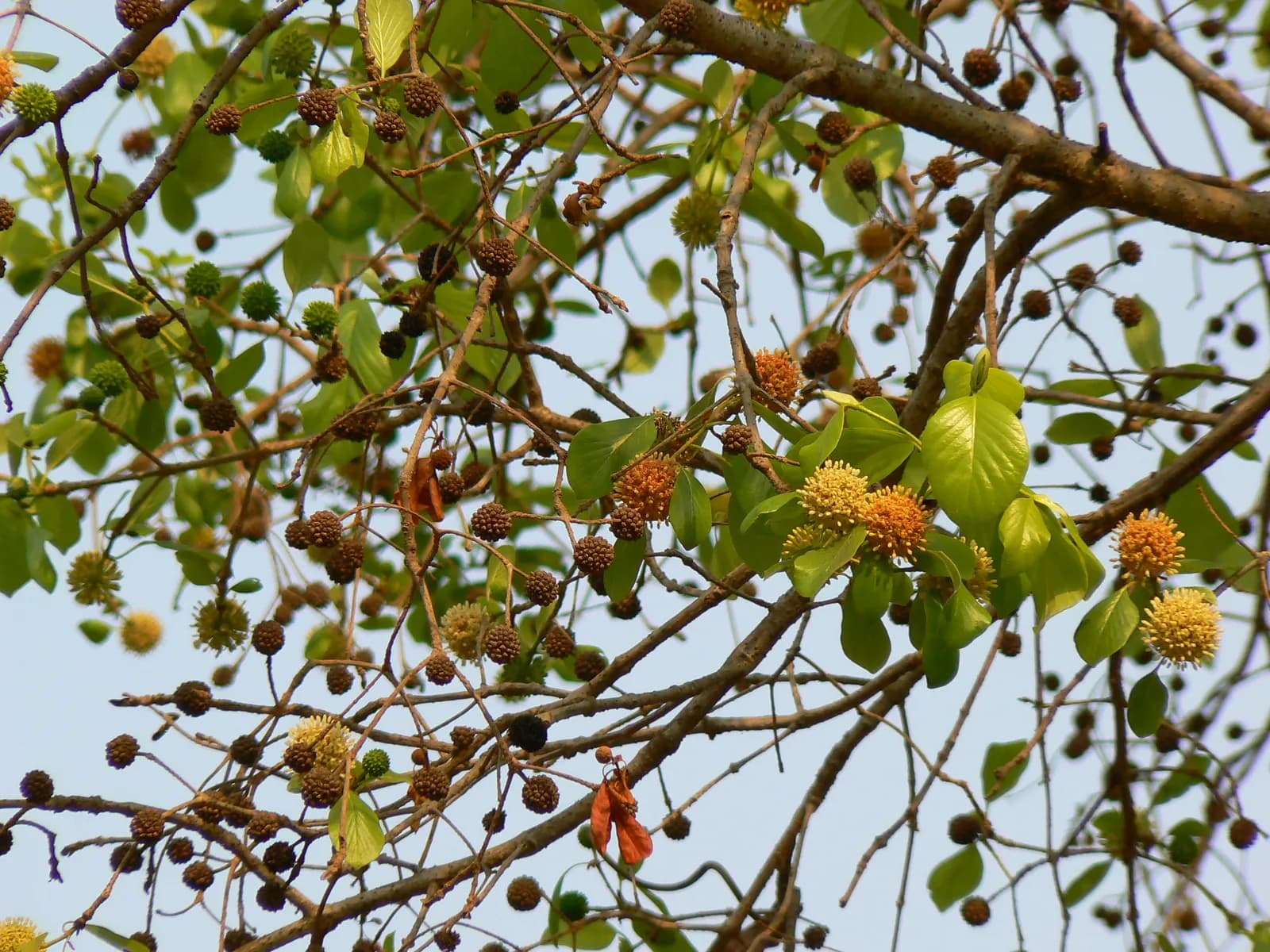
The Tree in Vrindavan
In Vrindavan the kadamba is the tree of the flute. Picture Krishna with His flute, and a kadamba will almost certainly be nearby: He is leaning against its trunk, standing in its shade, or perched in its branches. A single line by Srila Prabodhananda Sarasvati brings it all together at once:
vilasat-kadamba-mūlālambī saṁvīta-pīta-cāru-paṭaḥ
rādhāṁ vilokya muralīṁ kvaṇayan vṛndāvane harir jayati
“Glory to Krishna, who, dressed in beautiful yellow garments, leaning against a radiant kadamba and gazing at Radha, plays His flute in Vrindavan!”
The Flute, the Garland, and the Rainy Season
A yellow dhoti matching the golden blossoms, the flute, Radha before His eyes, and the kadamba itself as His support. The poets of Vraja repeat this image tirelessly. In a verse by Sri Govinda in the Padyavali, a devotee prays that his heart may rest forever upon “the Deity of the kadamba” – upon Him who, in a yellow dhoti, sweetly plays the flute in a woodland garden1.
Sri Madhavendra Puri longs to see the son of Nanda crowned with a garland of nipa flowers: nipa is another name for the same kadamba. And an anonymous poet of the same anthology captures a single moment:
pṛṣṭhena nīpam avalambya kalindajāyāḥ
kūle vilāsa-muralīṁ kvaṇayan mukundaḥ
prāk pūraṇāt kalasam ambhasi lolayantyā
vaktraṁ vivartayati gopa-kulāṅganāyāḥ
“Leaning His back against a kadamba on the bank of the Yamuna and suddenly striking up a tune on His flute, Mukunda made a cowherd girl turn around as she was dipping her still-unfilled pitcher into the water.”
The Colors of the Couple
A garland of kadamba flowers is part of Krishna's forest attire, and He wears it only in Vraja. When, in the Brihad-bhagavatamrita, Balarama dresses His younger brother in forest garb, it is a kadamba-mala that He places around His neck, a peacock feather on His head, and earrings of gunja2 berries on His ears. Srila Sanatana Gosvami observes that Krishna wears these ornaments – the feather, the gunja, the kadamba garland – nowhere else, neither in Dvaraka nor in Vaikuntha.
The kadamba blooms in the rainy season and has thus become inseparable from varsha – the season of clouds, lightning, and love swings. In the Krishna-bhavanamrita, Srila Visvanatha Cakravarti Thakura paints Radha and Krishna at play in a kadamba forest in the rain. The trees there have bluish branches and countless golden flowers dripping with honey, and their beauty outshines the very clouds and lightning: the blue branches stand in for the clouds, the golden flowers for the lightning. Terraces stretch between the trunks like emerald balconies beneath flower garlands. Here the tree is no mere backdrop – its colors are the very colors of the Divine Couple, dark and golden.
That is why in Vraja the kadamba is often planted beside a tamala, and the pair is read as the Divine Couple: the tamala is dark like Krishna, the kadamba fair and golden-flowered like Radha. For the poets, this pair is a golden vine embracing the dark tamala3. And in the Krishna-bhavanamrita, Radha at dusk mistakes a tamala for Krishna and embraces the tree – and Vishakha remarks to Her that the mistake is not so great after all: both spring and the motionless tamala are called by the same name – Madhava.
Kaliya and the Theft of the Garments
The kadamba serves in yet another way: twice in Krishna's childhood pastimes it becomes His platform, from which He leaps down – and both times it happens on the bank of the Yamuna.
The first time was when the serpent Kaliya poisoned a pool of the Yamuna. In the Bhagavatam the leap is described thus:
taṁ caṇḍa-vega-viṣa-vīryam avekṣya tena duṣṭāṁ nadīṁ ca khala-saṁyamanāvatāraḥ
kṛṣṇaḥ kadambam adhiruhya tato ’ti-tuṅgam āsphoṭya gāḍha-raśano nyapatad viṣode
“Krishna, who descended into this world to subdue the wicked, surveyed the poisoned river, climbed a very tall kadamba tree, tightened His belt, slapped His arms – and plunged into the venomous water.”
Krishna's Tree at Kaliya-hrada
The commentators speak of this tree in its own right. Kaliya's poison scorched all life along the banks, yet one kadamba survived. Srila Baladeva Vidyabhushana and others cite the Puranic explanation: Garuda once perched on this tree, letting fall drops of nectar, and so it did not wither. Above all, though, the kadamba held on in hope that the Lord's feet would one day touch it. Srila Jiva Gosvami cites the saying — kadambaḥ kṛṣṇa-vṛkṣo hi, “the kadamba is Krishna's tree”: that is why it alone did not perish beside the poisoned pool, waiting for the Lord4.
The memory of this tree lives on: according to the Mathura-mahatmya of Rupa Gosvami and the Laghu-vaishnava-toshani of Jiva Gosvami, to the east of Kaliya-hrada stands an enormous kadamba with a hundred branches — ever cool, in bloom all year round, shedding light in every direction, untouched by the decay of the earthly world. The gopis in separation appeal to the trees along the Yamuna — the chuta, the bakula, the amra, “the kadamba and the nipa” — begging them to point out where Krishna has gone5.
The second leap belongs to another lila. During the month of worship of the goddess Katyayani, the young cowherd girls were bathing in the Yamuna, having left their garments on the bank. Krishna carried the garments off, nimbly climbed a kadamba, and from there, laughing with His companions, playfully called the girls to come and claim what was theirs6. Srila Sanatana Gosvami in the Krishna-lila-stava bows to Him by this very name — kadambarudha, “He who climbed the kadamba, expert in jokes, whose greed was kindled by the gopis' pleas.”
So the tree knows Krishna from two sides: as the fearsome subduer of the serpent and as the mischievous boy with an armful of stolen garments in the branches. And in the memory of Vraja the two leaps have merged into a single image — a dark youth high in the crown of a kadamba above the waters of the Yamuna.
Separation and Poetics
And then Krishna leaves for Mathura — and the same tree becomes an instrument of longing. Srila Rupa Gosvami has a verse about this. Krishna once planted a tiny two-leaved kadamba with His own hand at the entrance to Vraja; now, years later, it has grown tall and come into bloom — and its very sight torments the cowherd girls, reminding them of the one who is gone:
sakhi ropito dvipatraḥ śatapatrākṣeṇa yo vraja-dvāri
so ’yaṁ kadamba-ḍimbhaḥ phullo vallava-vadhūs tudati
“Friend, that baby kadamba with its two little leaves, which the lotus-eyed one planted at the entrance to Vraja — see, it has blossomed and now burns the cowherds' wives.”
The Fragrance That Wounds
A tree planted by the beloved's hand grows together with love – and, blossoming in His absence, it wounds most sharply of all. The fragrance of the kadamba works in the same way. Its flowers open with the coming of the rains, and the monsoon wind carries their pollen – and for those in separation, this sweet fragrance becomes unbearable.
The Padyavali is full of such laments: the breeze drifting from the kadamba flowers strikes the heart like a weapon; the sky is gray with pollen, the riverbank is in bloom – yet the beloved is nowhere to be found. Even Krishna in Dvaraka remembers “the valleys fragrant with kadamba flowers, and Radha as she was at their first meeting” – and is filled with pain7. And the gopis send Him a bitter reproach through a wanderer: can it be that neither the bank of the Yamuna, nor the beloved Bhandira tree, nor the kadamba by Kaliya's lake – Your old friends – have any place left in Your heart, even to be blamed?
That is why, for the poets of Vraja, the kadamba is not merely a tree but almost a living being, “the Deity of the kadamba forest,” beneath whose shade Krishna, dark as a young tamala, wanders at night. And it is bound not to Krishna alone. Srila Raghunatha dasa Gosvami, in the Vraja-vilasa-stava, describes how Krishna, captivated by the glances of Radharani, the queen of the forest, adorns Her with flowers from “the king of kadamba trees” – and he prays that this king of kadambas may appear to him as well. The tree of the flute proves to be the tree of Their meeting too: beneath it He plays to call Radha, and with its flowers He adorns Her hair.
Worship
Behind the poetry stands a simple practice: kadamba flowers are offered to Krishna, and they please Him especially. Srila Sanatana Gosvami, in the Hari-bhakti-vilasa, cites verses from the Skanda Purana on this point:
na tathā ketakī-puṣpair mālatī-kusumair na hi
toṣam āyāti deveśaḥ kadamba-kusumair yathā
dṛṣṭvā kadamba-puṣpāṇi prīto bhavati mādhavaḥ
“The Lord of the gods does not delight in ketaki or malati flowers as He does in kadamba flowers. At the mere sight of kadamba flowers Madhava is already pleased – what to speak of when He is worshiped with them.”
The Name Kadamba on the Map of Vraja
The same compendium promises: one who honors Govinda with golden kadamba flowers need not fear the wrath of Yamaraja. The logic is simple – Krishna holds dear whatever grows in His forest and is bound to His pastimes.
The very places of Vraja also bear the kadamba's name. At Pavana-sarovara near Nandagram, according to the Vraja-vilasa-stava, the gopis met Krishna again and again on the pretext of fetching pure water – the lake was full of kadambas and humming with bees. There too lie Kadamba-khandi and the Kadambavan grove, and near Nandagram stands Ter-kadamba, the hill where Krishna herded the cows and where, much later, Srila Rupa Gosvami performed his bhajana.
Beyond Vraja
The kadamba grows in the shastras beyond the Vrindavan stories as well. In the same Tenth Canto of the Bhagavatam, a sweet drink flows in streams from the hollow of a kadamba in Vrindavan — varuni — the goddess of intoxicating drink, daughter of Varuna, sent to serve Balarama. And in the description of the abode of the sage Kardama, the kadamba stands among the other trees of the celestial garden — an emblem of beauty and abundance, which is what it had been for all of Sanskrit poetry long before Vraja.
The very mood of “kadamba and separation” was known even before Krishna. The Padyavali has a scene: Krishna, talking in His sleep, raves with the pain of a former life — “these cruel winds wafting from the kadamba flowers strike Me, separated from Janaki, straight to the heart” — and Radha, hearing Him call out to Sita in His sleep, flares up with jealousy. Even on the lips of Rama, the kadamba remains a tree whose monsoon fragrance stirs an unbearable longing for the beloved.
Ayurveda
Ayurveda knows the kadamba as a cooling and astringent tree. In taste (rasa) it is pungent, bitter, and astringent; in potency (virya) it is cooling. The Raja Nighantu says it pacifies vata and relieves fever and pain caused by pitta and kapha. Charaka places the kadamba among the “greens” (shaka-varga) and describes it as heavy, cold, and “channel-blocking,” while the Kashyapa Samhita mentions it in the section on treating snakebites. The bark, leaves, and flowers are all put to use; the tree's cooling, astringent nature is the common thread running through all these applications.
Botany
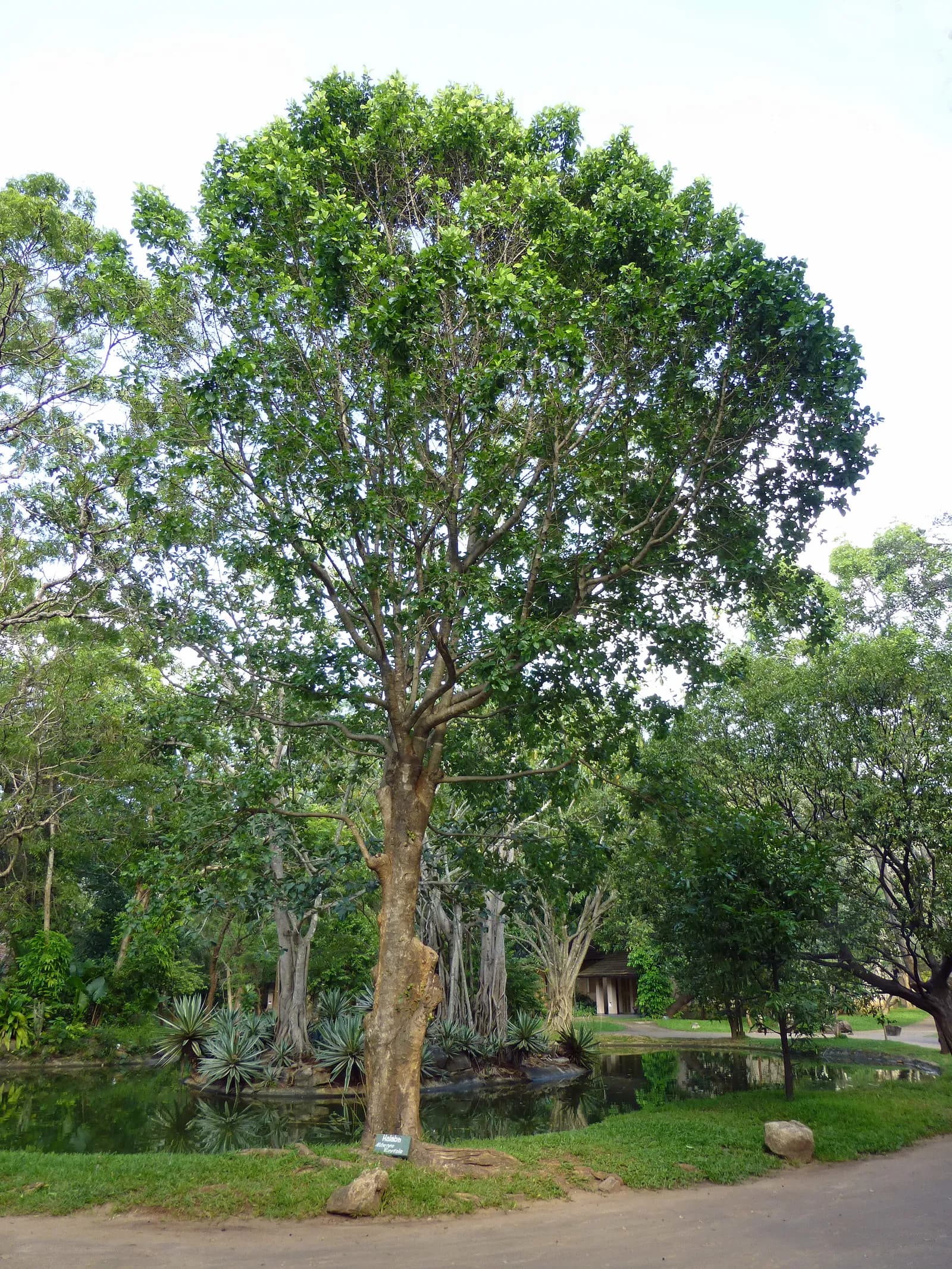
In Vraja, the kadamba is Mitragyna parvifolia, a tree of the Rubiaceae (madder family), known in Hindi as kaim and in Sanskrit as dhuli-kadamba. It is a tall tree with a broad crown and smooth, dark green leaves; its flowers are gathered into dense yellow balls. It is this Mitragyna that local tradition and botanists alike recognize as the “true” kadamba of the Vraja stories, distinguishing it from the better-known large-flowered kadamba of the plains.
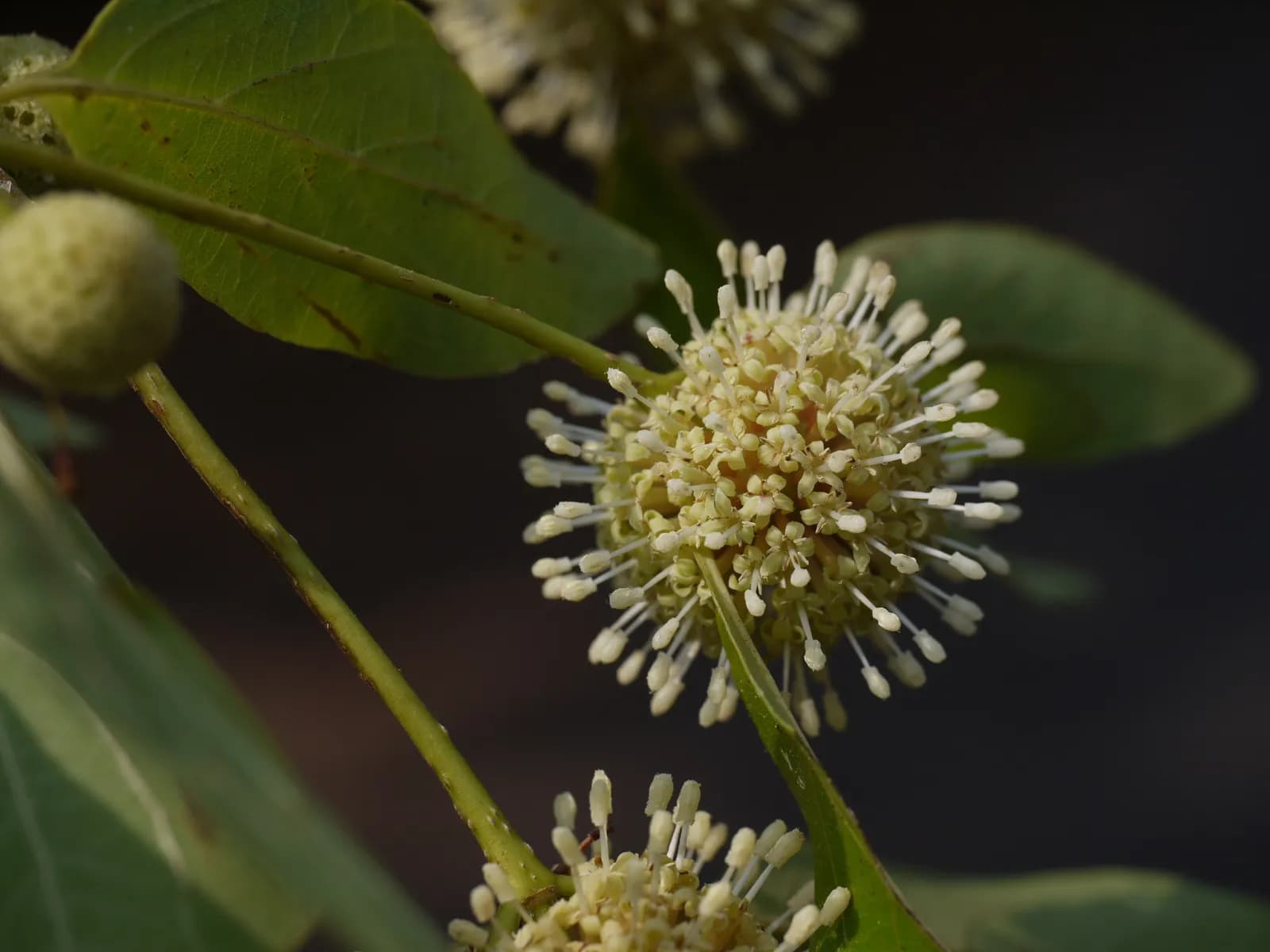
Kadamba: fruits, leaf, bark, crown
Sources
We build Vrajapedia together – with stories, verses, photographs and parikrama experience. If you know something more, tell us and it will appear on this page.


