Gunja
A tiny forest bead – scarlet like a drop of love, with a black eye at the base. It is the seed of the twining gunja vine, an unassuming treasure of Vraja. And yet it is this berry, not jewels, that the cowherd boy Krishna wears on His chest: a necklace of gunja berries beside a peacock feather is His signature, by which He is recognized in Vrindavan. These same berries are woven into garlands for Giriraja-Govardhan and for shilas, and the very redness of the berry is read in Vraja as an image of Radharani, whose love is just as complete and whole.
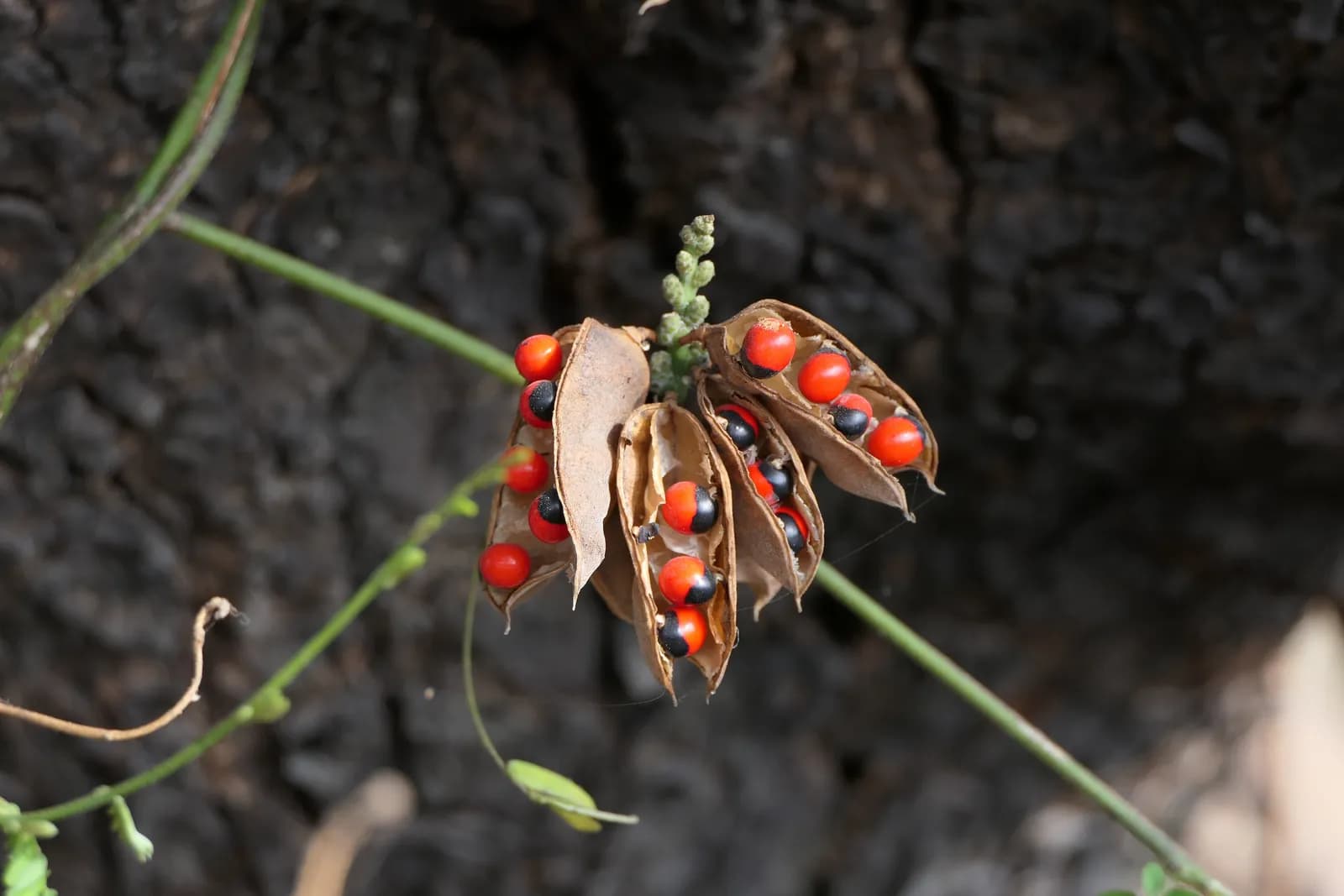
Gunja in Vrindavan
What is gunja in Vraja? A forest vine that twines around trees, bushes, and hedges – and the whole question is why it is treasured more than gems. When the mothers of Gokula dress their cowherd boys for the forest, they adorn them with necklaces of crystal and red gunja berries; and once in the forest, the children complete their attire with fruits, leaves, mineral pigments, and peacock feathers. Thus from the very beginning gunja is an adornment of play, not of luxury.
And it is precisely this simplicity that underlies one of Vrindavan's most powerful theological images. When Lord Brahma, humbled after the theft of the calves, composes himself and offers a prayer to Krishna, he describes not the four-armed splendor of Vaikuntha but the forest cowherd boy Himself:
naumīḍya te ’bhra-vapuṣe taḍid-ambarāya
guñjāvataṁsa-paripiccha-lasan-mukhāya
vanya-sraje kavala-vetra-viṣāṇa-veṇu-
lakṣma-śriye mṛdu-pade paśupāṅgajāya
“O worshipable one! Your body is dark like a cloud, Your garment flashes like lightning, and Your face shines with earrings of gunja berries and a peacock feather. Wearing a forest garland, with staff, buffalo horn, and flute, You stand in Your beauty – the son of the king of the cowherds.”
The commentators of the Gaudiya sampradaya – Sanatana, Jiva, Visvanatha Cakravarti – all pause here at the very same word. Brahma mentions gunja deliberately, answering the unspoken objection, “but the Lords of Vaikuntha look just the same”: the simple gunja berries of Vrindavan surpass the priceless jeweled ornaments of Vaikuntha. Jiva sharpens the point still further: glass beads and gunja berries are dearer to the mothers of Gokula than the greatest gems – simply because they belong to Vrindavan1. This is the logic of Vraja in a single bead: love places a forest berry above a crown.
Sri Chaitanya Mahaprabhu distills the same idea into a plain formula when He speaks of the wealth of Vrindavan itself:
vṛndāvanera sampad dekha, – puṣpa-kisalaya
giri-dhātu-śikhi-piccha-guñjā-phala-maya
“Just see what all the wealth of Vrindavan amounts to: a few flowers and sprouts, a handful of mountain minerals, a couple of peacock feathers, and the creeper known as gunja.”
Four things – flowers, minerals, feathers, and gunja – and in them lies the whole sampada of Vraja. Gunja stands in this list as the very name of forest simplicity, behind which the highest wealth hides. That is why the poets love it so: Srila Rupa Gosvami in the Stavamala calls Krishna “the wearer of the gunja-hara” again and again – His broad chest is adorned with a garland of red berries, and this adornment alone is enough to know Him among all others.
The Necklace of Radha and Krishna
But gunja truly comes alive where it becomes a token of love passing from hand to hand. Srila Rupa Gosvami built an entire drama on this in the Vidagdha-madhava. First young Radha, having only just heard Krishna's name, goes to the grove to gather gunja berries – and strings them into a necklace. Then Her friend Vishakha carries this necklace to Krishna to gauge His feelings by His response, and places it around His neck with words that carry a deliberate double meaning:
udīrṇa-rāgeṇa karambitāntarā
parisphurat-kṛṣṇa-mukhī guṇāñcitā
guñjāvalī mañjutarāvalambatāṁ
sārādhikeyaṁ tava kaṇṭha-saṅgamam
“May this wondrous red-and-black gunja necklace entwine Your neck.” Yet read another way – sā rādhikā iyam: “May the virtuous Radha, whose lips sing ‘Krishna,’ whose heart blazes with love, entwine Your neck like this gunja necklace.”
A single word – and the necklace turns out to be Radha Herself. Then the play begins: Krishna feigns to find fault with the berries – they may be red and round, He says, but “somewhat crooked and unripe”; the gunja necklace passes from Him to Her and back again, and on the pretext of placing a “priceless necklace” around Radha's neck, Krishna touches Her. And the memory of those moments later wounds most of all: in separation, Radha has only to see a strand of gunja and She weeps bitterly, as the elder Mukhara relates2.
The same exchange also crowns the rasa dance. Srila Krishnadasa Kaviraja Gosvami relates in the Govinda-lilamrita how Krishna, pleased with the dancing and singing, takes the gunjavali from His own neck and gives it to Radha – and She places it upon Her breast, as if it were Krishna's royal fortune itself. And Srila Prabodhananda Sarasvati paints the same picture on the banks of the Yamuna: in a jasmine bower, a youth dark as a tamala tree weaves a shining necklace of gunja with His own hands and lovingly places it around Radha's neck. That is why Radha's most treasured necklace is the one that once rested on Krishna's neck: the black strand of gunja with which She stole His very heart3.
Gunja as an Image of Radharani
Behind all these scenes lies one simple insight, which is what brought gunja into the very heart of Vraja poetry. The redness of the gunja came to be read as an image of Radha's love: complete, whole, with no other side to it. No one put it more clearly than the poet Sri Govardhanacharya, whose verse Rupa Gosvami included in the Padyavali:
sā sarvathaiva raktā rāgaṁ guñjeva na tu mukhe vahati
vacana-paṭos tava rāgaḥ kevalam āsye śukasyeva
“Radha is red all over with love for You – like a gunja berry, which is red not merely on the surface but through and through. But You, O silver-tongued Krishna, wear the redness of love only on Your lips – like a parrot, whose beak is scarlet while the rest of him is of quite another color.”
Here the red-and-black bead becomes a measure of two hearts: Radha's love is whole, like the gunja; while Krishna's redness – so the poet teases – is mostly on His tongue. That is why in Vraja they say that gunja embodies Radharani Herself; and when a devotee strings a necklace of these berries, what he holds in his hands is not an ornament but a small image of Her all-consuming love.
The Gift to Raghunatha Dasa
This is exactly how Sri Chaitanya Mahaprabhu understood this bead. In Jagannatha Puri, when parting with young Raghunatha dasa, He gave him two things He cherished dearly – a stone from Govardhan Hill and a garland of gunja berries that He Himself had worn on His chest during remembrance and chanting of the Holy Name. And Svarupa Damodara explained to Raghunatha what this meant:
śilā diyā gosāñi samarpilā ‘govardhane’
guñjā-mālā diyā dilā ‘rādhikā-caraṇe’
“By giving me the shila, Mahaprabhu granted me a place at Govardhan itself; and by giving the gunja garland – shelter at the lotus feet of Srimati Radharani.”
Thus the gift itself was explained: the garland of red berries is shelter at Radha's feet. Raghunatha dasa later recalled this gift in a tearful prayer of gratitude – the Lord had given him what He cherished dearly, “the gunja garland from His own chest and the stone from Govardhan” – and this Gauranga, he says, arises in the heart and drives one mad4.
Worship
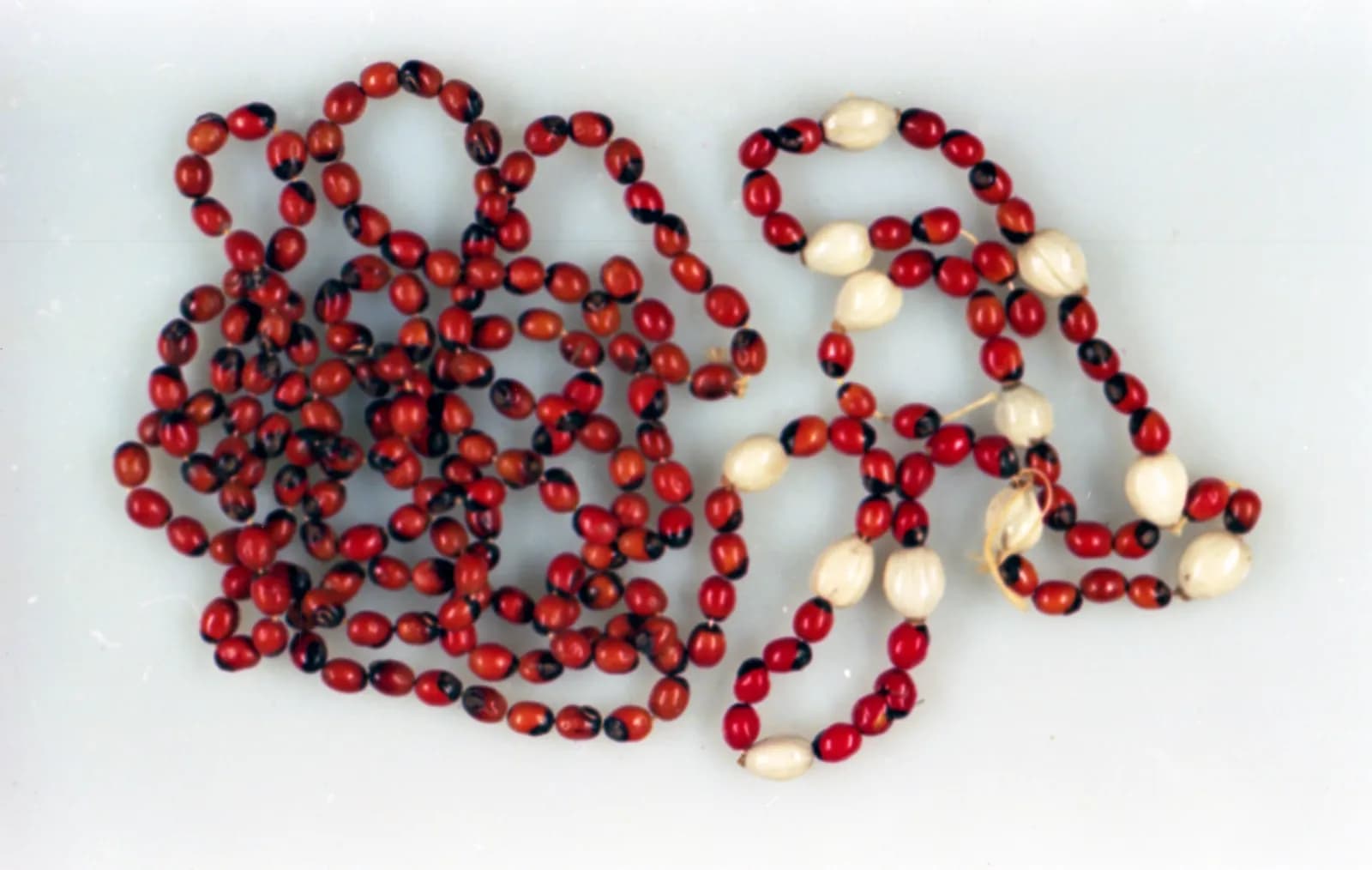
Hence gunja's place in service. Its berries are strung into garlands for Giriraja and for govardhana-shilas – following that very gift of Mahaprabhu, in which the shila and the gunja-mala stand together, like Krishna and Radha. One point deserves mention: in the Russian and English translations of the Chaitanya-charitamrita, gunja-mala is rendered as “a garland of small conchshells” – this is a translator's gloss; in fact it refers to a strand of red-and-black wild gunja berries, the very ones that grow on the creeper of Vraja.
Beyond Vraja
Gunja also enjoys a thoroughly worldly fame – as a unit of weight. The dictionary defines the name in just this way: “gunja” is both the shrub itself, with its red-and-black berry, and that same berry used as a jeweler's weight, the smallest in the set. Small and remarkably uniform, its seeds have served as this measure since ancient times: the famous “ratti” (Skt. raktika, krishnala).5 The Srimad-Bhagavatam says that the Syamantaka stone yielded eight bharas of gold daily, and it is the commentators who spell out the scale itself: four grains of rice make one gunja, five gunjas make one pana, and so on. The Hari-bhakti-vilasa knows this measure as well: even gold “the size of a gunja”, offered to Lord Vishnu, opens to the giver the abode of Indra until the very deluge. The berry that became an image of love in Vraja has remained, in the rest of India, a weight on the goldsmith's scales.
Ayurveda
Ayurveda recognizes two kinds of gunja – the red (rakta-gunja) and the white (shveta-gunja); the Raja Nighantu lists twenty-two synonyms for it. Both kinds are bitter in taste; the seeds are hot in nature, the roots act as an emetic, and the leaves relieve pain but are poisonous. The plant was used as a laxative and an emetic, as a tonic, and as a remedy for hair growth in baldness. That said, the seeds are genuinely toxic (they contain abrin) and must be purified by heat treatment – shodhana – before use. The Kashyapa Samhita mentions gunja among nasal antidotes for snakebite. And the same berry gives Ayurveda and the jeweler a shared unit of weight: one ratti-gunja is about 125 mg, and eight rattis make one masha.
Botany
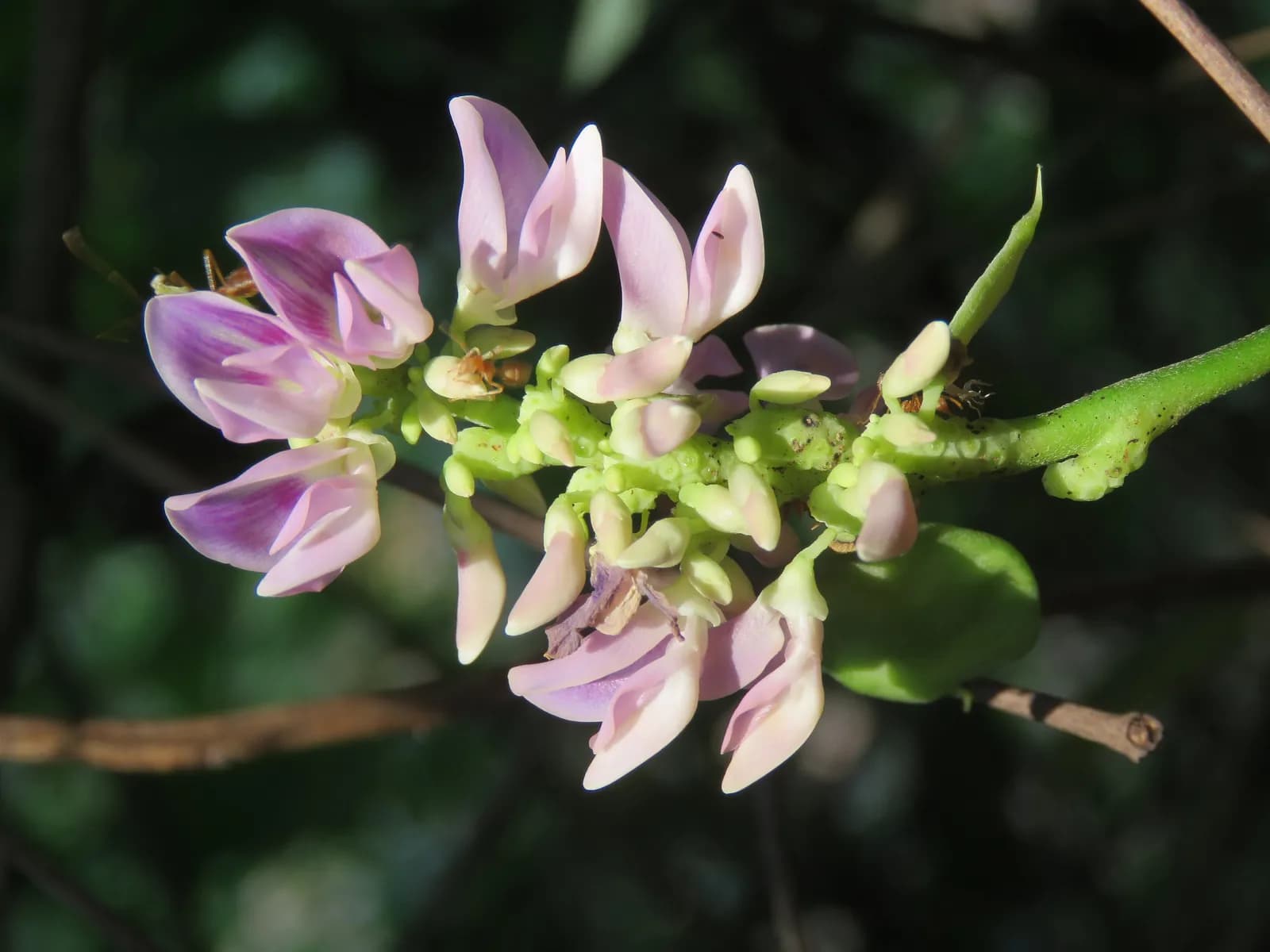
Gunja is Abrus precatorius, a woody twining climber of the Fabaceae (pea family, relatives of peas and beans). It climbs high on supports with its slender shoots; the leaves are alternate and paripinnate, made up of many pairs of small oval-oblong leaflets. The flowers are small and inconspicuous, violet to pink, borne in racemes. Its most distinctive feature is the seeds: 6–7 mm, glossy scarlet with a black spot at the hilum, like tiny ladybugs; everywhere they grow, they have been strung into necklaces and ornaments. In English the plant is called Rosary Pea, and its Latin name precatorius means “prayerful”. Gunja is not native to India alone: its native range stretches across tropical Africa and Arabia, through India and Southeast Asia, all the way to Australia, and it was introduced into the tropics of the New World.
Gunja: seed, pod, climber
Sources
We build Vrajapedia together – with stories, verses, photographs and parikrama experience. If you know something more, tell us and it will appear on this page.


