Udumbara
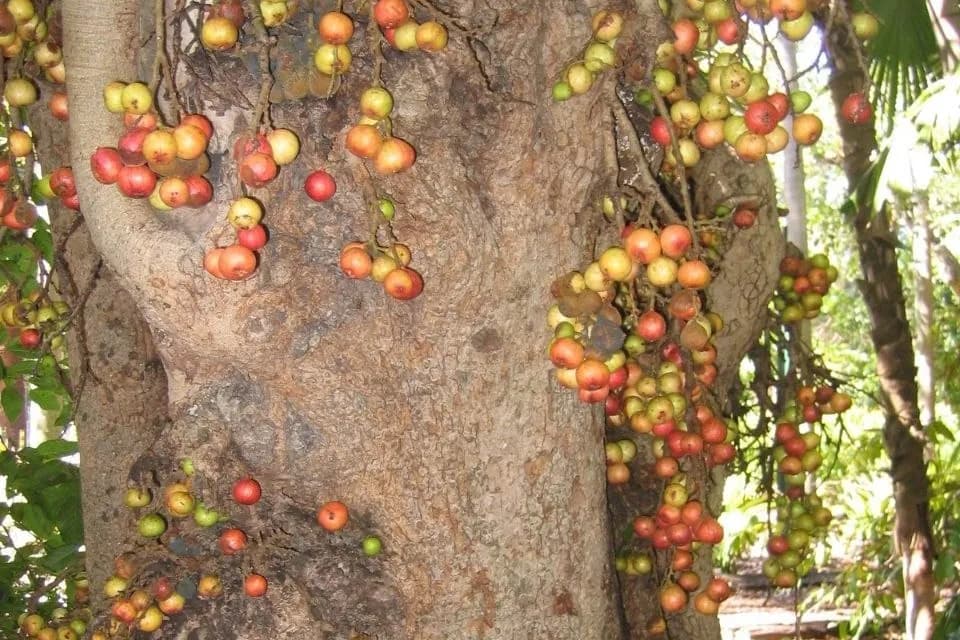
This tree seems to bear no flowers at all, while its fruits – reddish figs, kin to the common fig – cluster right on the trunk. Break one open, and inside you will find a swarm of tiny insects for whom it is an entire world. It was to this fruit that Akrura compared the universes he saw within Krishna in the waters of the Yamuna: they teem inside Him like gnats in a single fig. The tree’s second name is yajnanga, “a limb of sacrifice”: its wood is used for the Vedic altar.
Contents
The Tree in Vrindavan
The udumbara greets anyone entering the forest of Vrindavan for the first time. In Gopala-champu, Srila Jiva Gosvami describes how the cowherd boys and their mothers, stepping into an unfamiliar forest, set about identifying the trees. What is that tree whose leaves are all trembling? That is a pipal. And this one, all covered in long “locks”? A banyan. And that one over there, studded with millions of buds? – That is an udumbara1. And indeed, the clusters of its figs hug the trunk so densely that the tree seems covered in countless buds. And the pipal and the banyan – vata – identified in the same scene are sacred fig trees as well: the udumbara is one of their number.
Yet it was the fruit, not the appearance, that made the udumbara famous. When Akrura, driving Krishna and Balarama to Mathura, bathes in the Yamuna, the universal form of the Lord is revealed to him in the waters: within Krishna lie all the worlds with their gods and living beings. To express this, Akrura draws on an image from ordinary forest life:
tvayy avyayātman puruṣe prakalpitā
lokāḥ sa-pālā bahu-jīva-saṅkulāḥ
yathā jale sañjihate jalaukaso
’py udumbare vā maśakā mano-maye
“All the worlds, with their presiding demigods and teeming populations, originate in You, the inexhaustible Supreme Personality of Godhead. These worlds travel within You, the basis of the mind and senses, just as aquatics swim in the sea or tiny insects burrow within an udumbara fruit.”
This is no poetic license but a precise observation: the udumbara fig really is full of tiny pollinating fig wasps that spend their whole lives inside it and know nothing beyond it.
The commentators take the comparison further. Sridhara Svami observes that the insects inside an udumbara fig do not even know of one another – just so, countless universes move about within the Lord, each unaware of the others2. Srila Visvanatha Cakravarti Thakura adds that the tiny creatures in the fruit are beyond counting. And Srila Jiva Gosvami clarifies the comparison itself: the udumbara fruit here is the Lord Himself, who contains the universes within Himself3. Vallabhacharya adds in his Subodhini: just as the fig itself feels no weight from the thousands of creatures living inside it, so the Lord effortlessly holds all the worlds within Himself.
The Tree of Sacrifice
The udumbara's second name is yajnanga, “a limb of sacrifice” – a name its wood has earned. In Hari-bhakti-vilasa, describing the installation of the Deity, Srila Sanatana Gosvami prescribes performing the fire sacrifice with logs of five kinds of wood – palasha, udumbara, ashvattha, apamarga, and shami: they are offered into the fire by the thousands, and then the Lord's lotus feet are touched4. The same wood marks the boundaries of the ritual site: according to the Matsya Purana, the sacrificial mandala has four gates made of four kinds of ficus, the southern one of udumbara wood5.
And when undertaking a vow, a devotee, on the word of the sage Devala, takes an audumbara-patra full of water and, facing north, makes his promise6. What kind of vessel this is has been read in different ways: the word can mean either “made of udumbara wood” or simply “made of copper.” Sanatana Gosvami himself takes it in the second sense.
The tree is also linked to a rite that Krishna Himself underwent. When Krishna and Balarama received their sacred threads in Mathura, the rules assigned each class its own staff: palasha for a brahmana, bilva for a kshatriya, and udumbara for a vaishya7. Krishna appeared in a family of cowherds, and cowherds are vaishyas; about His own staff, however, the commentary is silent.
With the fruit, though, everything is different. The wood of the udumbara is revered as sacred for the altar, yet the fruit is barred from it: according to the Vishnu-dharmottara and the Kurma Purana, the udumbara fig is not to be offered to the Lord, and the scriptures declare a twice-born man who has tasted it fallen8. There is no contradiction here: the trunk is yajnanga, “a limb of sacrifice,” while the fruit is jantu-phala, “the fruit full of insects,” teeming with life and therefore unfit for offering.
Beyond Vraja
The udumbara also appears often in lists of the trees of heavenly gardens and holy mountains. It grows on Kailasa alongside the ashvattha, the plaksha, and the banyan9, and in the Ritumat garden on the slope of Trikuta, where celestial maidens sport, it stands among mandara, tamala, and arjuna trees10.
Ayurveda
In Ayurveda, udumbara is prized as an astringent and cooling remedy. Its fruit is astringent in rasa (taste) (kashaya), heavy and dry in guna (qualities) (guru, ruksha), cooling in virya (potency) (shita-virya), with a pungent vipaka (post-digestive effect) (katu-vipaka); this is precisely why it pacifies pitta and kapha. Sushruta and Vagbhata place udumbara in the nyagrodhadi gana – a group of astringent, wound-healing remedies headed by the banyan – while Charaka classes it among the urine-retaining remedies (mutrasamgrahaniya). The bark, the milky sap (latex), and the fruits, ripe and unripe alike, are all put to use: they stop bleeding, treat urinary disorders and diabetes, cleanse and heal wounds, and help broken bones knit.
Botany
Udumbara is Ficus racemosa (formerly Ficus glomerata) of Moraceae (mulberry family), a large fig tree known as the Cluster Fig and, in Hindi, as gular. It grows up to thirty meters tall, with a crooked trunk and a broad, spreading crown, and, unlike the banyan, it does not send aerial roots down to the ground. Its inflorescences are hidden inside each fig and are pollinated by tiny wasps that crawl in through a barely visible opening. Near water the udumbara stays evergreen, while in dry places it sheds its leaves by midwinter; it grows throughout the Indian subcontinent and remains a common tree both in the forest and on the outskirts of towns.
Udumbara in bloom
Sources
We build Vrajapedia together – with stories, verses, photographs and parikrama experience. If you know something more, tell us and it will appear on this page.


