Jamun
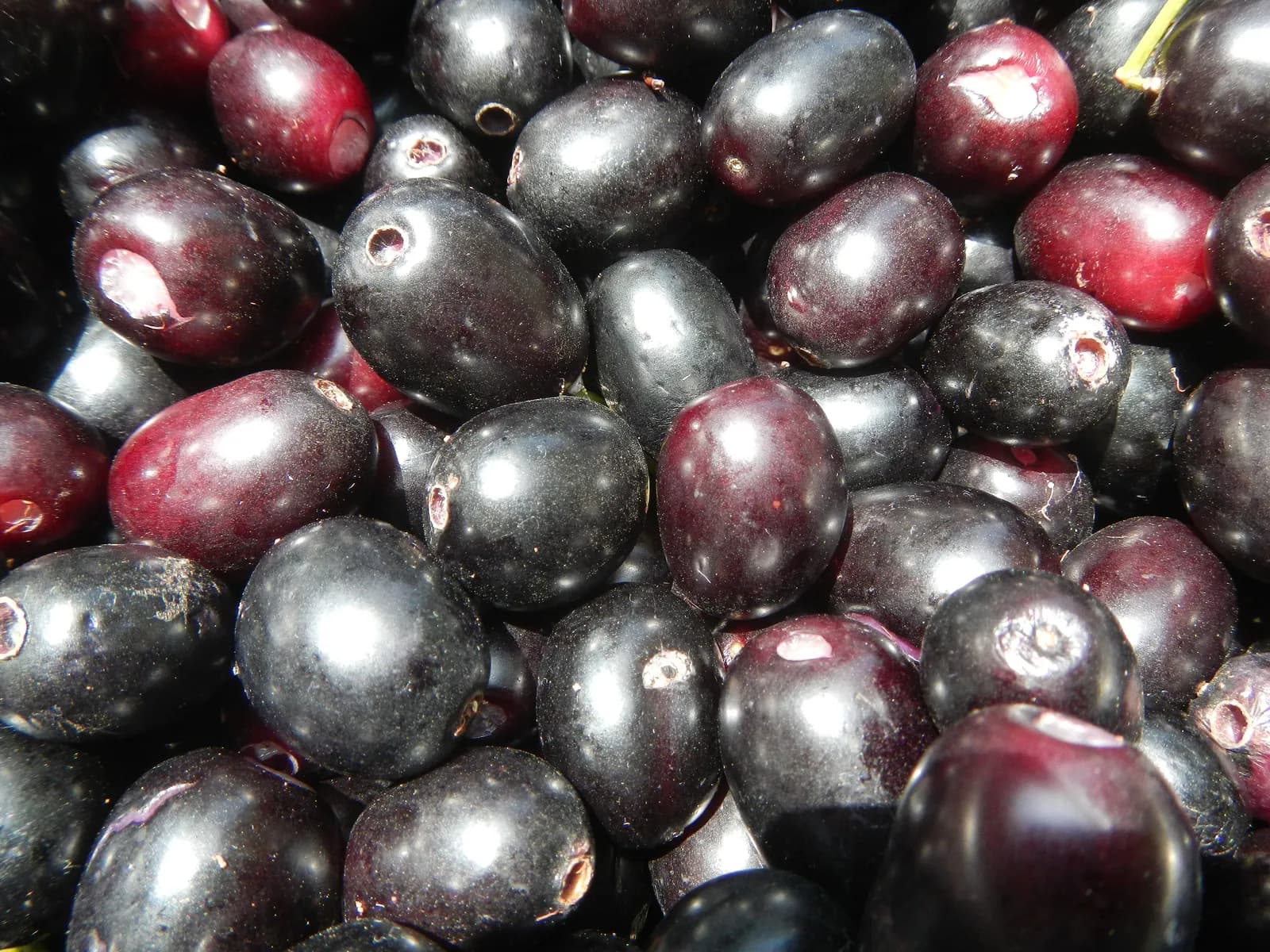
The tree that gave its name to an entire world: our whole island-earth is called Jambudvipa, “the island of the jambu,” after the colossal tree growing on the slope of Meru. Its fruit is deep purple, almost black, and when ripe it stains the tongue purple; a commentator on the Bhagavatam calls the jambu precisely that – kṛṣṇa-phala, “the dark-fruited one.” Kṛṣṇa itself means “dark.” That is why the jambu, known in Hindi as jamun, keeps the same dark company as the raincloud, the tamala tree, and the waters of the Yamuna. And that is also why, when the gopis, tormented by separation, wander along the riverbank searching for Krishna, they call out to this tree as well.
The Tree in Vrindavan
The night of the rasa-lila has ended, and Krishna has vanished. The gopis, mad with separation, wander through the forest and, finding no trace of Him, begin to question the trees: first the great ones – the ashvattha and the banyan, then those growing along the Yamuna. Among them is the jambu:
cūta-priyāla-panasāsana-kovidāra-
jambv-arka-bilva-bakulāmra-kadamba-nīpāḥ
ye ’nye parārtha-bhavakā yamunopakūlāḥ
śaṁsantu kṛṣṇa-padavīṁ rahitātmanāṁ naḥ
“O chuta, priyala, panasa, asana, and kovidara! O jambu, arka, bilva, bakula, and mango! O kadamba, O nipa, and all you other trees who live on the bank of the Yamuna for the sake of others – tell us where Krishna has gone: we have lost our minds.”
Silent Sages by the Holy River
Why do the gopis trust that the trees on the riverbank will not lie? The commentators answer with one voice: the trees by the holy river are like silent sages who stand motionless, their minds ever fixed on Vishnu. They are tirtha-vasis, dwellers of a holy place, and therefore truthful and compassionate. Srila Sanatana Gosvami adds that the Yamuna herself is Yamaraja's sister: just as her brother punishes sinners, she cannot bear to see others suffer – and so the trees nourished by her waters are full of compassion.
The commentator Vamsidhara, for his part, explains just what kind of tree this is: jambu is she whose fruit is black and whose leaf is glossy1. A tree bearing fruit the very color of Shyamasundara could hardly fail to notice the dark-hued cowherd boy.
In Vraja, the jambu grows not as solitary trees but in whole groves. When Srila Rupa Gosvami, in his drama Lalita-madhava, leads Radha along a familiar path, a jambu grove marks the way:
agre campaka-cakram asya purataḥ punnāga-vīthī tato
jambūnāṁ nikarambakaṁ tad abhitas tuṅgā kadambāṭavī
“Ahead lies a circle of champaka trees, beyond it a row of punnagas, farther on a dense grove of jambu, and beyond that a tall forest of kadamba: thus the broad path runs from the slope of Govardhan to the Kalindi.”
And, like every tree of Vrindavan, the jambu is a desire tree: it bears fruit all year round. Srila Rupa Gosvami names the jambu among the trees of Vrindavan in Ujjvala-nilamani, while in Srila Visvanatha Cakravarti Thakura's Krishna-bhavanamrita the sakhis gather ripe jambu fruits in the kunja, along with dates and grapes, and offer them to Radha and Krishna at a forest meal. The tree of longing on the riverbank becomes a tree of abundance in the kunja.
The Dark Fruit in the Poetry of Vraja
The dark, almost black color of the ripe jambu is an image the poets returned to again and again: in Vraja it is the color of Krishna Himself. Srila Rupa Gosvami describes the Yamuna, blue to the point of blackness, in exactly these words: “drink her waters, blue as the ripe jambu fruit”2. The river, the tamala, the raincloud, and Krishna's body all turn out to be one and the same color.
Srila Krishnadasa Kaviraja Gosvami offers a turn no one would expect. In Govinda-lilamrita, Radha, nestling close to Krishna, leaves a dark trace of her eye collyrium on His lips – and the lips become two ripe jambu fruits:
asyā dṛg-añjanālepāt pakva-jambū phalāyate
kṛṣṇādhare ’smin danto ’syā bubhukṣita śukāyate
“At the touch of Radha's eye collyrium, two jambu fruits seem to have ripened on Krishna's lips; and Her teeth, hungering for them, have become a parrot.”
The same dark fruit appears in descriptions of Radha's beauty as well: the Stavavali of Srila Raghunatha dasa Gosvami declares Her locks lovelier than a whole scattering of ripe jambu fruits3. The fruit plays yet another role. Among the signs by which the Lord's advent is recognized, and among the marks on Krishna's lotus feet, the shastras list the jambu-phala – a mark in the shape of this fruit4.
Chaitanya Mahaprabhu
The verse with which the gopis called out to the jambu and the other trees rang out again millennia later – this time from the lips of Sri Chaitanya Mahaprabhu. In the Antya-lila of the Chaitanya-charitamrita, Krishnadasa Kaviraja records the scene in which Mahaprabhu, overcome by the mood of the gopis separated from Krishna, himself addresses the trees: “O mango, O panasa, O priyala, jambu, and kovidara! You dwell in a holy place – so do good to others and show us where Krishna has gone.” What for the gopis was a cry of longing on the bank of the Yamuna became for Mahaprabhu a prayer of the heart – and with these verses the jambu entered the lore of Gauranga.
Beyond Vraja
In Vraja the jambu is one of the forest's many trees, yet in the structure of the universe it is one of a kind. On the slope of Mount Meru-Mandara grows a jambu tree whose fruits are the size of elephants; falling from a tremendous height, they burst open, and their juice flows as a whole river:
evaṁ jambū-phalānām … rasena jambū nāma nadī
meru-mandara-śikharād … nipatantī … ilāvṛtam upasyandayati
“The juice of the jambu fruits, which burst open as they fall from the summit of Meru-Mandara, forms a river named the Jambu-nadi, which floods all of Ilavrita-varsha.”
It is after this tree that all of Jambudvipa – “the island of the jambu,” our part of the universe – is named. And the silt on the banks of the Jambu-nadi, soaked with the juice and dried by the sun, turns into jambunada gold – the very gold from which the ornaments of the denizens of heaven are made. That is why in the poetry of Vraja “jambunada” came to mean simply the purest gold, and Srila Prabodhananda Sarasvati compares the radiance of Vrindavan to the luster of jambunada gold and emerald.
The name of Jambudvipa is also tied to a promise made by the Lord Himself. In the Gopala-tapani Upanishad Krishna says: “One who worships Me in the Deity form, whether in Mathura-mandala or anywhere else in Jambudvipa, is dearer to Me than anyone on earth.”5 The fruit itself is offered as well: the Hari-bhakti-vilasa lists the jambu among the fruits offered to Lord Vishnu – and one who honors Him with such gifts ascends at the end of life to the supreme abode.
Ayurveda
In Ayurveda, the jamun is, above all, the tree that fights the sweet disease. Its seed (bija) is a classic remedy for madhumeha, diabetes, and this remains its best-known use to this day. The fruit is astringent, sweet, and slightly sour in taste (kashaya, madhura, amla), light and dry in quality, cooling in potency (shita-virya), with a pungent post-digestive effect (katu-vipaka); this is why it pacifies pitta and kapha but may aggravate vata. Its astringent, binding nature (grahi) makes it a remedy for diarrhea and dysentery; the bark is used for women's ailments, and the leaves for disorders of the mouth and throat. The tree's Sanskrit names – mahaphala (“great fruit”), rajajambu, surabhipatra (“fragrant-leaved”) – say plainly what it is prized for: its large fruit and fragrant foliage.
Botany
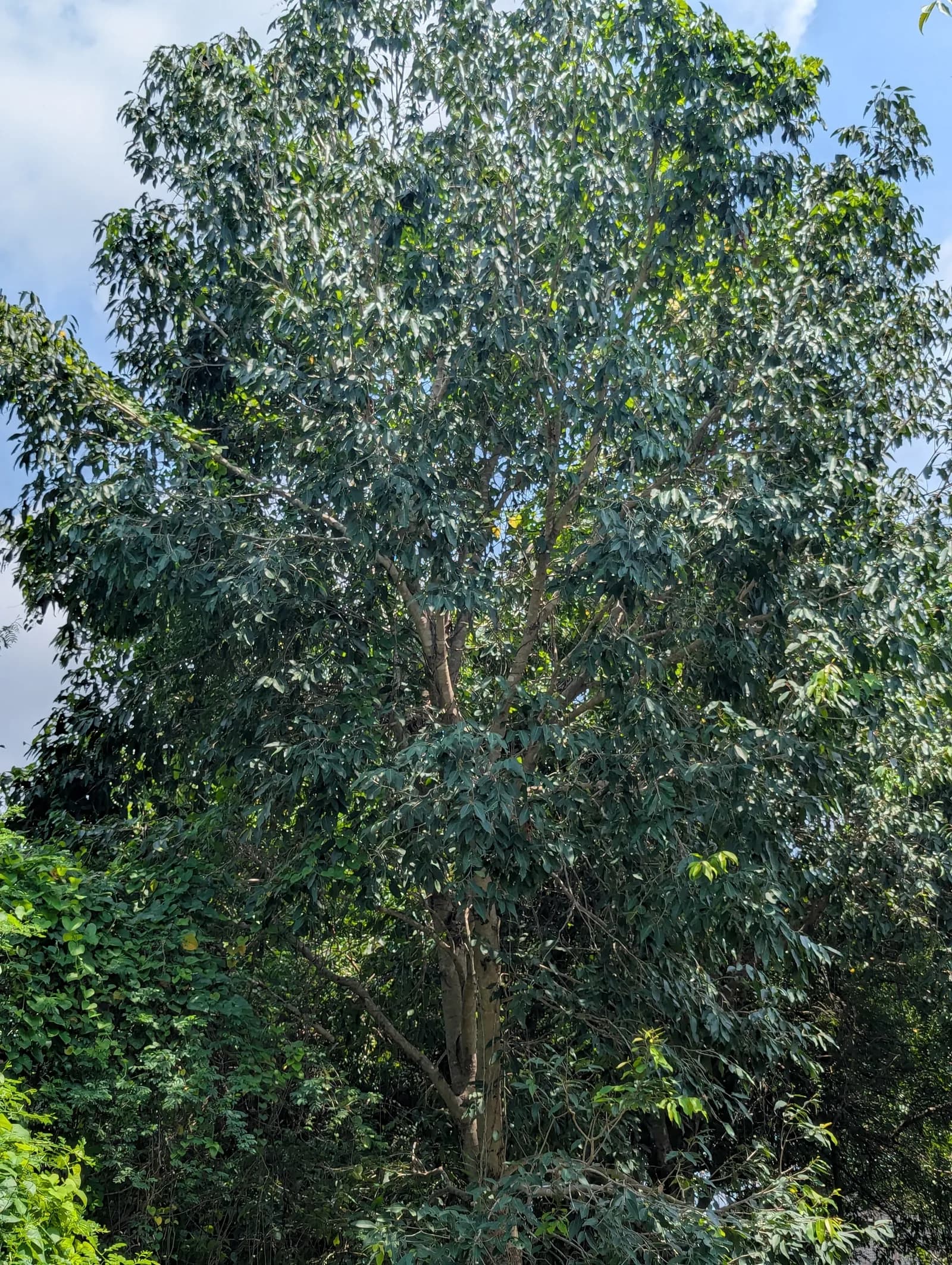
The jamun is Syzygium cumini of Myrtaceae (myrtle family, family of clove and eucalyptus), native from India and Sri Lanka to southern China, Indonesia, and northeastern Australia; it grows everywhere across the Indian subcontinent. The leaves are opposite, oblong, smooth, and glossy, with a faint terpene-like, “turpentine” scent. The berries turn from green to crimson-red and, when ripe, to glossy purple-black; their flesh is astringent-sweet and leaves on the tongue that telltale purple stain for which children all over Vraja love the tree.
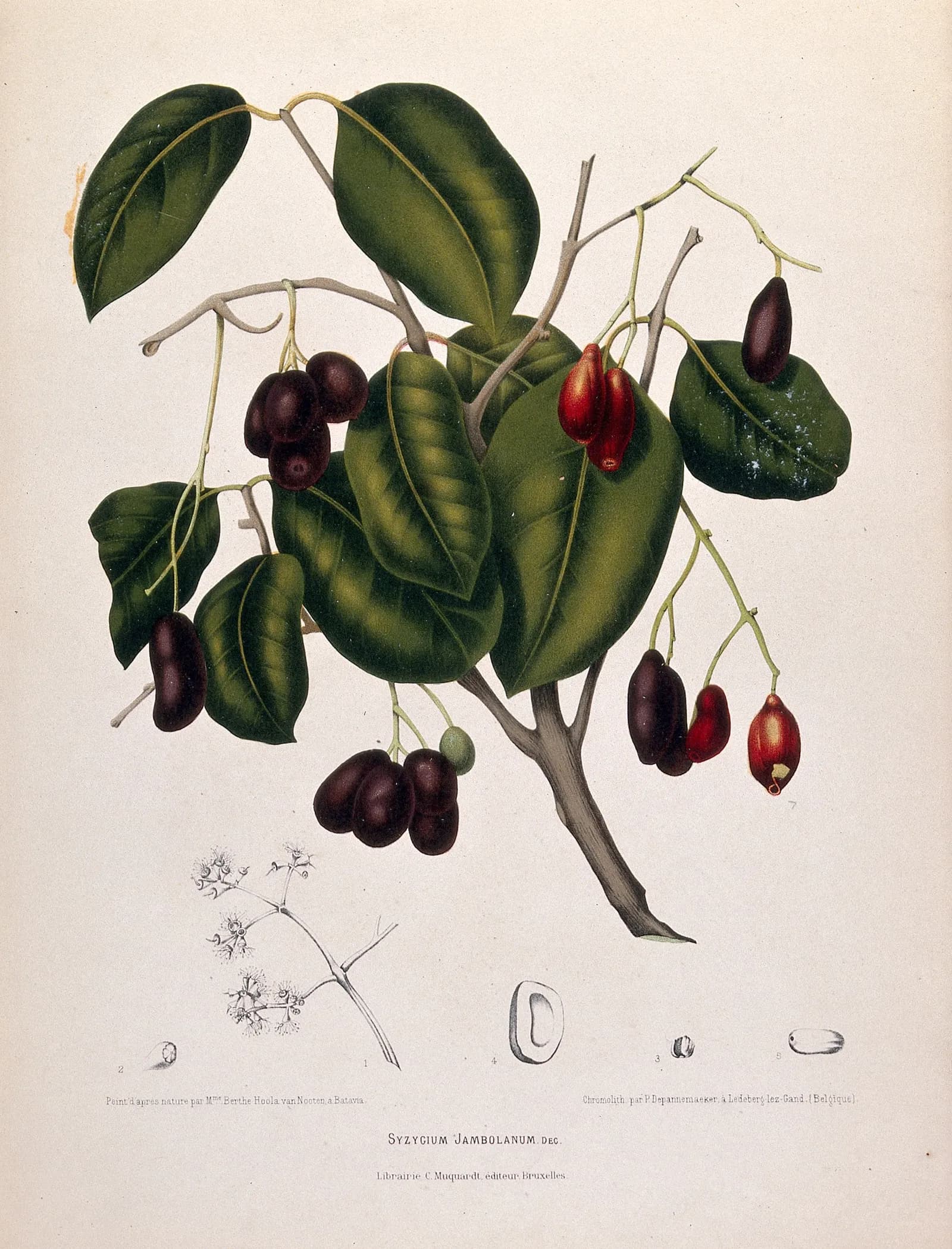
The jamun: flower, fruit, leaf, tree
Sources
We build Vrajapedia together – with stories, verses, photographs and parikrama experience. If you know something more, tell us and it will appear on this page.


