Red Sandal
In Vraja there are two sandals. The white one, fragrant, is ground into a cool paste and laid on the dark shoulders of Krishna, saving Him from the heat. The other has almost no scent, but it bleeds: cut it, and a red sap comes out. This second one is wanted in Vraja not for coolness but for colour. It enters the lila as the red pigment of a rite: together with a copper vessel and saffron Radha carries it from home – supposedly to worship the Sun. The red sandal grows in the bower of the gopi Tungavidya, in the same place as the lavanga.
Contents
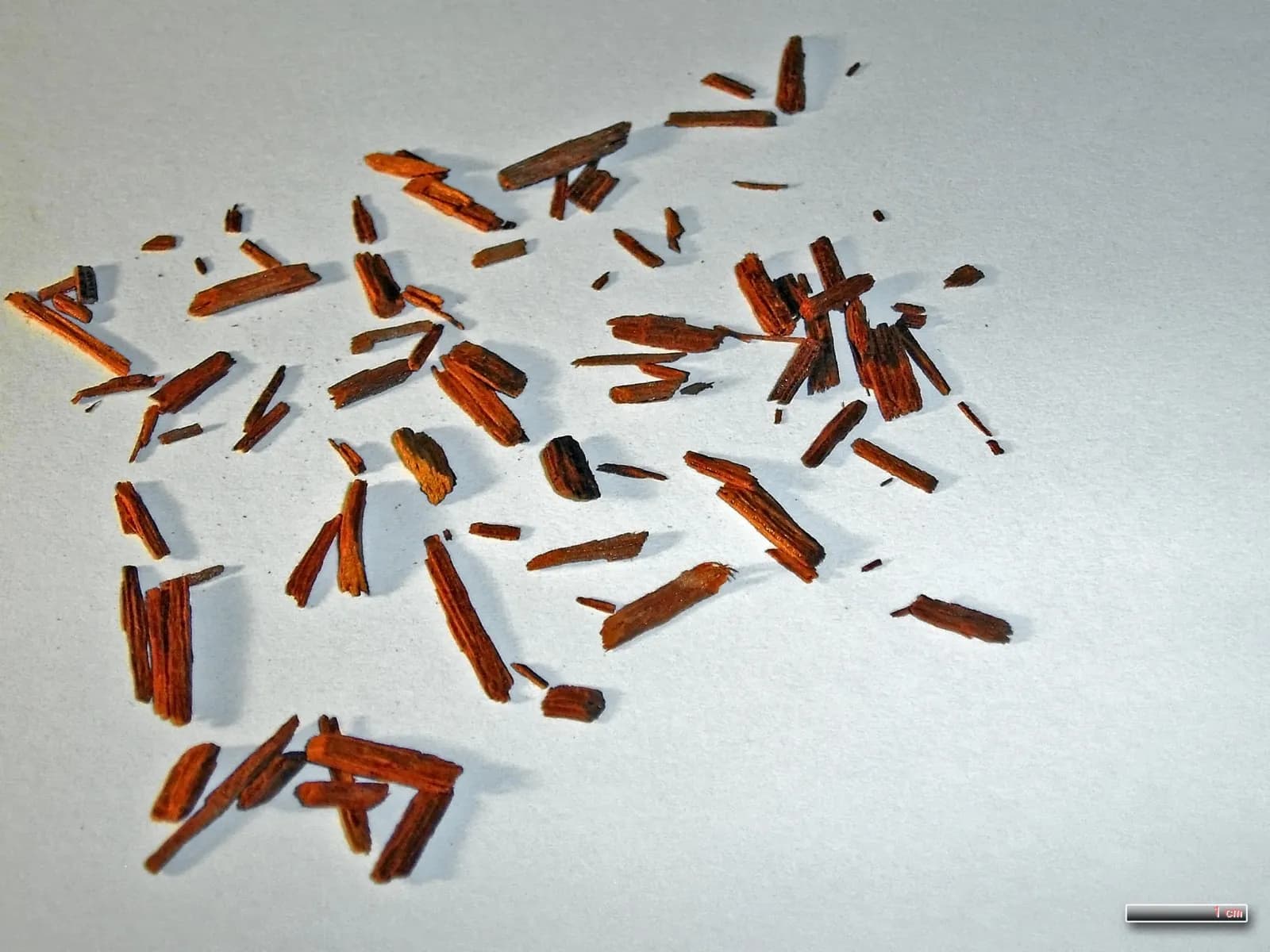
The Tree in Vrindavan
The white sandal is in constant use in Vraja: it is ground into gandha, a fragrant paste, and the body of Krishna is anointed with it; tilaka is made from it, and it goes into the chewing tambula. The red one is not used for anointing – it has almost no scent, and what is valued in it is not the smell but the colour. Hence in the shastras it stands not among the unguents but among the pigments and offerings.
And it grows in Vrindavan on a par with the other trees. In the Krishnahnika-kaumudi, where the trees of Vraja are listed whose sight kindles love in the hearts of the Two, the red sandal stands between the syandana and the kapittha, next to the kadamba, the shalmali semal and the mandara:
jambū-nimba-kadamba-śālmali-dhava-śrī-parṇikā-kiṁśukaiḥ |
kharjūrārjuna-marja-pīlu-khadiraiḥ śailūṣa-lodhrāsanair
dāru-syandana-rakta-candana-kapitthāśvattha-sat-pītanaiḥ ||
mandārair haricandanair agurubhiḥ santānakaiś campakaiḥ...
“…with the jambu, the nimba, the kadamba, the shalmali, the dhava, the shri-parnika and the kimshuka, with the date palm, the arjuna, the marja, the pilu and the khadira, with the shailusha, the lodhra and the asana, with the daru, the syandana, the red sandal, the kapittha, the ashvattha and the pitana, with the mandara, the heavenly sandal, the aguru, the santanaka and the champaka…”
But the red sandal comes to the fore in the scheme of the worship of the Sun. The strict mother-in-law of Radha, Jatila, would never let her daughter-in-law out of the house alone, but against a surya-puja, the worship of the Sun god, she has no defence: the pretext is too pious. And so Radha is fitted out for the road: in the Govinda-lilamrita Srila Krishnadasa Kaviraja Gosvami lists everything she is to take from home, and between the saffron and the garland of lotuses the word patraka appears in that list:
rādhe tvaṁ tāmra-kuṇḍīm aruṇa-kapilikā-kṣīra-dadhyājyam ijyaṁ
sārpiṣkānnaṁ javām aikṣavam atha ghusṛṇaṁ patrakaṁ padma-mālām |
sārdhaṁ sakhyā nayety ādy-upakaraṇa-cayaṁ putri gehād gṛhītvā...
“O Radha, take from the house a copper vessel, the milk of a red cow, curd, ghee, food cooked in ghee, java flowers, sugar, saffron, patraka and a garland of lotuses – go with your friend, and let Gargya or another brahmana youth skilled in rites perform the worship of the Sun for you.”
The Sanskrit commentary explains briefly: patrakaṁ rakta-candanam – “patraka is the red sandal”1. And it lies in the inventory beside the saffron and the hibiscus flowers.
Jatila’s care does not end there: in the next verse she instructs Lalita not to leave Radha alone anywhere there is “so much as the scent of the son of Nanda”. The warning proved vain: the “priest” at this rite will be Krishna Himself, dressed as a young brahmana of the line of Garga, and the decorous worship of the Sun will turn into a meeting of the Lovers.
The Red Sandal in Worship
The tree took its name from its colour. The commentator on the Ananda-Vrindavana-champu sets the rakta-candana in a row with words for shades of red – kuṅkuma, rudhira (blood), rakta – and remarks briefly: the names differ by colour2.
Its second Sanskrit name, though, carries a slight. The lexicons render ku-candana by the same “red sandal”, but it is made up of candana and the prefix ku-, which Monier-Williams marks as a sign of diminution, deficiency and reproach: not the right sandal, an inferior sandal. And so it is, if one judges sandal by scent – and not at all so, if by colour.
Hence its own service in worship. The white malayaja sandal is prescribed for the cooling paste with which the body of the Deity is anointed3, while the red is given the role of an offering: the Hari-bhakti-vilasa, the compendium of the rules of worship gathered by Srila Sanatana Gosvami, names the red sandal among the substances that, offered with love, bring good to a person:
kāleyakaṁ turuṣkaṁ ca rakta-candanam uttamam
nṛṇāṁ bhavanti dattāni puṇyāni puruṣottama
“Kaleyaka, turushka and red sandal are excellent; offered by people, O Purushottama, they become a source of merit.”
And where a rite calls for red, this sandal stands beside vermilion and turmeric.
How familiar this set was can be seen from a story of the youth of Shri Chaitanya Mahaprabhu. In Navadvipa the brahmana Gopala Chapala, angry at the kirtans in the house of Shrivasa Thakura, laid at his door a banana leaf with the paraphernalia for the worship of the goddess – turmeric, vermilion sindura, red sandal and rice – and set a pot of wine beside it4. In the morning Shrivasa called the neighbours together and announced that all of it was his own, for the worship of Bhavani – and the scheme of Gopala Chapala came to nothing.
Ayurveda
A cooling power belongs to both sandals: Ayurveda counts both the white and the red as cold in vīrya. Only the white cools by its scent as well, and for this it is ground into a paste for the body, while the cold of the red is without fragrance. Its taste (rasa) is bitter and sweet, its aftertaste (vipāka) pungent; it quenches pitta and kapha.
Hence it goes against heat: the classical texts, from the Charaka-samhita to the Madhava-chikitsa, put it into remedies for fever and for disorders of the bowels, and give it for burning, bleeding and vomiting. The heartwood ground into a paste is what is used – both as medicine and as a cooling, colouring salve for the skin. Only one must not confuse things: the same name is sometimes given to saffron and to sappanwood as well, so in an old recipe it is worth looking at which “red” is meant.
Botany
The red sandal is Pterocarpus santalinus, and its kin are not the white sandal but the pea and the bean. Its crown is dense and rounded; with age the bark runs into deep cracks that break it into rectangles, and from a cut a dark red sap oozes. The leaves are leathery, of three leaflets, more rarely of four or five. The fruit gives away the legume stock and explains the name of the genus: Pterocarpus is Greek for “wing-fruit” – an oblique rounded pod together with its wing. But the main thing is hidden in the trunk: the heartwood is heavy and extremely hard, orange-red on a fresh cut, darkening with time almost to black. It has almost no scent – in this it differs from the fragrant white sandal (Santalum album); in the old pharmacopoeias, into which the red sandal came as a raw material for dye, it was written just so: “almost odourless”. The tree is an endemic: it grows only in the south of the Eastern Ghats – the range along the eastern coast of India – and keeps there to dry stony hills, from 150 to 1000 metres above sea level; for its red wood it was carried far beyond India for centuries (in China it is known as zitan), and for this reason the wild red sandal is now on the IUCN Red List and protected by CITES.
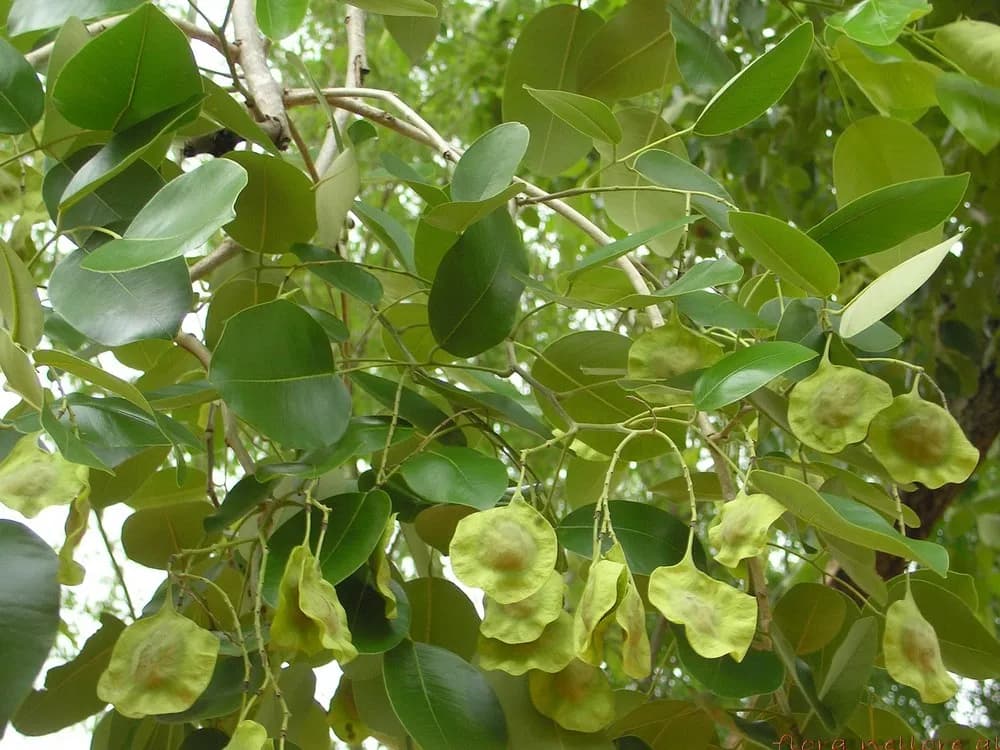
Red sandal: the tree, the wood and the fruits
Sources
We build Vrajapedia together – with stories, verses, photographs and parikrama experience. If you know something more, tell us and it will appear on this page.


