Semal
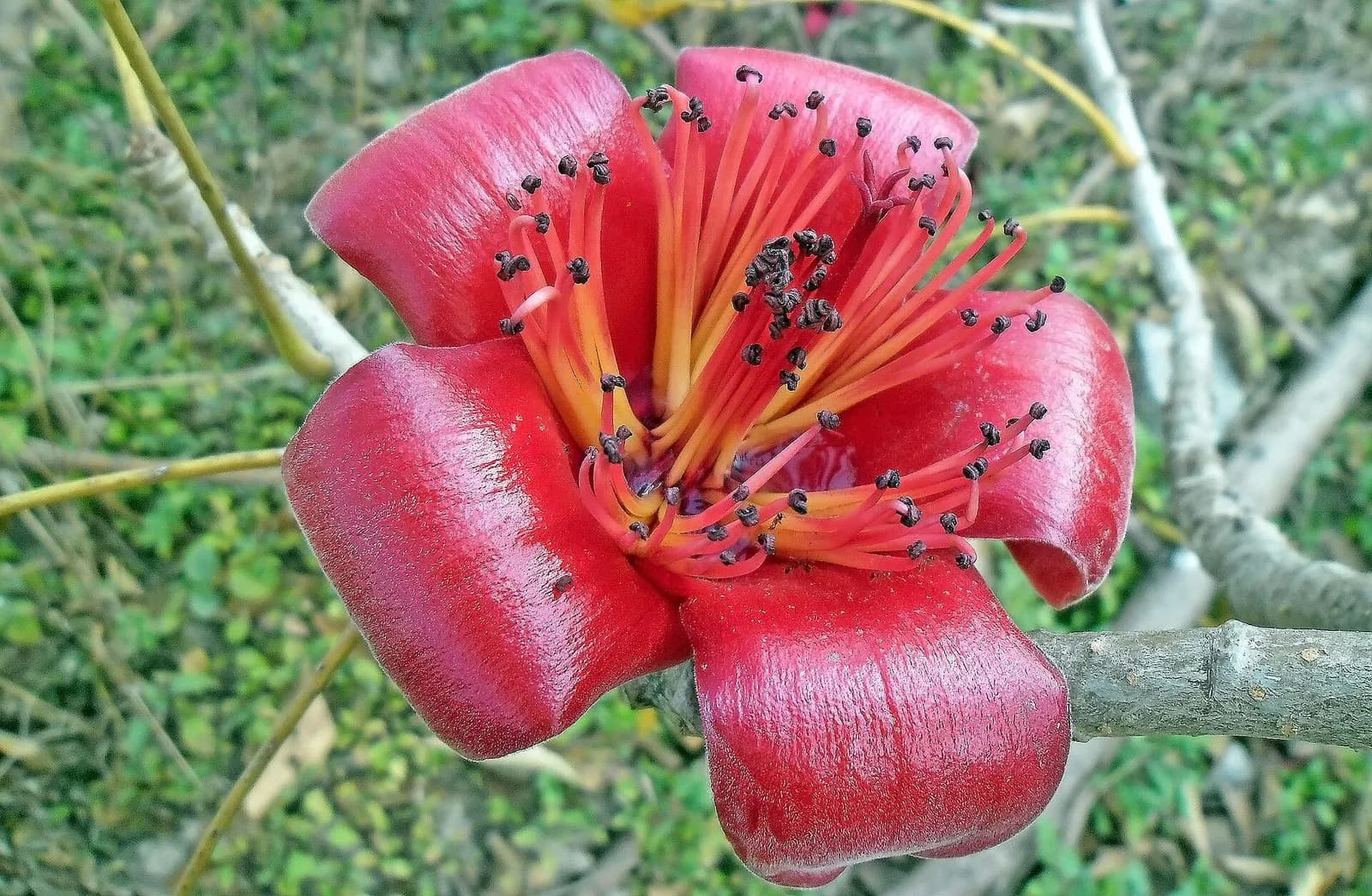
A huge tree with a thorny trunk that in the depth of winter bursts into large scarlet flowers. The semal has a poor name: its flower may not be laid on an altar, and the shastras gave its name to a whole hell of thunderbolt spikes. Yet in Vrindavan it stands among the trees of desire, and in the expanses of the universe its namesake is a colossal tree on which the king of birds, Garuda, sits chanting the Vedas.
The Tree in Vrindavan
This is an uncomfortable tree: it shoots up above its neighbours, the trunk of a young one is set with hard spines, and its timber is so light and weak that it goes into little more than matches and plywood. And yet in Vrindavan the semal stands among the holy trees. Speaking of what kindles the mood of love here, Srila Rupa Gosvami quotes from the Krishnahnika-kaumudi of Srila Kavikarnapura a long list of trees, and the semal goes in it beside the tamal, the kadamba and the scarlet palasha-kimshuka:
akṣa-plakṣa-rasāla-tāla-sarala-nyagrodha-tāpiñchakair
jambū-nimba-kadamba-śālmali-dhava-śrī-parṇikā-kiṁśukaiḥ
“…[Vrindavan, adorned] with the trees aksha, plaksha, rasala (mango), tala, sarala, nyagrodha, tapinchha (tamal), jambu, nimba, kadamba, semal, dhava, shri-parnika, kimshuka…”
Trees of Desire
In Vrindavan there are no “low” trees: Srila Prabodhananda Sarasvati says it again and again – the trees here are kalpa-taru, trees of desire, whose bodies are woven of bliss, and whose flowers serve the joy of Radha and Krishna. In this forest the semal ceases to be a thorny giant of the roadside.
Each of the closest friends of Radha has a grove of her own, and the semal, by tradition, grows in the bower of Tungavidya, where Lavanga-manjari – the eternal form of Srila Sanatana Gosvami – renders service.
Worship
But the flower of the semal may not be laid on an altar, for all its beauty. Considering which flowers are fit for the service of the Lord and which are not, Srila Sanatana Gosvami in the Hari-bhakti-vilasa gives the prohibition:
kūṭajaṁ śālmalī-puṣpaṁ śirīṣaṁ ca janārdane
niveditaṁ bhayaṁ cograṁ niḥsattvaṁ ca prayacchati
“The flower of the kutaja, the flower of the semal and the flower of the shirisha, offered to Janardana, bring dreadful misfortune and take away one’s strength.”
Beyond Vraja
The true scale of the semal is in cosmology. The Fifth Canto of the Bhagavatam, describing the structure of the universe, calls one of the seven great islands Shalmalidvipa, “the island of the semal”: in the midst of it stands the tree shalmali – so the semal is called in Sanskrit. That tree is unimaginably great, and upon it is the abode of Garuda:
yatra ha vai śālmalī plakṣāyāmā yasyāṁ vāva kila nilayam āhur
bhagavataś chandaḥ-stutaḥ patattri-rājasya sā dvīpa-hūtaye upalakṣyate
“On Shalmalidvipa there grows the shalmali tree, from which the island took its name. This tree is as great as the plaksha tree – a hundred yojanas wide and eleven hundred high. Learned men say that this gigantic tree is the abode of Garuda, the king of all birds and the carrier of Lord Vishnu. Upon this tree Garuda offers Lord Vishnu the Vedic prayers.”
Sridhara Swami, and after him Srila Vishvanatha Chakravarti Thakura, explain why Garuda is called chandaḥ-stut, “praised by the metres of the Vedas”: the very limbs of his body are the poetic metres with which he glorifies Vishnu.
And close by, in the same canto, the semal has a wholly different role. Among the hells to which Yamaraja sends sinners there is Vajrakantaka-shalmali:
yas tv iha vai sarvābhigamas tam amutra niraye vartamānaṁ
vajrakaṇṭaka-śālmalīm āropya niṣkarṣanti
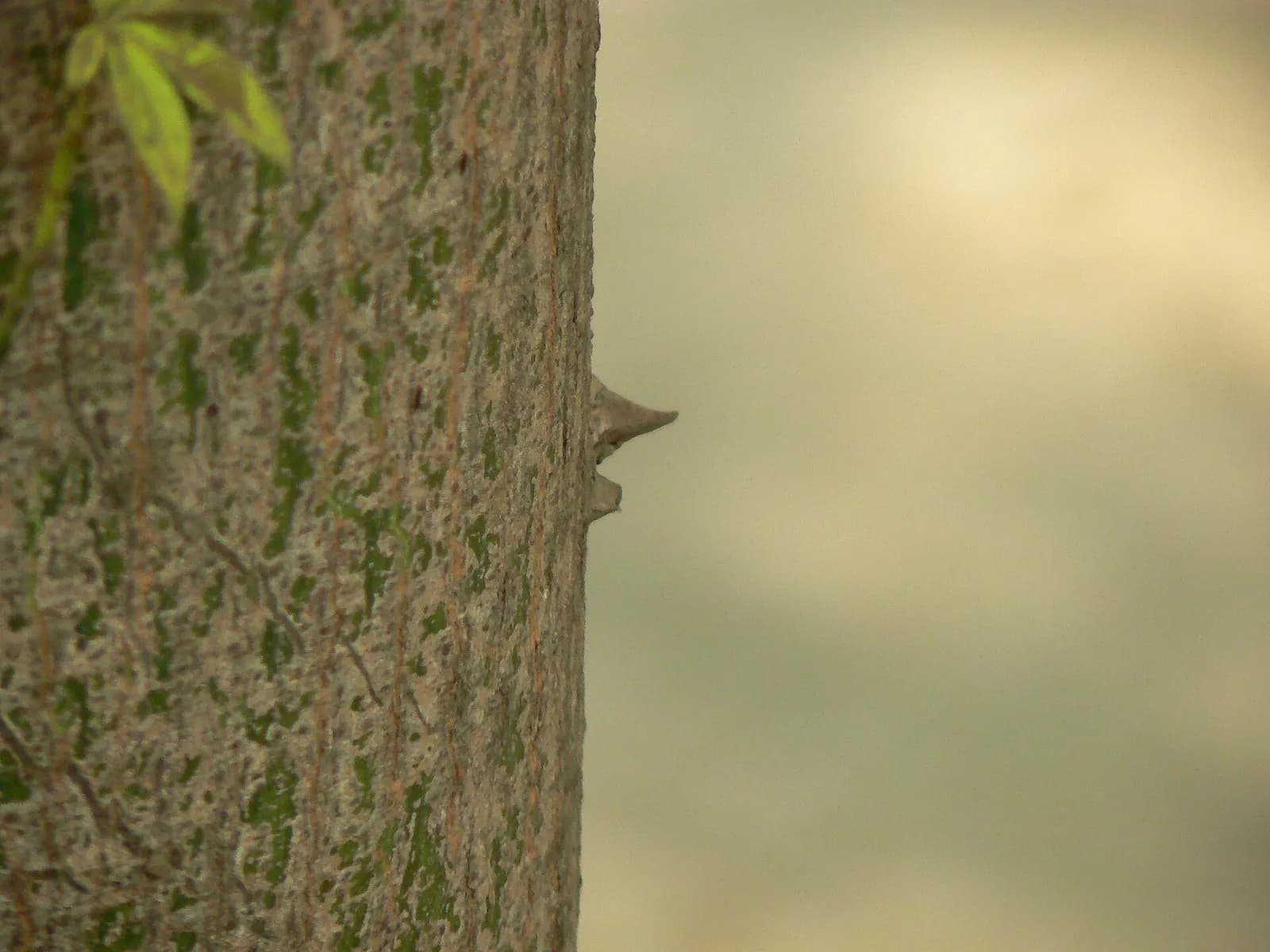
“…after death he falls into the hell Vajrakantaka-shalmali. There grows a huge silk-cotton tree, all covered with spines as sharp and mighty as thunderbolts. The servants of Yamaraja hang the sinner upon this tree and then drag him down by force, so that these spines tear his whole body, causing him dreadful pain.”
A Thread to the Heart of Vraja
Those very spines that bristle on the trunk of the earthly semal have here become an instrument of punishment.
A thread stretches from the island of the semal to the heart of Vraja as well. According to the Garga-samhita, the hill Govardhan was born not in Vraja but on far-off Shalmalidvipa, west of Bharata-varsha; the sage Pulastya, captivated by the beauty of the hill, begged for it and carried it with him, but set it down on the way in Vraja, where Govardhan has remained for ever1.
And in the hymn of the names of Krishna from the same Garga-samhita the Lord is called Shalmali as well, the lord of the island of the semal2: the name of the tree that may not be offered to Him turned out to be one of His own names.
Ayurveda
Ayurveda values the semal for its coolness and its nourishment. The Bhavaprakasha calls it śītala, cooling, and puts it among the rasāyana, the means of rejuvenation: its seeds are oily, it builds up the tissues, and it pacifies disorders of the blood and of pitta.
Different parts are used: the scarlet flower stops bleeding, the gum mocha-rasa, weeping from the bark, checks diarrhoea, and the root of a young tree, known as semal-musli, goes into strengthening preparations. Charaka counts the semal among the greens, the śāka-varga: parts of the tree are eaten as a vegetable.
Botany
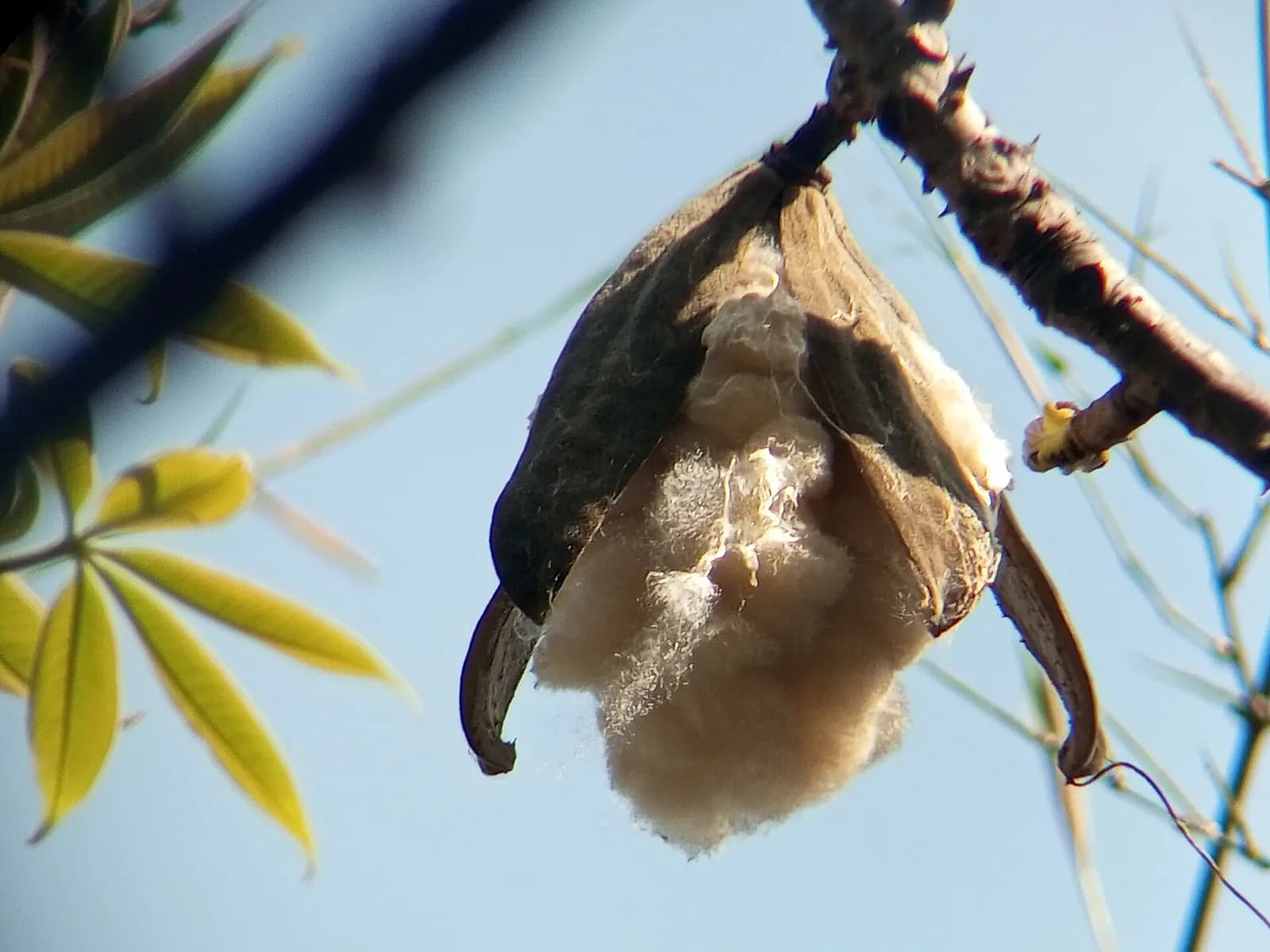
The semal is Bombax ceiba; the old lexicons call it the tūla-vṛkṣa as well, “the tree of cotton wool”. It is one of the largest trees of the Indian plain: at the base the trunk spreads into mighty buttresses, on a young tree it is set all over with black conical spines, and on an old one they wear away. The leaf is palmate, of five to seven leaflets in a fan on a long petiole. After flowering the oblong capsules ripen; bursting, they release a cloud of silky white floss – Malabar kapok. The floss does not soak or sink, and insects do not touch it. The homeland of the semal is wide: from Pakistan and India to southern China, Indonesia, New Guinea and northern Australia.
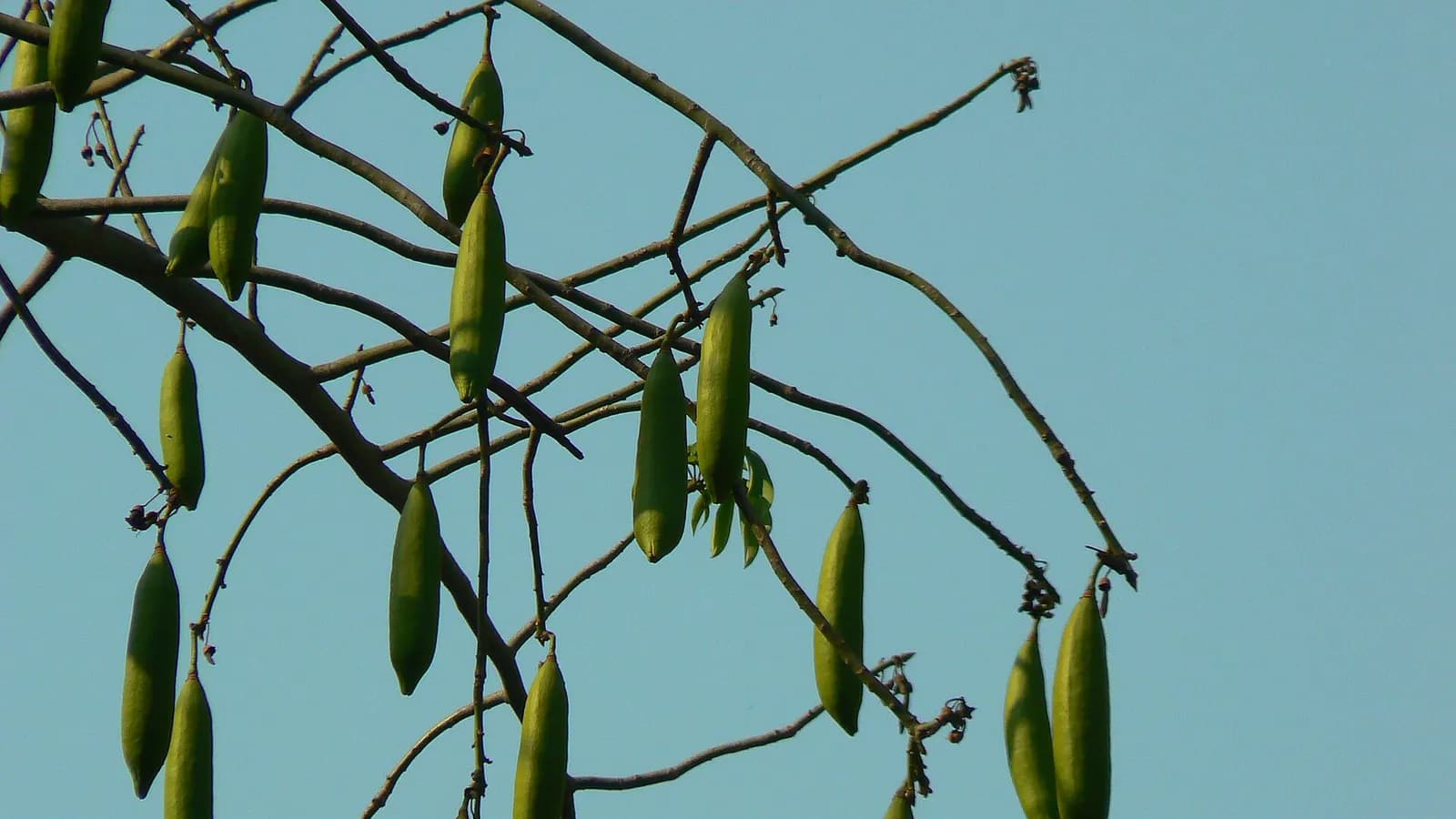
Semal: the tree, the flowers and the trunk
Sources
We build Vrajapedia together – with stories, verses, photographs and parikrama experience. If you know something more, tell us and it will appear on this page.


