Lavanga
Lavanga is the clove: the dried buds of a tropical tree, the spice everyone knows. But in Vraja something else grows under that name. The lavanga-lata, “the lavanga vine”, drapes in a fragrant curtain the bowers where Radha and Krishna meet – it is with it that Srila Jayadeva Gosvami begins his song of the Vrindavan spring. And Lavanga-manjari, “the blossom of the lavanga”, is the name of an eternal maidservant of Radha; in the Gaura-lila this is Srila Sanatana Gosvami. The clove tree familiar to us does not grow in Vraja and is never a vine: Sanskrit calls two different plants by one root.
Lavanga in Vrindavan
The Vrindavan spring opens with the lavanga in poetry. Srila Jayadeva Gosvami in the Gita-Govinda begins his song with it – with the vines that the warm southern wind runs through:
lalita-lavaṅga-latā-pariśīlana-komala-malaya-samīre
madhukara-nikara-karambita-kokila-kūjita-kuñja-kuṭīre
viharati harir iha sarasa-vasante
nṛtyati yuvati-janena samaṁ sakhi virahi-janasya durante
“My dear friend. Alas, springtime is excruciating for the forlorn and lonely-hearted. The Malaya breeze is so enchanting as he arrives and impetuously embraces the tender, charming clove creepers again and again. The forest bower is permeated with the sweet cooing of the cuckoos and the drone of bees. And Krishna is dancing in this forest bower, enjoying pastimes with the young ladies, immersed in a festival of love.”
The Vine by the Bower
The breeze, already cool and fragrant, becomes gentler still from the touch of these vines, the commentary explains, and it paints the vines themselves as tightly embracing the trees. On that breeze, in that bower, Krishna carries on His spring pastime.
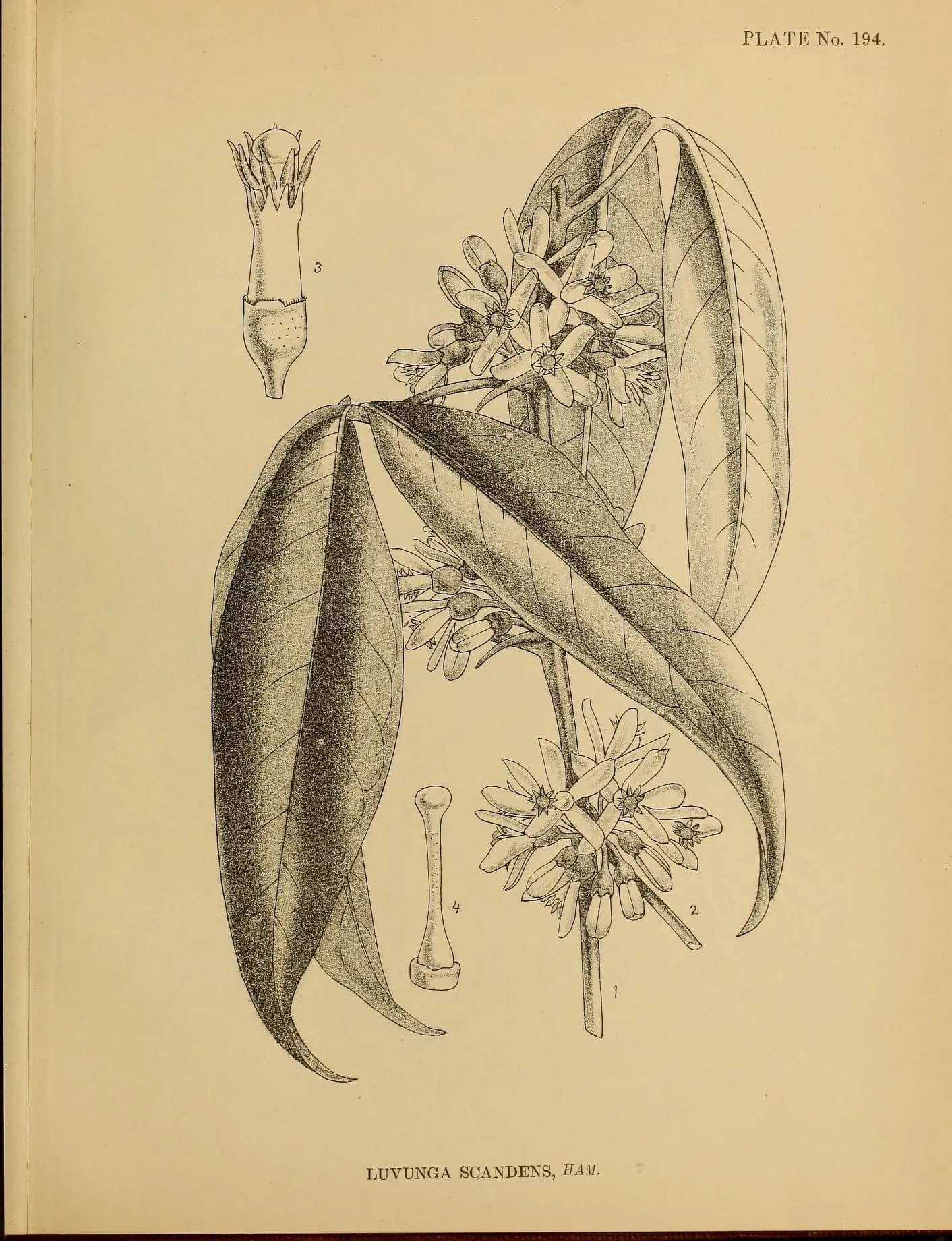
This vine is not the clove tree: that grows only in the wet tropics and is never a climber. Behind the name lavanga-lata in Sanskrit stands a plant of its own, a climbing vine of the rue family; more of that at the end of the article. In the verses one word sounds, and both are heard in it.
And this vine does not merely grow by the bower. In the Vidagdha-Madhava Srila Rupa Gosvami brings on Vrinda-devi, who before the coming of the Couple orders all the vines of the grove to bloom at once, the lavanga among them:
smitaṁ vitanu mādhavi prathaya malli hāsodgamaṁ
mudā vikasa pāṭale purata-yūthi nidraṁ tyaja
prasīda śata-patrike bhaja lavaṅga-valli śriyaṁ
dadhāra saha rādhayā harir ayaṁ vihāra-spṛham
“Smile, madhavi; laugh, malli; open in joy, patala; wake, golden yuthi; be gracious, lotus – show your beauty, clove vine: for Hari has desired to play here with Radha.”
The flowers of this vine adorn Radha Herself as well. In a song that Rupa Gosvami puts in Her mouth, She is in the mood of a svadhina-bhartrika – one who tenderly commands her Beloved – and asks Krishna:
piñcha-mukuṭa mama piñcha-nikāśam varam avataṁsaya kuntala-pāśam
atra sanātana śilpa-lavaṅgam śruti-yugale mama lambhaya saṅgam
“O You who wear a crown of peacock feathers, adorn My braids that are like a peacock's tail; and here, O unchanging one, fasten skilfully to both My ears these clove flowers.”
The Flower in Service
This flower is so light that it betrays the least trembling: in the neighbouring song, the moment Krishna comes near, the lavanga falls from Radha's trembling fingers1. And earrings are made for Her from the same blossom – “clove earrings of unprecedented beauty”, lavanga-manjari2. In that word one already hears a name that in Vraja belongs to no flower at all.
The lavanga goes into garlands too. Srila Sanatana Gosvami in the Brihad-bhagavatamrita lists the flowers from which the cowherd boys in the spiritual abode weave ornaments for Krishna, and the lavanga stands there beside the tulasi, the madhavi and the jasmines3.
Lavanga-manjari
Manjari is an unopened bud, a blossom; and so the young maidservants of Radha are called as well – those whom Srila Narottama dasa Thakura names “the buds of the wish-fulfilling vine in the form of Sri Radhika”. One of them bears the name of this flower – Lavanga-manjari – and in the Gaura-lila this is Srila Sanatana Gosvami. Srila Kavikarnapura says so outright:
lavaṅga-mañjarī yāsīc chrīmad-vṛndāvane purā
rūpāgrajo 'bhavat so 'dya gosvāmī śrī-sanātanaḥ
“She who was formerly Lavanga-manjari in Sri Vrindavan has now appeared as Srila Sanatana Gosvami, the elder brother of Rupa Gosvami.”
The First of the Messengers
Her portrait is preserved in the Prema-bhakti-chandrika with its commentary: in the colour of her body she is like a flash of lightning, her dress is woven over with stars, and her service is to gladden Sri Krishna. She lives to the east of the kunja of Tungavidya, in a bower named Lavanga-sukhada. And her place among the maidservants is told most precisely by one detail: Lavanga-manjari is older than Rupa-manjari by exactly one day4.
In the Ujjvala-nilamani Rupa Gosvami, setting out which of the maidens serve as messengers between Radha and Krishna, names her first of all:
lavaṅga-mañjarī-bhānumaty-ādyāḥ paricārikāḥ
“Maidservants such as Lavanga-manjari and Bhanumati act as messengers.”
And Srila Vishvanatha Chakravarti Thakura adds in his commentary: “Among all the maidservants Lavanga-manjari is the most honoured; this cannot be hidden. And in the Ganoddesha-dipika she is named one of the foremost.” That is why the rupanuga Vaishnavas pray to her on a par with Rupa-manjari: Narottama dasa Thakura calls Rupa and Lavanga-manjari – that is, Rupa and Sanatana Gosvami – the very embodiment of ujjvala-rasa, the brilliant rapture of love, and Vishvanatha Chakravarti asks: “O Lavanga-manjari, you have fallen into the flood of prema – grant me then your nectarean glance”5.
Worship
On the altar, however, it is the spice itself that serves Krishna. Srila Sanatana Gosvami in the Hari-bhakti-vilasa puts the clove into the tambula, the fragrant betel chew offered to the Lord to refresh His mouth, and into the water for achamana, the rinsing of the mouth, beside nutmeg and kakkola; and in the list of flowers dear to Keshava the lavanga stands together with the atimuktaka-madhavi.
In the Govinda-lilamrita a whole day of the Divine Couple is steeped in lavanga – from the garlands and the scented water to the sweets and the tambula; and one of the bowers, built in the form of a scarlet lotus, is wholly wound about with its flowering vines.
Chaitanya Mahaprabhu
In the Gaura-lila the clove is a sign of closeness and care as well. After a meal Mahaprabhu is offered clove with tulasi blossoms as mukha-vasa, a mouth freshener: so does Advaita Acharya, receiving Him with Nityananda at his home, and so does Sarvabhauma Bhattacharya. And mother Shachi rolls sweet balls for Him of clove, camphor and pepper. Once Mahaprabhu even takes these spices for a teaching: sugar, camphor, clove, cardamom are in themselves things “prakrita”, worldly, but by the touch of Krishna they become fully spiritual.
But the closest bond with Mahaprabhu belongs not to the spice but to that same clove vine. Of all the verses of the Gita-Govinda it is the line lalita-lavaṅga-latā, the one that opens the Vrindavan spring, that He told His companions to sing, while He Himself danced to it, unable to stop6.
Ayurveda
Ayurveda values the clove as lavanga or devakusuma, “the flower of the gods”. Its taste (rasa) is pungent and bitter, and its potency (virya) – for all its heat – cooling; it pacifies kapha and pitta and evens out the movement of vayu. The dried buds are what is used: they are given for indigestion, cough and excess mucus, for diarrhoea, they go into the strengthening chyavanaprasha, and they are held in the mouth as a freshener and a help to digestion.
Botany
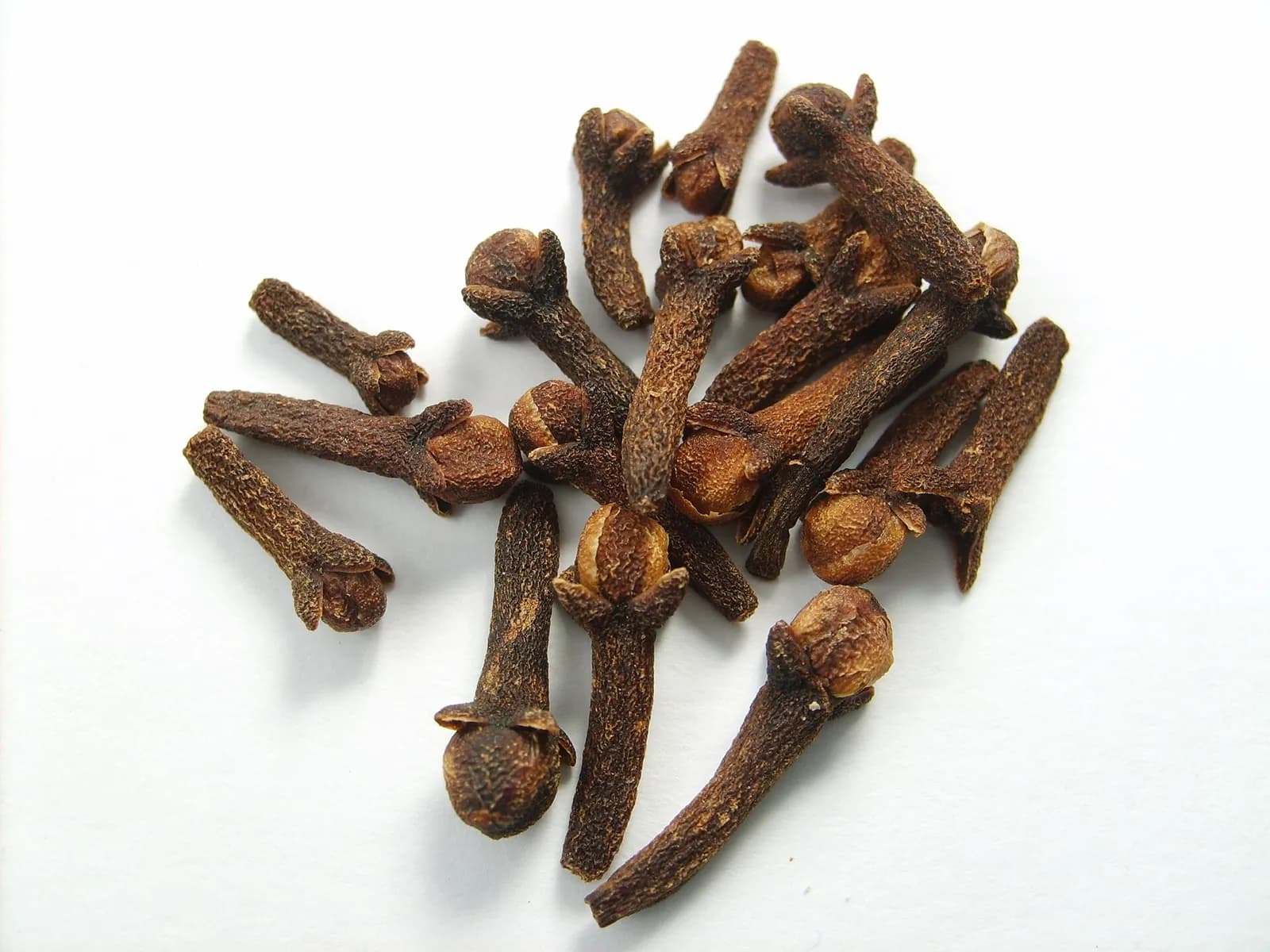
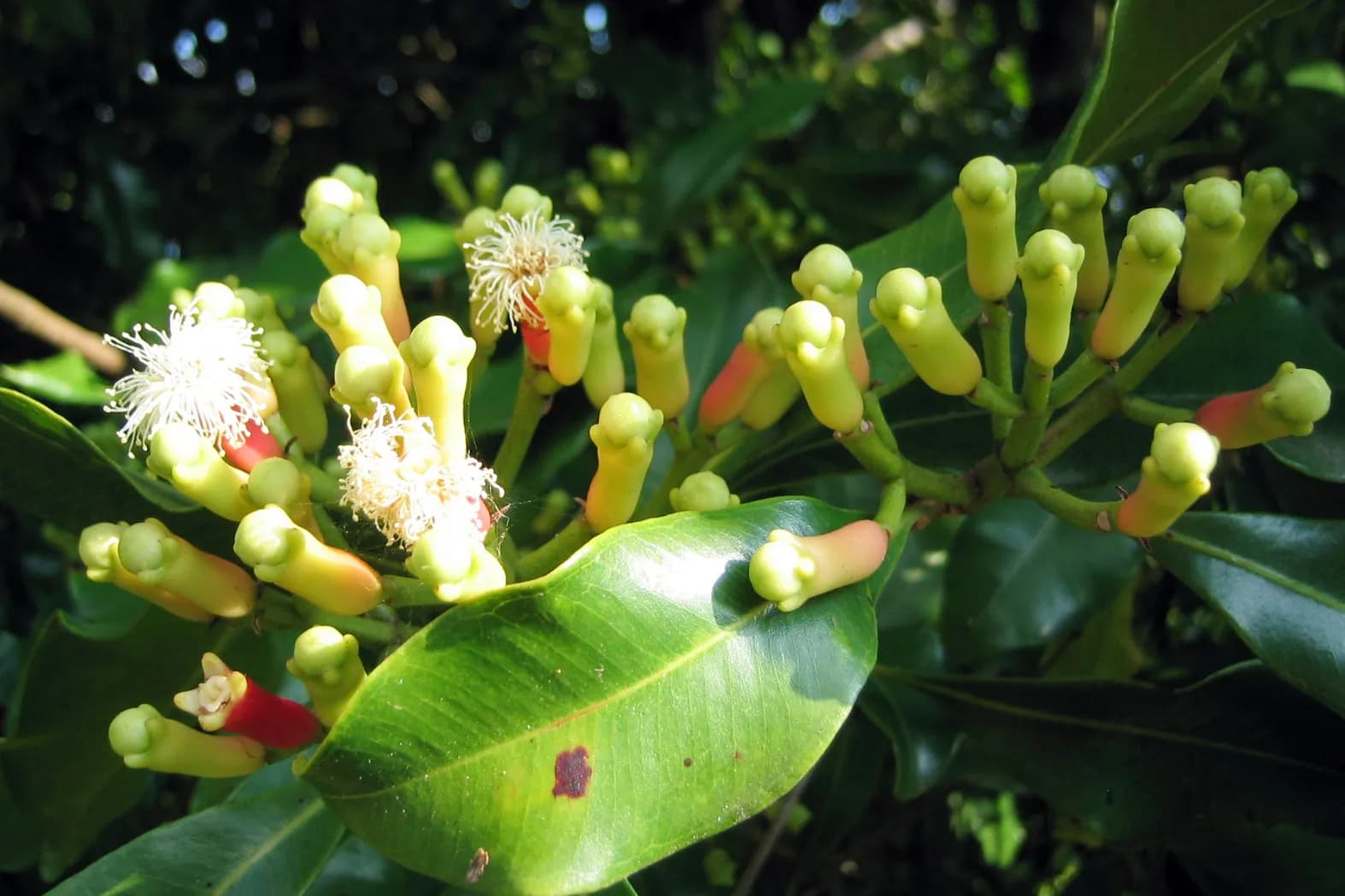
The lavanga is Syzygium aromaticum, a tree with leathery glossy leaves. The bud is built so: a long calyx tube, four projecting sepals and four petals closed into a little ball in the middle. It is picked when it has stretched to a centimetre and a half or two and filled with red.
The home of the tree is the Moluccas, the Spice Islands of Indonesia, and to India the clove came by sea. Just when is harder to say than it seems: those mentions of the clove in South Asia, China and the Near East that are older than the established trade with South-East Asia are considered errors of identification – behind them stand cassia buds, cinnamon, nutmeg. The earliest material find in this part of the world is two cloves from the excavations of Mantai in Ceylon, 900–1100 AD.
And in Vraja the clove tree does not and cannot grow. The clove needs an even wet tropic – lowlands where the temperature hardly changes, and no less than fifteen hundred millimetres of rain a year, while the best spice comes from places with three or four thousand. In Mathura the climate is hot and semi-arid, and about six hundred and sixty millimetres of rain fall: there will be no clove plantation here.
And a clove tree is never a vine at all. Lavanga-lata in Sanskrit is not a description but an independent name of a plant: the lexicon of Böhtlingk gives it to Limonia scandens, a climbing vine of the rue family, a kinswoman of the citrus, which present-day botany calls Luvunga scandens. So the vine in the kunja and the spice in a pinch are things that Sanskrit calls by one root and botany sets in different families.
The clove tree: the flower and the drying
Sources
We build Vrajapedia together – with stories, verses, photographs and parikrama experience. If you know something more, tell us and it will appear on this page.


