Java (Hibiscus)
A five-petalled fire: the flower burns scarlet and yet has almost no scent – and it is for this brightness without fragrance that the poets of Vrindavan chose it when a name was needed for pure red: it is with hibiscus that Radha’s scarlet silks are compared. But java does not flower in scarlet alone. Out of its soft white buds Vrindadevi weaves earrings for Radha and Krishna, and it is with the white hibiscus, by the word of the shastras, that the Lord Himself is worshipped.
Contents
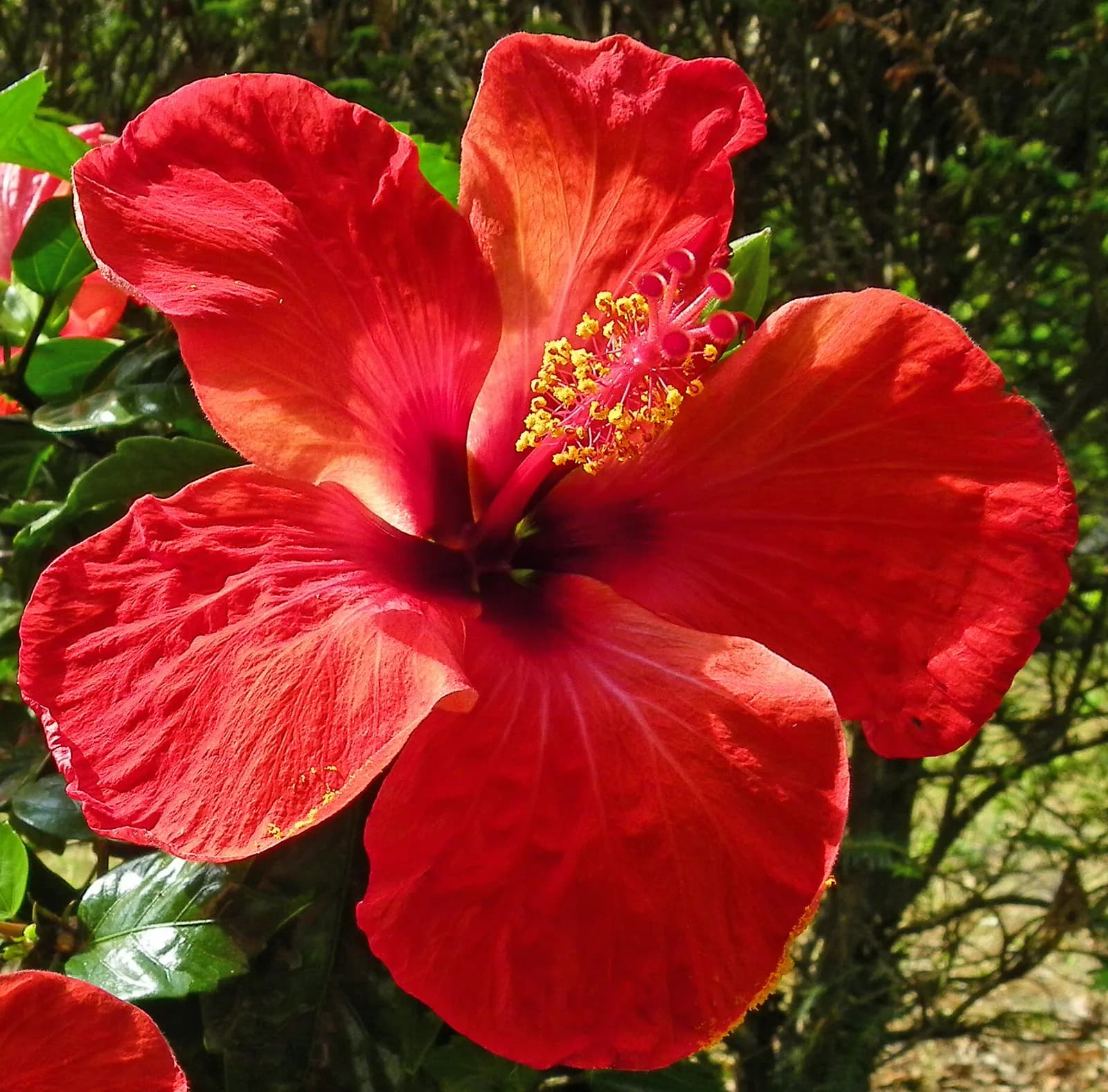
Hibiscus in Vrindavan
In Vraja the tenderest java is not the scarlet one but the white. In the “Govinda-lilamrita” of Srila Krishnadasa Kaviraja Goswami there is a winter scene: Radha and Krishna are resting in a forest bower, and Vrindadevi, the mistress of the Vrindavan groves, comes up to Them with ornaments she has woven herself. To Krishna she hands earrings with a core of soft white hibiscus buds:
harir atha dayitāyā vṛndayānīya dattau
sita-mṛdula-javāntar-mañjarī-karṇa-pūrau
sa-pulaka-kara-kampaṁ karṇayoḥ saṁnyadhatta
śruti-yugam anu tasyaiṣāpi kaundāvataṁsau
“Vrindadevi brought earrings with a soft white core of java buds and handed them to Krishna. And He, with trembling hands and the hair of His body standing on end, put them on the ears of His beloved; and She in return put on His ears earrings of kunda flowers.”
The flower here is not carried to the altar and not woven into a ceremonial garland – earrings are made of it, and Radha and Krishna put them on each other with trembling hands. The white hibiscus lies on Radha’s ears, the white kunda on Krishna’s, and Vrindadevi only hands over the flowers.
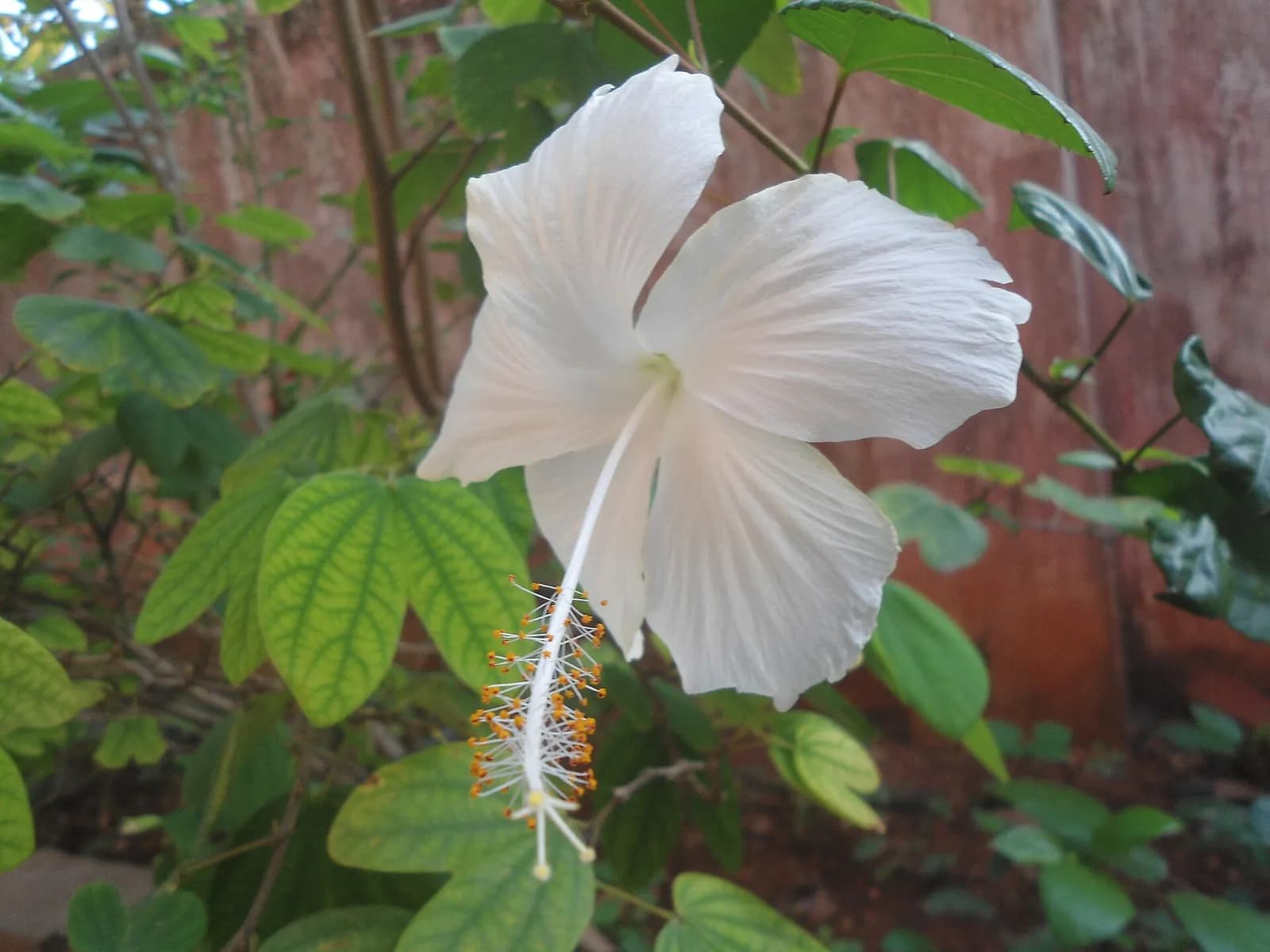
Worship
The white java is offered on the altar as well. In the “Hari-bhakti-vilasa” of Srila Sanatana Goswami a separate verse of praise from the “Vishnu-rahasya” is given to it – the java-mahatmya:
samujjvalair javā-puṣpair abhyarcya jala-śāyinam
supuṇyāṁ gatim āpnoti vīta-bhīr vīta-matsaraḥ
“Whoever honours with the white, shining flowers of java the Lord who reclines upon the waters is freed from fear and envy and attains an auspicious destination.”
The word samujjvala, “brightly shining”, Sanatana Goswami explains thus: shukla, “white”. It is precisely the white java that is meant. The same section adds: whoever with devotion worships Purushottama with the white hibiscus, the Lord gladdens and brings to the highest goal.
Java stands too in the list of flowers “best for the worship of Achyuta”, taken from the “Vamana Purana”: among bakula, patala and the rest, jasuvana is named there, and Sanatana Goswami explains that this is java-kusuma, the hibiscus1.
Bright, but with no scent
The poets take java above all for its colour – a pure red mixed with nothing. In such an attire, scarlet, “like the flowers of java and bandhuka”, is dressed the beauty of winter that comes out to meet the Divine Couple2. With this same flower Radha’s scarlet silk is compared: in the “Radhika-ashtottara-shata-nama-stotra” of Srila Raghunatha das Goswami one of Her descriptive names runs thus:
īṣac-candana-saṅghṛṣṭa-nava-kāśmīra-deha-bhāḥ
javā-puṣpa-prabhā-hāri-paṭṭa-cīnāruṇāmbarā
“Her body, lightly anointed with sandal and fresh saffron, shines; She is in scarlet silks whose beauty eclipses the glow of the java flower.”
On the same colour, only together with the absence of scent, is built a verse from the “Govinda-lilamrita”, where a parrot and his mate argue over who is the more beautiful, the gopis or Krishna. The parrot takes the side of the Lord:
gopī-śreṇī-javālīva saurabhā bahir ujjvalā
nīlotpala-nibhaḥ kṛṣṇaḥ suruciḥ saurabhānvitaḥ
“The row of gopis is like the flowers of java: bright without, but with no fragrance. Krishna, though, is like the blue lotus: both beautiful and fragrant.”
In a birds’ squabble this is only a deft argument, but the point is well taken. That is how hibiscus fell to the poets as the standard of colour, while the fragrance was left to the blue lotus and to kunda.
In this same colour Vraja itself is painted in the season of rains. The “Bhagavatam” says that the earth turned red in places from the indra-gopa insects that came out with the first downpour, and the commentator Vamshidhara Pandit explains: they shone like the flowers of java3.
Beyond Vraja
Outside Vrindavan the hibiscus has another face – scarlet and formidable. The red java is the favourite flower of the Goddess: it is offered to Kali and Durga, and to Parvati, the consort of Shiva. In Shaiva lists the worship with java flowers stands among the rites that “bring destruction to enemies”: the dark scarlet flower goes here not for tenderness but for power.
Ayurveda
In the Ayurvedic lists the hibiscus stands under its second name – japa, or japa-pushpa; so it is called, for instance, in the “Vaidyavallabha”. The flower, the leaf and the root are used: they are applied for strengthening and growing the hair, in women’s ailments, in cough and as a cooling remedy. Neither a taste, rasa, nor a potency, virya, is fixed to it.
Botany
Java is Hibiscus × rosa-sinensis, the China rose of the mallow family, in Hindi gudhal.
Sanskrit calls this flower by two names, japa and java, and the dictionaries set both side by side as one. The “Shabda-sagara” derives japa from the root jap, “to repeat inaudibly” – the very root that gave its name to japa, the silent repetition of mantra – and adds only that this flower is sacred. Why it was so named the dictionary does not say.
Its leaves are large, dark green and glossy, with a toothed margin. The chief mark of the flower is the long central column, at the tip of which sit the stamens and the pistil; in garden forms the petals may also be double. The colour is most often a fiery scarlet, but many forms have been bred, from white to yellow and pink.
And a homeland java has none at all. The Latin name promises China, but in the wild the hibiscus has been found nowhere: it is a garden hybrid bred by the Polynesians from two Pacific species, Hibiscus cooperi and H. kaute. It reached India long before the Europeans – it was from the gardens of India, Sri Lanka and Indonesia that Linnaeus described it in 1753 – so the poets of Vraja saw this bush with their own eyes. Whether the japa of the ancient dictionaries was this very plant, however, cannot be said: the name is older than what we know about the plant itself.
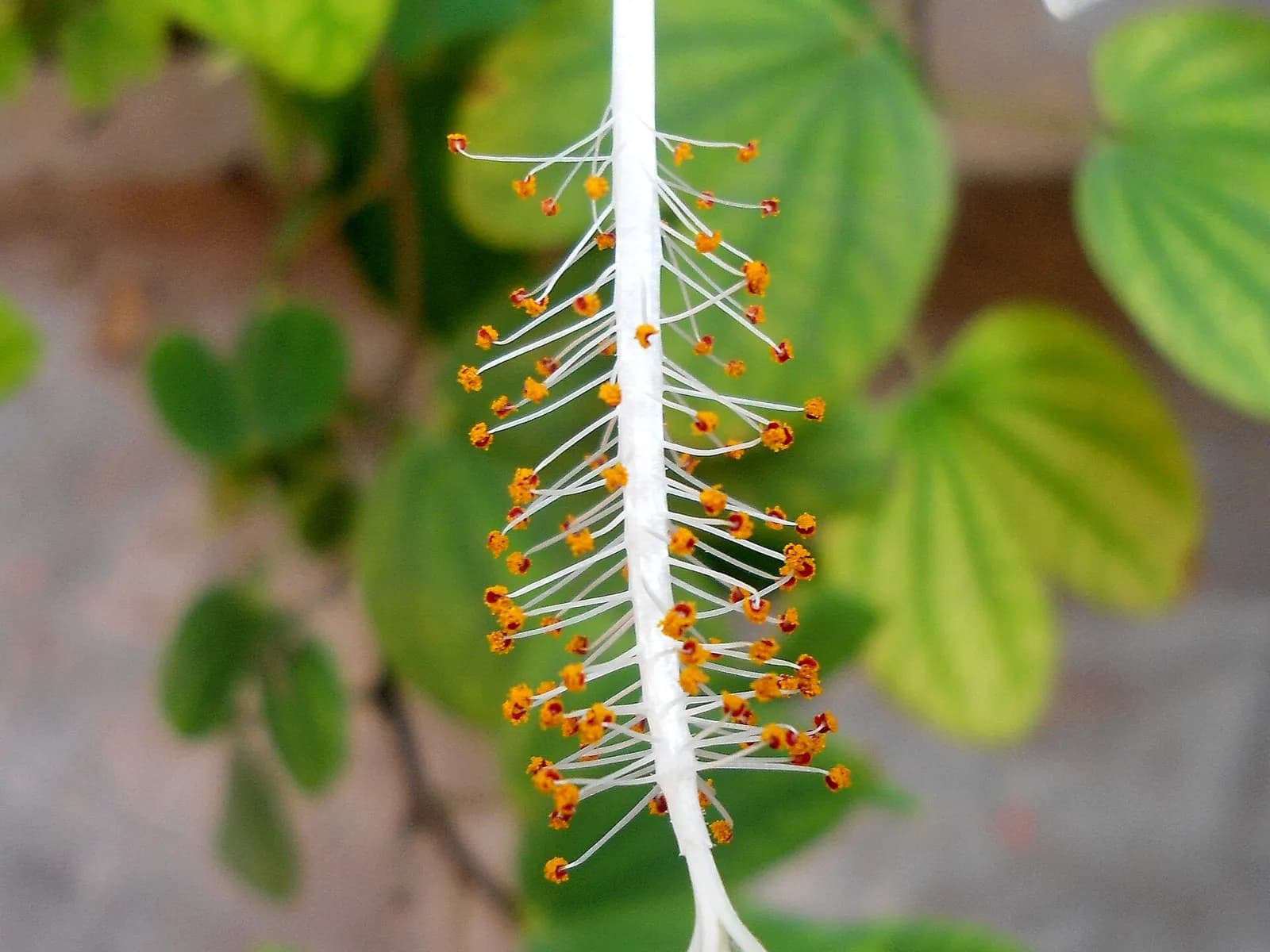
Java: white, double, yellow
Sources
We build Vrajapedia together – with stories, verses, photographs and parikrama experience. If you know something more, tell us and it will appear on this page.


