Mandara
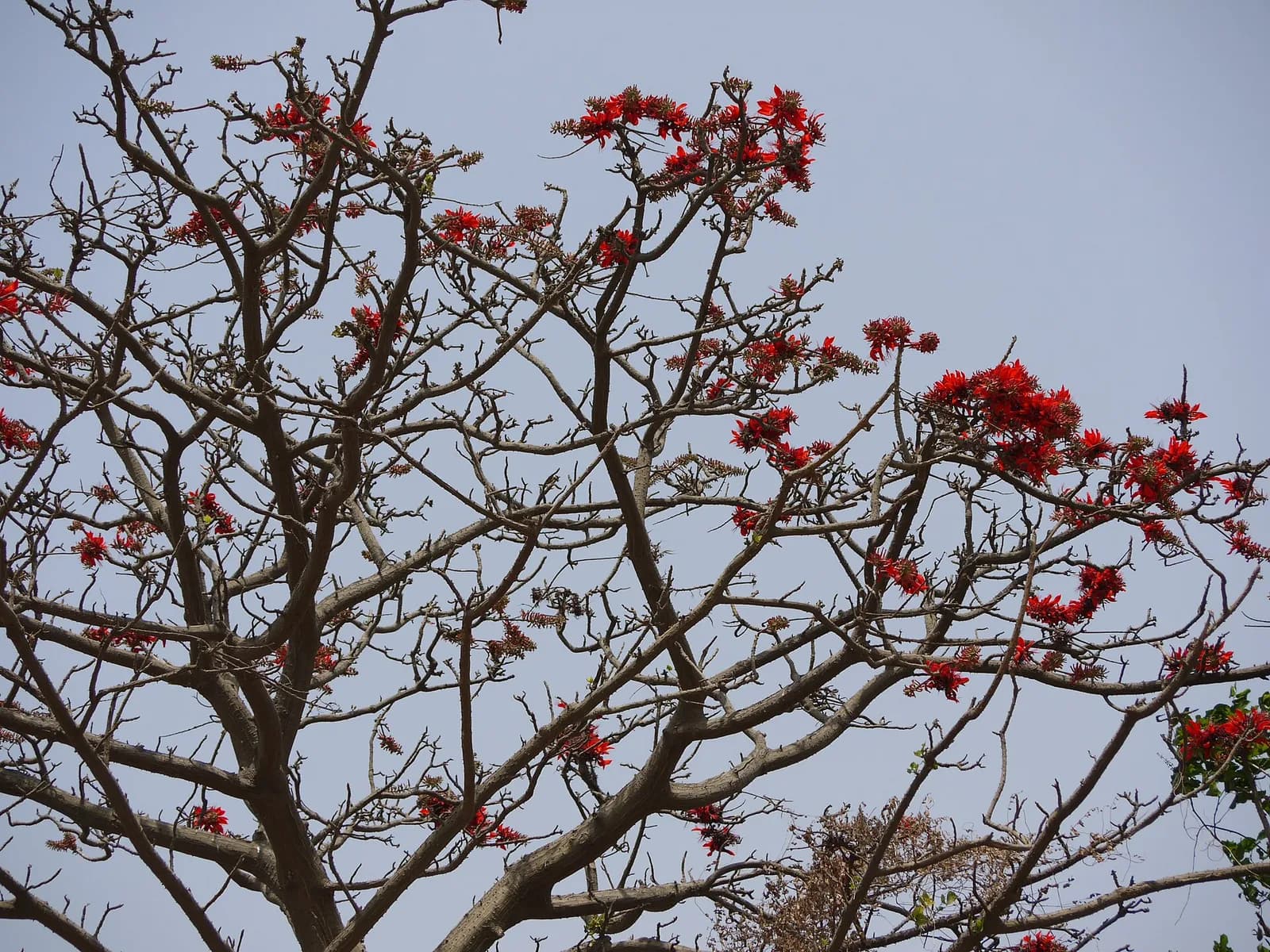
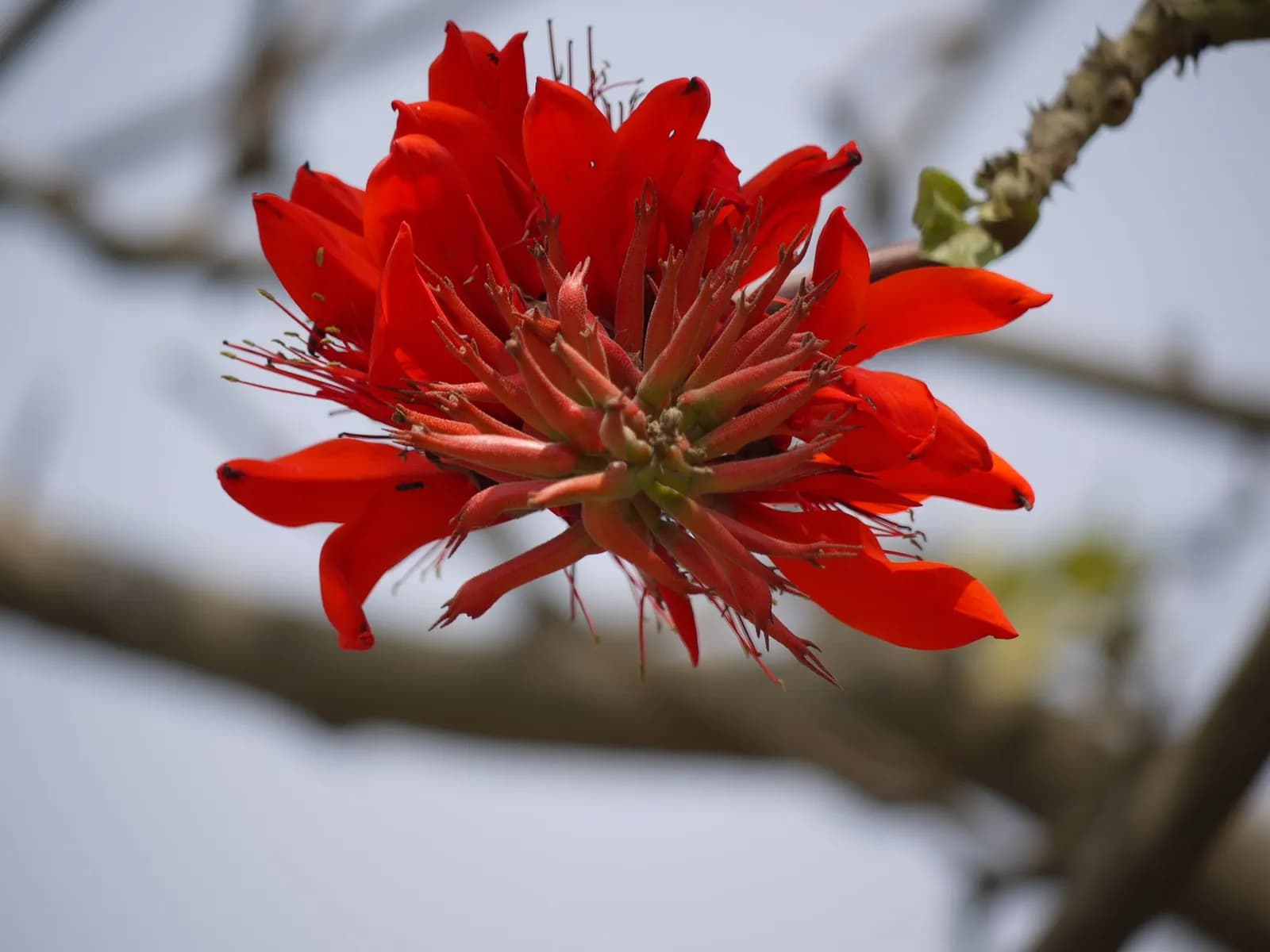
The coral tree, which at the end of winter blazes out in clusters of flowers as scarlet as flame. The mandara is one of the five trees of paradise that grow in the garden of Indra and fulfil any wish. Such a tree should stand in the heavens, and yet it grows on the earth of Vrindavan as well: it fills the bank of the Yamuna with its strong fragrance at the hour of the rasa-lila and lies as a garland on Krishna and on Radha.
Contents
The Tree in Vrindavan
The mandara is not an earthly tree. The Amarakosha lexicon, and after it the commentators on the Bhagavatam, set it in a row with four other trees of heaven: the santana, the kalpa-vriksha, the harichandana and the parijata. These five are called the deva-taru, the trees of the gods, and they grow in the paradise of Indra, fulfilling any wish.
One would think that such a tree belongs in heaven. But Srila Prabodhananda Sarasvati says that the whole of Vrindavan is full of these heavenly groves: the ground here is strewn with santana and harichandana, with countless kalpa-drumas, with forests of parijata and mandara, of nipa and kadamba1.
The mandara grows too where the rasa-lila begins. Having brought the gopis to the bank of the Yamuna, Krishna steps with them onto the sandy shore, and Shukadeva describes that place so:
tāḥ samādāya kālindyā nirviśya pulinaṁ vibhuḥ
vikasat-kunda-mandāra-surabhy-anila-ṣaṭpadam
śarac-candrāṁśu-sandoha-dhvasta-doṣā-tamaḥ śivam
kṛṣṇāyā hasta-taralācita-komala-vālukam
“The almighty Lord then took the gopis with Him to the bank of the Kalindi, who with the hands of her waves had scattered piles of soft sand upon the shore. In that auspicious place the breeze, bearing the fragrance of blooming kunda and mandara flowers, attracted many bees, and the abundant rays of the autumn moon dispelled the darkness of night.”
Two Fragrances and Garlands
On these two fragrances Vallabhacharya pauses. In the Subodhini he notes that the scent of the kunda is quiet and calm while the scent of the mandara is strong – and the difference is named for a reason: the quiet one awakens the desires that are hidden and secret, the strong one those that break out into the open2. In the same place is quoted the observation of Vitthaleshvara: the word “blooming” stands so that the flowers opened not beforehand but at that very moment when the Lord stepped onto the shore.
The same shore and the same mandara come back in other verses of Prabodhananda Sarasvati. He paints Radha and Krishna resting in a kunja of “young mandara vines” at the water's edge3. And in another place Radha, the queen of this forest, wears a garland of mandara flowers, earrings of karnikara and red lotuses at the ends of Her braids4.
The same garland lies on the shoulders of Krishna. In the Brihad-bhagavatamrita Srila Sanatana Gosvami describes how the cowherd friends weave garlands for Him, and He puts them on Himself and gives the rest away to His companions:
kadamba-nīpa-bakulair nāga-punnāga-campakaiḥ
kūṭajāśoka-mandāraiḥ karṇikārāsanārjunaiḥ
“…of kadamba, nipa and bakula, of naga, punnaga and champaka, of kutaja, ashoka and mandara, of karnikara, asana and arjuna… – these many-coloured garlands, woven by His friends, Krishna put on Himself and gave away to the others.”
And Srila Prabodhananda Sarasvati goes further and addresses those who still dream of paradise:
vṛndāraka-nuta-vṛndā-vipina-latā-śākhi-gulmānām
vṛndāraka iha nandata mandā mandāra-koṭibhiḥ kiṁ vaḥ
“The trees, bushes and vines of Vrindavan, to which the great demigods bow, are full of bliss. O dull-witted ones, what use to you are millions of heavenly mandaras?”
Worship
The mandara has its place in the practice of worship as well. When a devotee contemplates the form of Krishna by the rules of the Hari-bhakti-vilasa, he sees the Lord in garlands of mandara, with a smile as bright as the moon, the kunda and the mandara all at once5. And in the rite of worshipping the Deity those same five heavenly trees are honoured in a circle, each set in its own place: the santana, the parijata, the kalpa-druma and the harichandana around the Lord, and the mandara behind His back6.
Beyond Vraja
The mandara grows far beyond Vraja as well. First of all on Kailasa: the abode of Shiva, as the Bhagavatam describes it, is adorned with mandara and parijata, with sarala and tamala, with kadamba and champaka. In a valley of Mount Trikuta, where the elephant Gajendra fought the crocodile, stood the garden of Varuna – Ritumat, in flower all year round; mandaras grew there too, along with parijatas. A mandara stood as well in the forest hermitage of the sage Kardama, adorned with kunda, mandara, kutaja and young mango saplings.
All five heavenly trees grow in Dvaraka too: Vishvakarma laid out parks there with the trees and vines of the heavenly planets, and the commentators explain which trees these are – the santana, the kalpa-vriksha, the harichandana, the mandara and the parijata. In the mornings it is the wind from the mandara grove that wakes Krishna Himself there: the bees it stirs hum over the flowers, and the birds sing above the sleeper – like court singers at a royal bed7.
Ayurveda
Ayurveda knows the coral tree under the name paribhadra: pari, “all round”, and bhadra, “auspicious” – “auspicious all round”. Monier-Williams fixes this name to it with a reference to Sushruta, and the nighantus, the Ayurvedic lexicons of plants, give it a place of its own: the Bhavaprakasha in the guduchyadi-varga, the Raja-nighantu in the shalmalyadi.
But this name is shared by several trees at once: that same Raja-nighantu puts the paribhadra among the synonyms of the devadaru, the Himalayan cedar, and the lexicons give it to the neem and to the pine as well. So a paribhadra in a list of healing plants is not necessarily our tree.
The taste (rasa) of the bark is pungent and bitter, its potency (virya) warming, its post-digestive effect (vipaka) pungent. Its chief use is written into another name of the tree – krimighna, “the killer of worms”: the bark is given against intestinal worms. It serves as a febrifuge as well; a decoction treats the liver and intermittent fever, and an ointment of the leaves with coconut oil is laid on aching joints. The raw seeds are poisonous – they and the bark were once used to stun fish.
Botany
The mandara of the verses of Vraja is Erythrina variegata, in Hindi the pangara. The word itself is many-sided in the Sanskrit lexicons: mandara is the name of the mountain with which the gods churned the ocean, and of the wayside calotropis bush, and of the weeping fig. But to our tree the name is firmly fixed: Monier-Williams sets behind the Sanskrit mandara Erythrina indica, and that, in present-day botany, is the second name of the same Erythrina variegata.
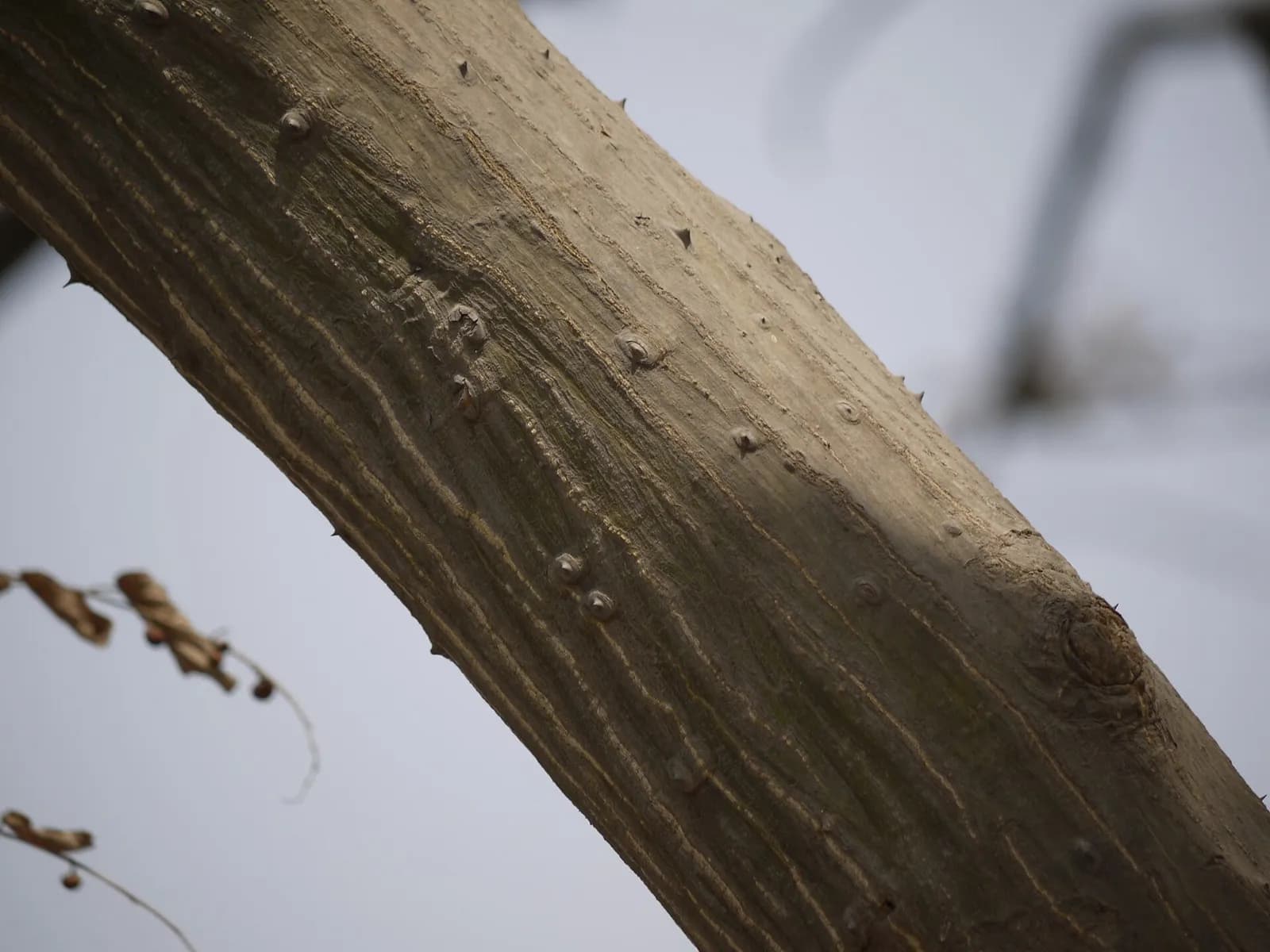
The stout branches are studded with black curved thorns – it is for them that the tree was nicknamed the tiger's claw; the leaves are three-parted, of rhomboid leaflets. The flowers sit in dense clusters up to forty centimetres long, most often in groups of three; for their colour the tree is called the coral tree, though a white-flowered form occurs as well. After the flowering, long cylindrical pods ripen, constricted between the red-brown seeds. The mandara grows throughout tropical Asia and beyond – from eastern Africa to the islands of the Pacific.
Mandara: flower, pod, tree
Sources
We build Vrajapedia together – with stories, verses, photographs and parikrama experience. If you know something more, tell us and it will appear on this page.


