Karnikara
The golden flower that Krishna tucks behind His ear. When He enters the forest of Vrindavan with His flute, in a yellow dhoti, with a peacock feather and the Vaijayanti garland, the karnikara sways by His cheek. That is how the “Venu-gita”, the cowherd girls’ song about the flute, describes Him. And in separation Radha will see the same flowers on the bank of the Yamuna – and they will remind Her of the one who has gone. In Vraja karnikara grows in the kunja of Champakalata, and the flowers for Krishna’s adornment are gathered here by Guna-manjari.
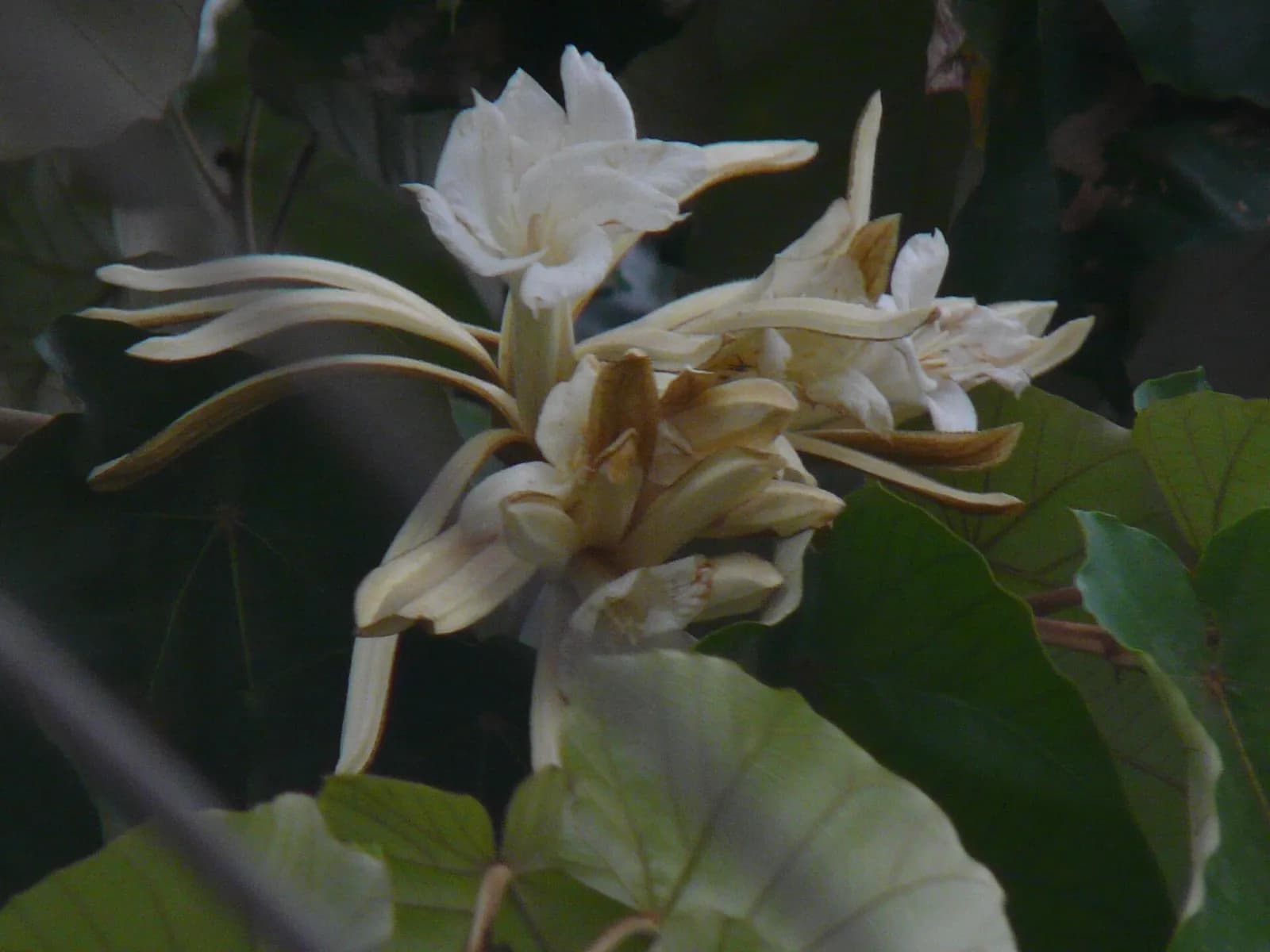
Karnikara in Vrindavan
The tree’s name says it all: karnika is an ear-loop, an earring, and karnikara is the tree whose flower asks to be worn behind the ear. In Vraja that is exactly where it goes – behind Krishna’s ear. Describing how Krishna enters the forest in autumn, Shukadeva names this flower right after the peacock feather:
barhāpīḍaṁ naṭa-vara-vapuḥ karṇayoḥ karṇikāraṁ
bibhrad vāsaḥ kanaka-kapiśaṁ vaijayantīṁ ca mālām
randhrān veṇor adhara-sudhayāpūrayan gopa-vṛndair
vṛndāraṇyaṁ sva-pada-ramaṇaṁ prāviśad gīta-kīrtiḥ
“With a peacock feather on His head, the karnikara flower on His ears, in a garment yellow as gold and with the Vaijayanti garland – in the form of the greatest of dancers Krishna entered the forest of Vrindavan, beautifying it with the marks of His feet; He filled the holes of His flute with the nectar of His lips, and the cowherd boys sang His glories.”
The flower behind the ear of the greatest of dancers
Srila Vishvanatha Chakravarti Thakur notices a grammatical oddity in this line: the flower, karnikara, stands in the singular, while the ears, karnayoh, are in the dual. One flower and two ears: it means Krishna kept shifting it from the left ear to the right, and this, the Thakur says, betrays “intoxication with youth”. Srila Jiva Goswami adds a note on the word bibhrat, “wore”: He did not merely wear the flower but ceaselessly displayed His beauty by it.
As for how the flower looks, Srila Sanatana Goswami and Srila Jiva Goswami write in the same words: karnikara is yellow and in shape resembles a lotus. Sanatana Goswami adds that in spring and autumn these flowers are especially many and the forest grows lovelier from them. In the “Krishna-lila-stava” the same Goswami bows to Him as “wearing karnikaras on His ears, dressed like a dancer, adorned with autumn flowers, enchanting in the autumn pastimes”1 – the whole “Venu-gita” in one line of prayer.
Often the flower turns up on both ears at once. Srila Rupa Goswami in the “Bhakti-rasamrita-sindhu” paints Krishna in the whole fragrant forest – with a garland of gunja, in a crown of peacock feather, in the glow of yellow silk:
karṇābhyāṁ karṇikāre dadhad alam urasā phulla-mallīka-mālyaṁ
nṛtyan dor-yuddha-raṅge naṭavad iha sakhīn nandayaty eṣa kṛṣṇaḥ
“…wearing karnikaras on both ears and on His chest a garland of blossoming mallika, dancing like an actor in the contest of wrestling – this Krishna gladdens His friends.”
It is the mistress of the forest herself who hands Krishna this flower. In the “Govinda-lilamrita” of Srila Krishnadas Kaviraja, Vrindadevi, catching sight of the approaching son of Nanda, joyfully hurries to Him and puts into His hands two ear-ornaments of karnikara2. So these flowers are no chance adornment but an ornament offered with love. That is why Srila Prabodhananda Sarasvati calls one to meditate on this image – on “the beautiful beloved of Sri Radha, whose ear is adorned with a karnikara flower, whose bimba lips are kissed by the cowherd girls, who plays the flute”3.
The karnikara grove and the tryst
Thickets of flowering karnikaras in Vraja are a secluded place for trysts. In Srila Rupa Goswami’s play “Vidagdha-madhava” Radhika calls her friend into the shade of such a grove as early as the first act, and later Paurnamasi gives an order: when Vishakha brings Krishna under the mango tree, let Lalita hide Radha among the karnikaras, apart from the other cowherd girls. So the earring-flower grows exactly where Radha and Krishna meet in secret.
And in the scene where Krishna and her friends dress Radha, the name itself is played upon. Vrindadevi holds out a bud: “Look, friend – this karnikara bud is just right for Your earring!” Here karnika, the earring, and karnikara, the tree, close into one word. Radhika notices that a bee, greedy for honey, has settled still on the fresh flower, and Krishna answers: this bee on the golden flower is “like the king of nectar himself, embodied, mounted upon a golden throne”4. The flower suits them both: Krishna wears karnikara behind His ear, and it becomes Radha too – no wonder Srila Prabodhananda Sarasvati paints the Queen of Vrindavan as well “adorned with karnikara earrings”.
Karnikara in separation
The moment Krishna leaves, the same flower turns into an instrument of longing. In Srila Rupa Goswami’s “Lalita-madhava” Radha wanders along the Yamuna, sees young karnikaras on the bank and recognises them:
rāsāt tirohita-tanuḥ sakhi yasya puṣpaiś
cūḍāṁ cakāra cikure mama piñcha-cūḍaḥ
kūle kalinda-duhitur dhṛta-kandalo ’yaṁ
māṁ dandahīti sa muhur nava-karṇikāraḥ
“My friend! These young karnikaras on the bank of the Yamuna – it was from flowers like these that He whose head is crowned with a peacock feather wove an ornament into my hair when He left the arena of the rasa-lila with me. And now they burn me again and again.”
It is not simply a beautiful flower: it is the very one that was in Her hair at the moment of closeness and of parting at once. Srila Vishvanatha Chakravarti explains: Radha wanders and, looking at the young karnikaras, pours out her grief. The flower that was the ornament of meeting has become the fire of separation.
Worship
Karnikara is offered to the Lord as well. Srila Sanatana Goswami in the “Hari-bhakti-vilasa”, sorting out with which flowers Vishnu is to be honoured, cites a verse from the Puranas:
karṇikāra-mayaiḥ puṣpaiḥ kāntaiḥ kanaka-suprabhaiḥ
arcayitvācyutaṁ loke tasya loke mahīyate
“One who worships Lord Achyuta with the beautiful flowers of karnikara, shining like gold, is honoured in His abode.”
The gold of the flower is no accident here: karnikara shines “like gold” (kanaka-suprabha) – a match for Krishna’s yellow dhoti and for the earrings at His cheeks.
Beyond Vraja
Karnikara occurs in the shastras beyond the Vrindavan stories too. In the Fourth Canto of the “Bhagavatam” Lord Vishnu appears at Daksha’s sacrifice with eight golden arms, a weapon in each. The verse says that with these arms He was like a flowering karnikara tree5, and the commentary unfolds the image: the eight arms are like eight golden petals around the whorl.
The whorl of the lotus
The name has a second sense as well. Karnika is not only an earring but also the whorl of a lotus, that seat in the centre of the flower where the seeds sit. The dictionaries give karnikara in both senses at once: the tree and this very whorl – and from the second the commentators derive the tree’s name itself.
Hence the cosmic image too. When Brahma in the “Brahma-samhita” describes the supreme abode as a thousand-petalled lotus by the name of Gokula, he calls the whorl of that lotus karnikara – the dhama of the Lord6. Sri Chaitanya Mahaprabhu repeats the same image in the “Chaitanya-charitamrita”: above the countless Vaikunthas, Krishnaloka is like the karnikara, the heart of the universal flower. So the name of the flower behind Krishna’s ear turned out to be the name of the whorl of that lotus which is His eternal home.
Folk medicine
In karnikara it is above all the flowers that are used: from them a tonic is prepared with which inflammations, ulcers, tumours, “diseases of the blood” and leprosy are treated. The downy underside of the leaf is used to stop bleeding from wounds, and the bark and leaves are applied in smallpox. The tree is considered non-poisonous.
Botany
In Vraja karnikara is Pterospermum acerifolium, a tree of the mallow family, kanak champa in Hindi, “the golden champaka”, or muchkund, and in Marathi it is simply karnikar. Its leaf is up to thirty centimetres long and twenty wide, palmately veined, dark green above and covered with rusty felt beneath. It is for this that the tree is called the dinnerplate tree in English: the leaves really do serve as plates and as wrapping. The species name acerifolium means “maple-leaved”: the leaf can also be lobed, like a maple’s. The generic name Pterospermum, “winged seed”, was given for the angular woody capsules: when ripe they blacken, split into five valves and release seeds with a wing.
But with the flower itself the ends do not quite meet. The Goswamis describe the karnikara flower as yellow and lotus-like, the “Hari-bhakti-vilasa” calls these flowers shining like gold, and the Sanskrit dictionary finishes the portrait: the petals are turned inwards so that the flower resembles a saucer, and the stamens stick out of it “like wicks from an oil lamp” – and it says in the same breath that the flower has no scent. In Pterospermum acerifolium the flower is cream-white and smells so strongly that at night moths and bats gather to it. The sources, though, disagree about the scent among themselves as well: the Sanskrit commentary on the “Govinda-lilamrita” calls karnikaras “special flowers with the scent of a lotus” – and that is already closer to the living tree than to the dictionary entry.
The name itself is not given to one tree alone. Monier-Williams and the “Shabda-sagara” give karnikara two owners at once – Pterospermum acerifolium and Cassia fistula, that is the amaltas, the “golden shower”, whose racemes are golden indeed. The commentator of the “Bhagavatam” Vamshidhara Pandit gives the same gloss, quoting the “Medini” dictionary: karnikara means both the aragvadha tree, that is the amaltas, and the “tree lotus”7. In Vraja the name is fixed to the first – to the one whose flower is not golden.
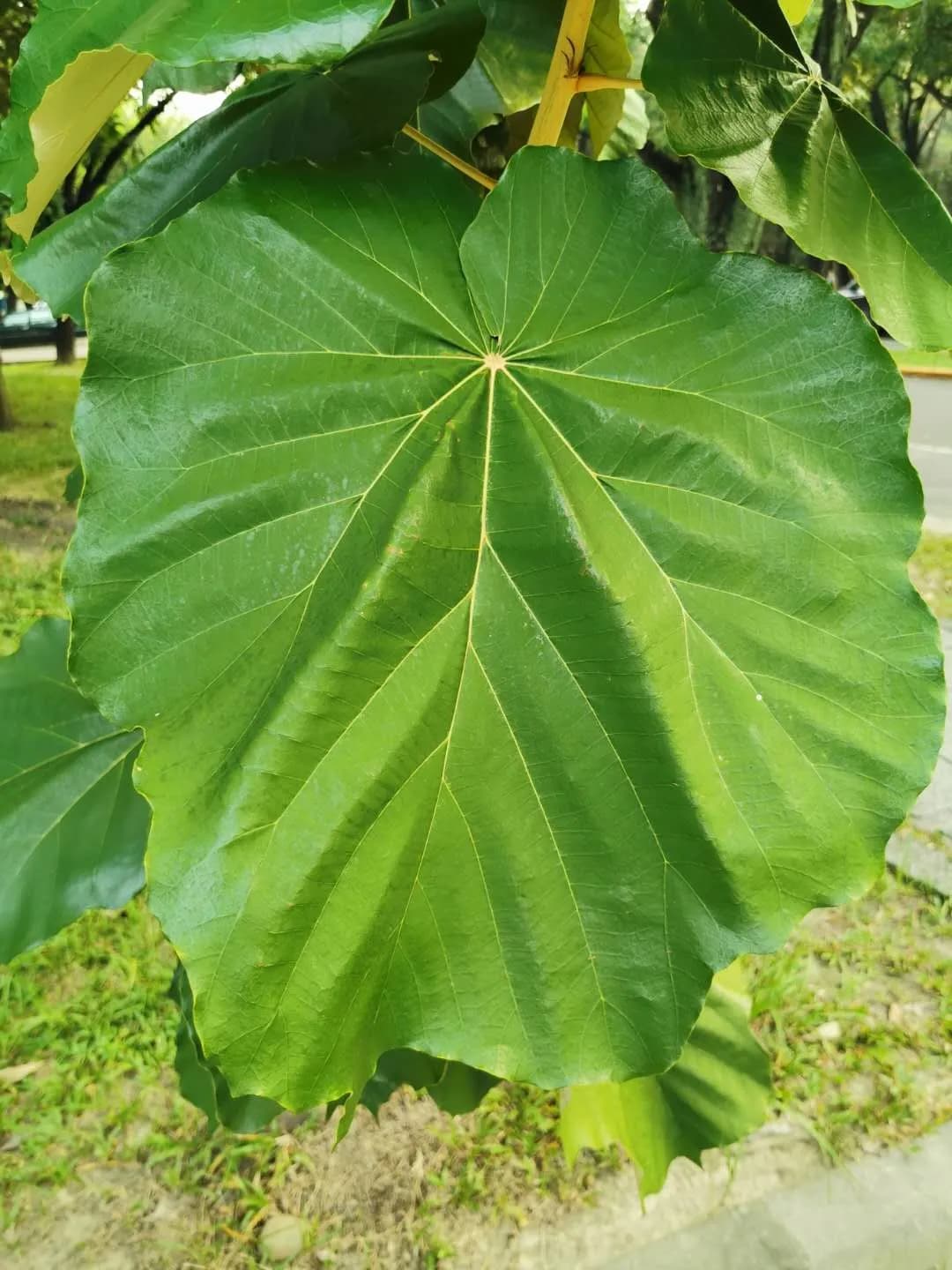
Karnikara: leaf, fruit, tree
Sources
We build Vrajapedia together – with stories, verses, photographs and parikrama experience. If you know something more, tell us and it will appear on this page.


