Amaltas
At the height of the hot season the amaltas flares into gold — long hanging racemes of yellow flowers. No pastime of its own is bound to it, yet it has a place in Vrindavan: it is named among the trees of that forest, and every one of them is a wish-fulfilling tree, and its flowers go into a garland for Krishna. The tree has as many names as it has virtues: “king tree,” “the golden one,” “the garland-weaver,” “the disease-slayer.”
Contents
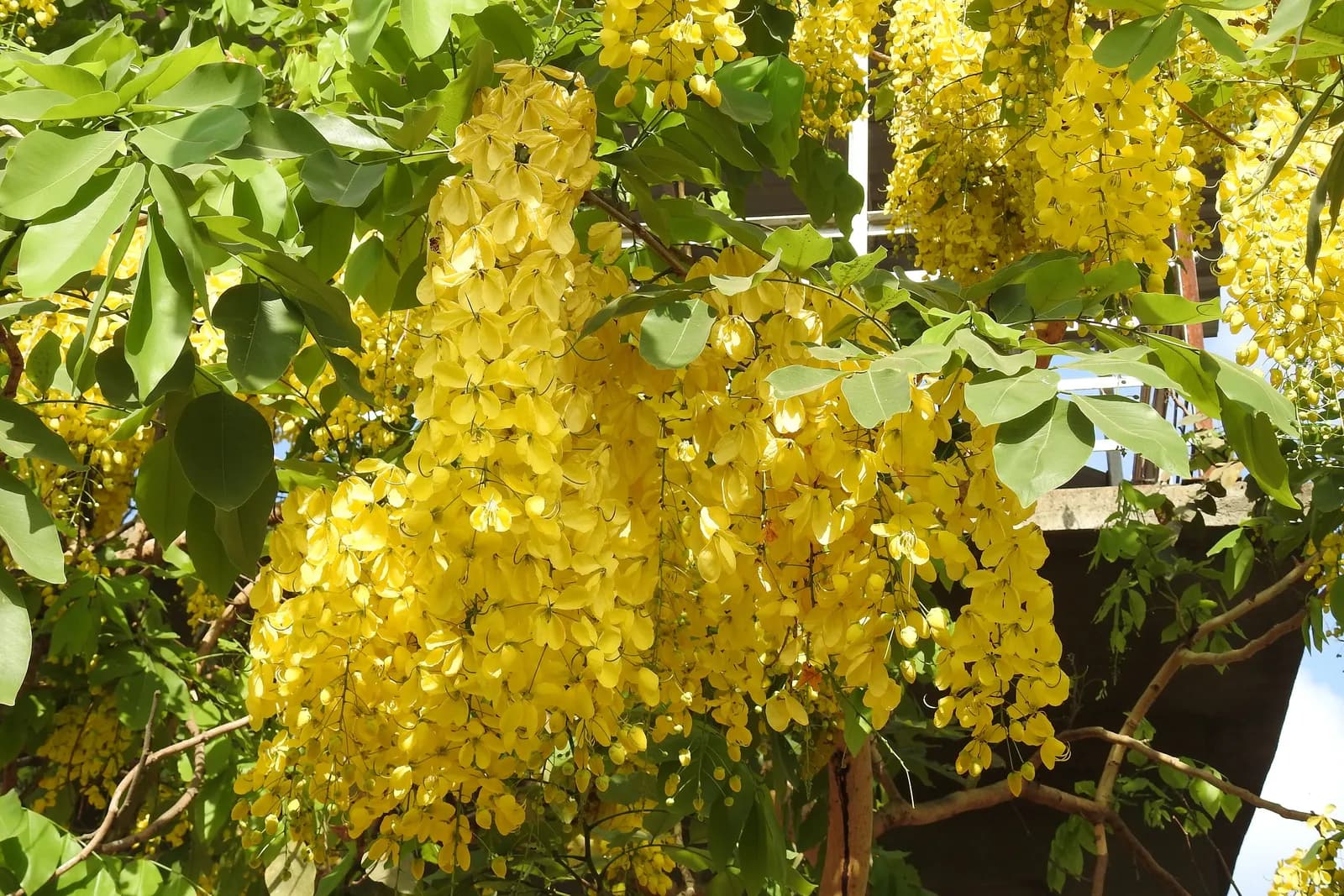
A Tree in Vrindavan
When Srila Krishnadasa Kaviraja Goswami lists the trees of Vrindavan in the Govinda-lilamrita, kritamala — the Sanskrit name of the amaltas — stands among the dozens of names:
golīḍhaiḥ kaṇṭaki-phalair madhuṣṭhīlair madhūlakaiḥ
kṛtamālair drukilimaiḥ phalādhyakṣair halipriyaiḥ
“…with golidha, kantaki-phala, madhushthila, madhulaka, kritamala, drukilima, phaladhyaksha and halipriya trees…”
The Wish-Fulfilling Tree
To be on that list means more than it seems. The Brahma-samhita calls the trees of Vrindavan kalpa-taru, wish-fulfilling trees: every tree here is a living being whose body is woven of bliss1. In the Vrindavana-mahimamrita Srila Prabodhananda Sarasvati shows that life in detail: out of love for Radha and Krishna the buds rise on the branches like the hair on a body, honey runs down the trunks as tears, the open flowers laugh, and the trees themselves, heavy with ripe fruit, bow to the Divine Couple2.
And in the eighth canto of the same poem Radha walks through the forest and recognises in it the body of Krishna. There a play on the tree’s name is built into the verse: read one way it lists trees — punnaga, amala, champaka, kritamala; read the other, it is Krishna Himself, adorned with a garland, a krita-mala, woven of those very flowers3.
Beyond Vraja
Under the name aragvadha the amaltas appears in the Puranas. The Skanda Purana counts it among the pure flowers fit for worship at any of the three times of day — beside punnaga, bakula, nagakeshara, kadamba and mandara4. It is on Mahadeva as well: by the same Purana He wears two garlands — one of skulls and one of aragvadha flowers. And the Bhavishya Purana, setting out which flowers are offered to which demigods during the Ratha-yatra, gives aragvadha to the Gandharvas, the singers of heaven.
Ayurveda
Ayurveda calls the amaltas aragvadha and vyadhighata — “disease-slayer” — and among the mild purgatives it puts the tree first. In taste (rasa) it is sweet, in potency (virya) cooling, with the same sweet post-digestive effect (vipaka); it acts gently and unctuously, pacifies pitta and kapha, and cleanses the bowels. Charaka places the tree in the groups of remedies against skin diseases (kushtha-ghna) and against itching (kandu-ghna), Sushruta in aragvadhadi and shyamadi5. What is used above all is the black sweetish pulp from the long pods, and with it the bark, the leaves and the flowers.
The Puranas have preserved particular recipes as well. The Garuda Purana, in its Dhanvantari section, prescribes a decoction of aragvadha, triphala (the mixture of three fruits), neem and bitter katuka — for heat and burning in the body. The leaves, ground with sour rice ferment, are laid on ringworm and long-standing skin diseases. The Agni Purana says the same: a decoction with aragvadha cleanses, loosens the bowels and relieves every kind of fever.
Botany
Botanists call the amaltas Cassia fistula, of the legume family. It is a tree of up to twelve metres with pinnate leaves. Before the rainy season it covers itself in racemes of yellow flowers, each a cubit long — which is what gave it the English name of golden shower tree. Then come dark brown cylindrical pods half a metre and more in length, with black sweetish pulp and a multitude of flat seeds. The tree is native to India and Sri Lanka; across the rest of tropical Asia it was brought into cultivation later.
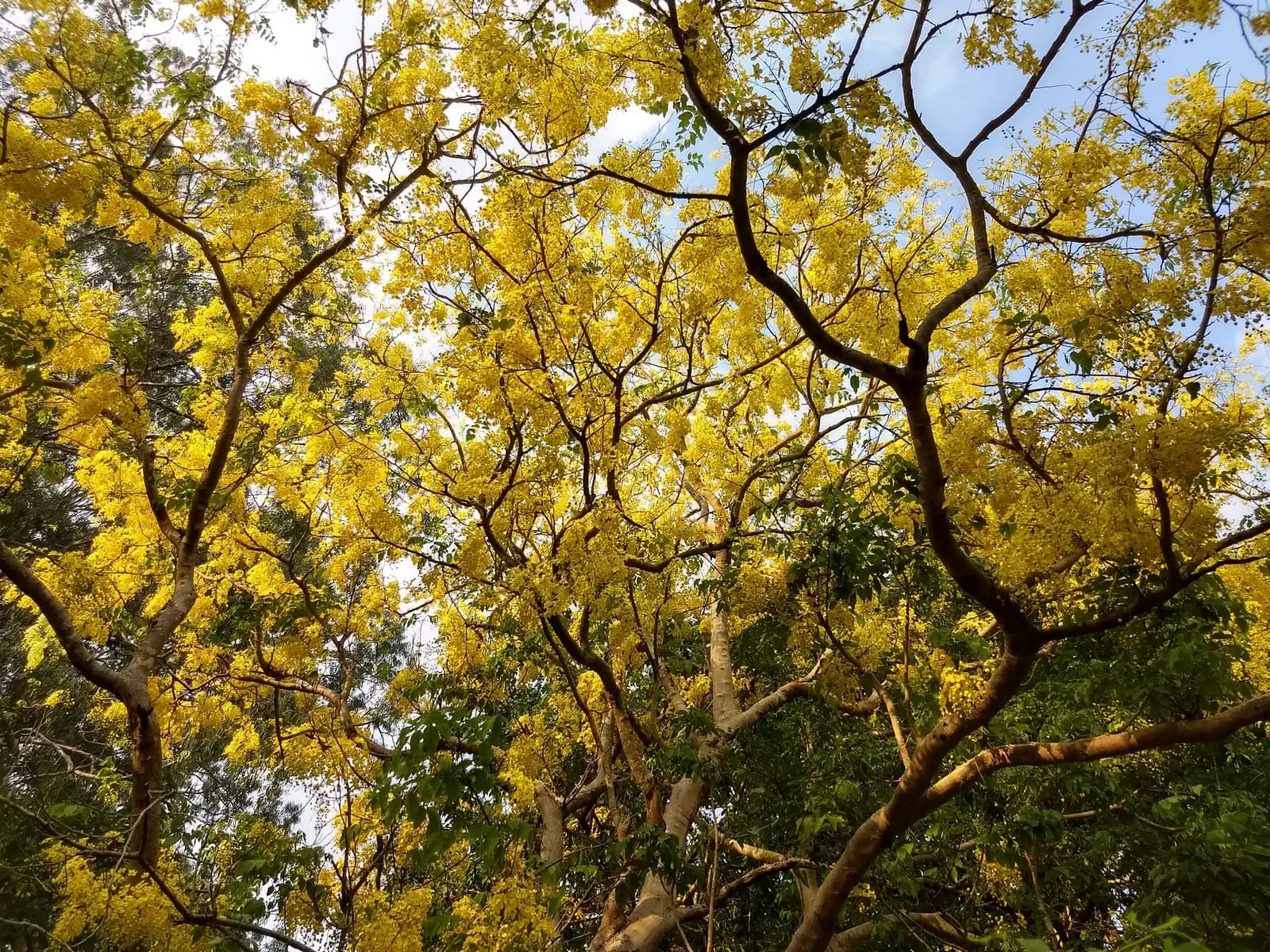
Amaltas in bloom
Sources
We build Vrajapedia together – with stories, verses, photographs and parikrama experience. If you know something more, tell us and it will appear on this page.


