Kunda
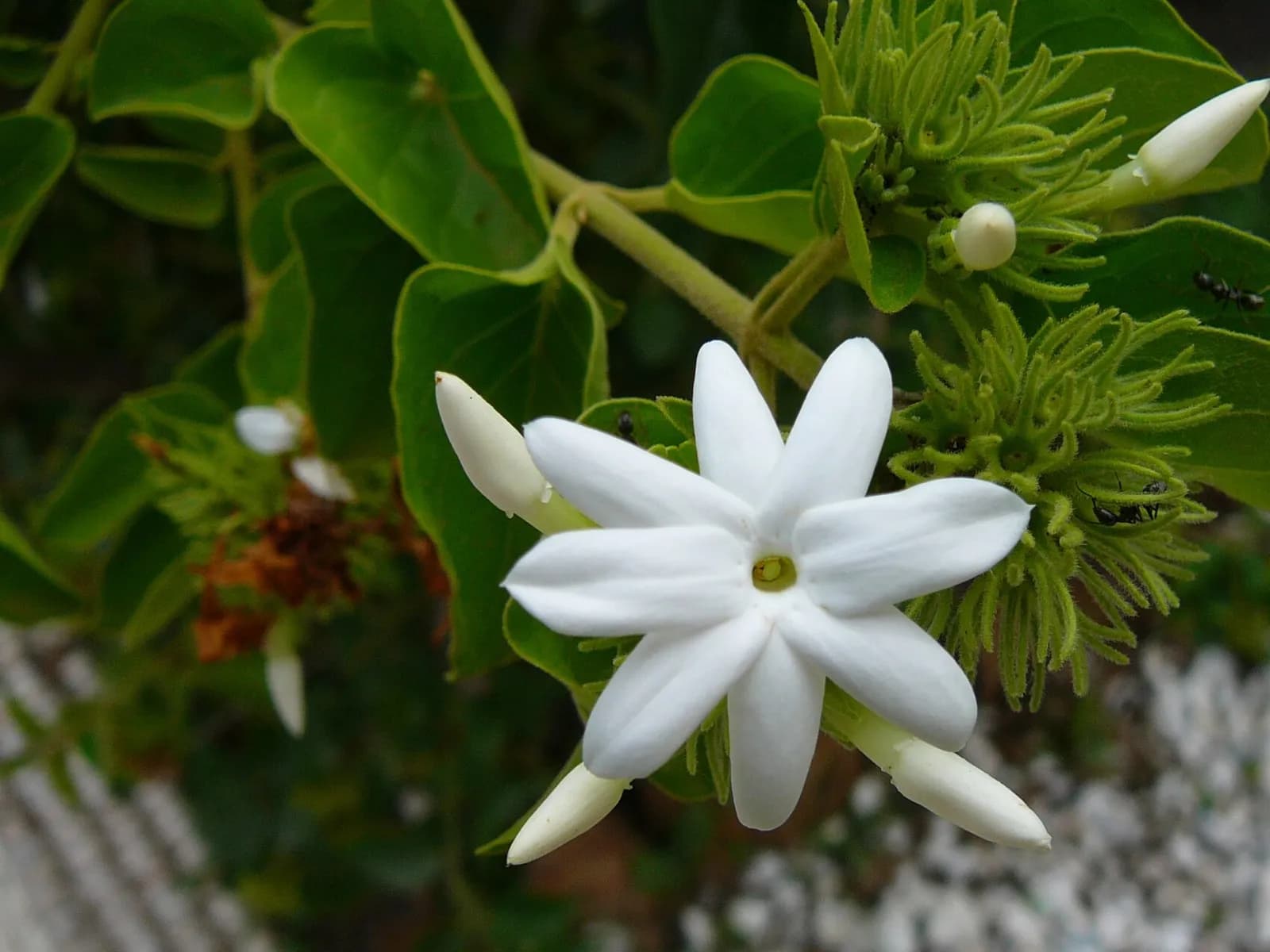
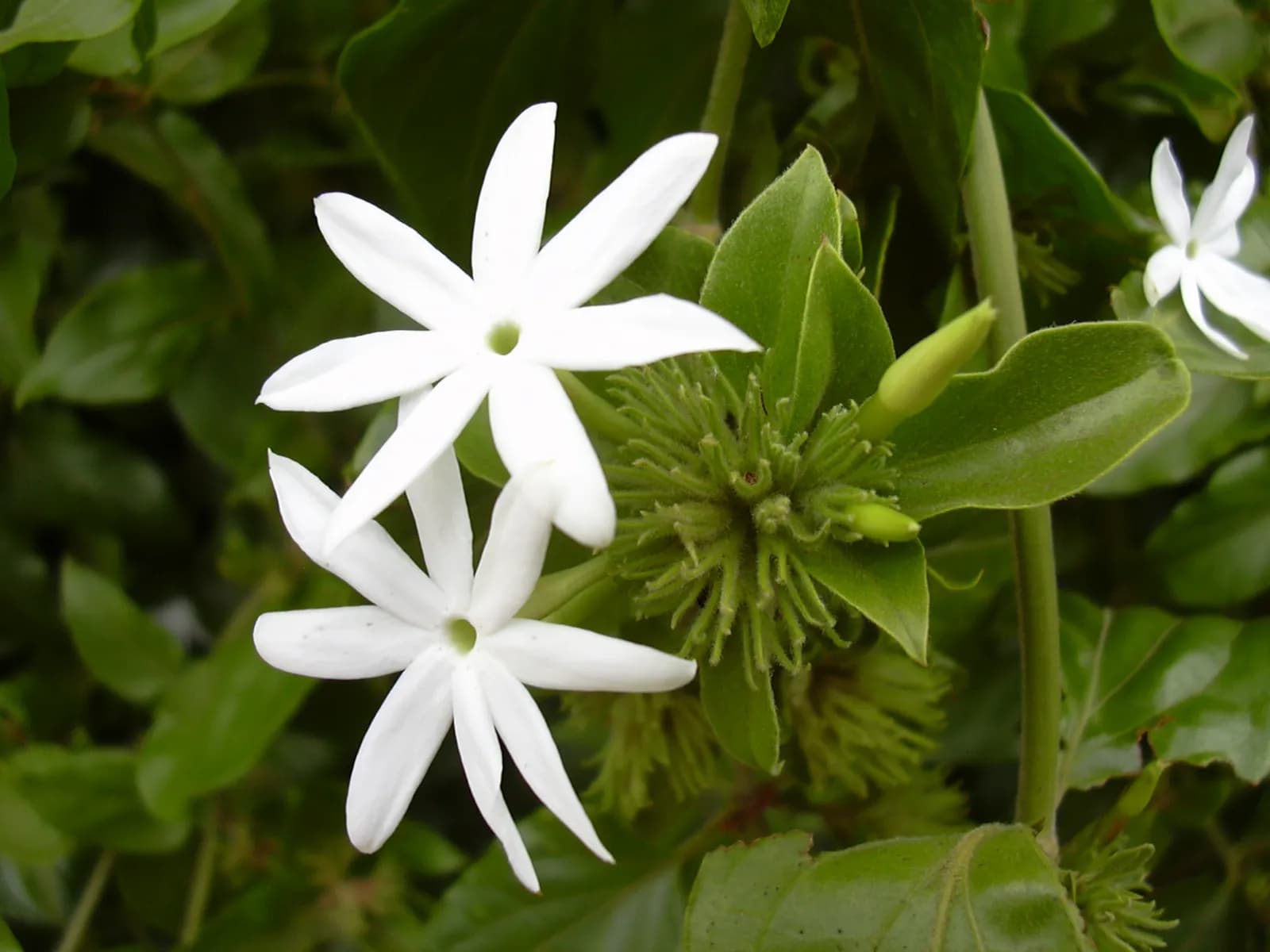
A jasmine that hardly has a scent. The kunda blooms white almost the year round, but its fragrance is barely audible – not at all the one for which its sisters in the genus are famed. And yet it was its whiteness that the poets of Vrindavan chose in order to speak of the most intimate things: the teeth of Radha in Her smile are buds of kunda, and a garland of kunda on the neck of Krishna once gave away to the gopis the whole secret of a night tryst.
The Vine in Vraja
The gopis have lost Krishna. At the height of the rasa dance He vanished – and, as the commentators explain, took Radha away with Him, though the Bhagavatam does not name Her. Now the girls wander the night forest, asking the trees, the vines and the animals about Him. The wind brings them a scent – and everything becomes clear:
apy eṇa-patny upagataḥ priyayeha gātrais
tanvan dṛśāṁ sakhi su-nirvṛtim acyuto vaḥ
kāntāṅga-saṅga-kuca-kuṅkuma-rañjitāyāḥ
kunda-srajaḥ kula-pater iha vāti gandhaḥ
“O friend, wife of the deer, has Lord Achyuta passed this way with His beloved, granting joy to your eyes? We feel the fragrance of His garland of kunda flowers, which He stained with the kunkuma from the breast of His companion when He embraced Her.”
The Modesty That Gave It Away
Here the whole subtlety of the choice comes out. The kunda is not rich in scent: on its own it would not have carried far, and the gopis would have caught nothing. But mixed with kunkuma, the red fragrant powder from the breast of the beloved, the faint scent of the kunda suddenly gained strength and reached the friends. Narayana Bhatta notes this detail in particular: though the fragrance of the kunda flower is faint, in union with the saffron kunkuma from the breast it became distinct1. So botany is woven into the very heart of the verse: were the kunda as fragrant as the mallika, it would have given nothing away – but it was its very modesty that let the scent of the tryst carry through the forest.
Whose breast and whose garland the gopis recognized is told by the commentators. Srila Sanatana Gosvami counts the garlands: three of them changed on Krishna that night – first the forest vaijayanti, then the tulasi, and now the kunda. And he explains why He changed them: on a moonlit night a white garland of kunda is especially fine, and for its sake He took off the vaijayanti2.
Narayana Bhatta Gosvami names another reason: this garland was woven and lovingly offered to Him by the very one with whom He disappeared. And Srila Jiva Gosvami tells who that is: the words belong to the friends of Radha Herself, and it was She who wove the kunda garland and placed it on Krishna’s neck:
“Radha placed on His neck a garland of kunda flowers that She had woven Herself. Bewildering the mind of even the god of love, the husband of Lakshmi was the shelter of the gopis, who are higher than Lakshmi herself.”
And then the verse reads differently: the garland by whose scent the friends search for Krishna is a gift from Radha to her Beloved.
The Kunda’s Own Pastime
The kunda has a pastime of its own as well. In the Krishna-bhavanamrita of Srila Vishvanatha Chakravarti, Krishna wanders with Radha and Her friends through the winter forest by Radha-kunda and, catching sight of the kunda in bloom, sets about picking the flowers to adorn His Beloved with them. Radha smiles, covers Her face with Her hand and wrinkles Her nose3: there is no need to adorn Her with kunda, for Her teeth are kunda already.
Words come into the game here too. Lalita teases Krishna that he keeps reaching “for that flowering kunda vine” – and kunda-latā means at once “the kunda vine” and the name of the gopi Kundalata; the double meanings come one after another, and Kundalata does not remain in debt.
A Smile White as Kunda
In Vraja the kunda is above all the colour of a smile. Its whiteness has become proverbial: where we would say “white as snow”, the Indian tales say “white as kunda”, and the lexicons place this flower in one row with the moon and the snow. And the name says the same: among the names of the kunda in the nighantu stands aṭṭahāsaka, “loud laughter” – the lexicons explain it by the likeness of the flower to a smile on a beautiful face.
The same image that called the teeth of Radha buds of kunda the Bhagavatam turns upon Krishna Himself. When in the midst of the rasa-lila He stands surrounded by the gopis, Shukadeva paints Him thus:
tābhiḥ sametābhir udāra-ceṣṭitaḥ
priyekṣaṇotphulla-mukhībhir acyutaḥ
udāra-hāsa-dvija-kunda-dīdhatir
vyarocataiṇāṅka ivoḍubhir vṛtaḥ
“The infallible Krishna, surrounded by the young gopis, seemed the moon among the stars. With tender glances He made their faces bloom, and when He smiled broadly, the girls beheld the radiance of His teeth, like buds of kunda.”
Kundadanti and Kunda-rada
Baladeva Vidyabhushana explains briefly: dvija-kunda means teeth like buds of kunda. And then the image became a name. In the Krishna-bhavanamrita, among the names of Radha stands Kundadanti – “she whose teeth are kunda”, and Krishna Himself the poet calls Kunda-rada, “the kunda-toothed”4.
In the same poem a garland of kunda, “for whose beauty the young girls long”, hangs on the breast of Krishna beside the Kaustubha gem5. And in the bowers around Radha-kunda the kunda blooms together with the mallika, the yuthika and the ketaki, and the bee drinks nectar from its vines6.
Beyond Vraja
The whiteness of the kunda accompanies Krishna even where the forest bowers are gone. In the Brihad-bhagavatamrita of Srila Sanatana Gosvami, in the description of His pastimes in majesty, the lips of the Lord, red as the bimba fruit, are reflected in two rows of teeth “whiter than the flowers of the kunda and putting their pride to shame” – and with that shining smile He steals the hearts of the devotees7. The same flower that in Vraja was the smile of the cowherd boy remains here the measure of His beauty.
The kunda has a place in the descriptions of the spiritual world as well. In the same work, listing everything that blooms in the abode of the Lord, Sanatana Gosvami sets the kunda beside the mandara, the champaka, the punnaga, the nagakeshara, the bakula and the parijata – but only in order to say: for all their fragrance these flowers unceasingly honour the humble leaf of tulasi, for the Lord prefers to adorn Himself with it8.
The kunda is known far from the sacred groves too. In Manipur its white flowers (there they are called kundo) are used both for the worship of the gods and for a wedding: the bride puts two kunda garlands on the groom, and he takes one of them off and puts it on her. So even at the far edge of India this quiet jasmine remains a flower of purity and union.
Ayurveda
In the medical books the kunda goes under its own name and a fan of poetic synonyms; one of them, sadāpuṣpa, is “ever-flowering”, exactly about its year-round blooming. The nighantus differ on its rasa – its taste: the Kaiyadeva-nighantu calls the kunda pungent, the Raja-nighantu sweet and astringent. In the rest they agree: the quality of the kunda is light (laghu), and its potency cooling (śīta), and so it pacifies kapha and pitta. The flower is held to be hṛdya – good for the heart. Other parts of the plant are used as well: a poultice of the leaves is laid on wounds, the root is applied against snake venom, and the flowers with long pepper in rice-washing water are given to drink in shortness of breath. The kunda is mentioned in the Bhavaprakasha-nighantu (Pushpa-varga), the Kaiyadeva- and Dhanvantari-nighantu, and in the Raja-nighantu.
Botany
The kunda is Jasminum multiflorum of the olive family (Oleaceae), which includes the lilac and the olive as well. It grows as an evergreen branching vine one to three metres high and as much across; if desired it is grown as a shrub too. The flowers are white and star-shaped: a short tube of 1.2–1.5 cm and 7–9 pointed petals; they are gathered in dense clusters, and the buds and young shoots are softly downy – hence the English name Downy Jasmine. Unlike its sisters in the genus, the kunda smells faintly, barely perceptibly. But it blooms almost the year round. Its native range is wide – from India, Nepal and the Western Himalayas to Myanmar, Thailand and Vietnam; in gardens the kunda has long been kept by the houses for the sake of its white flowers.
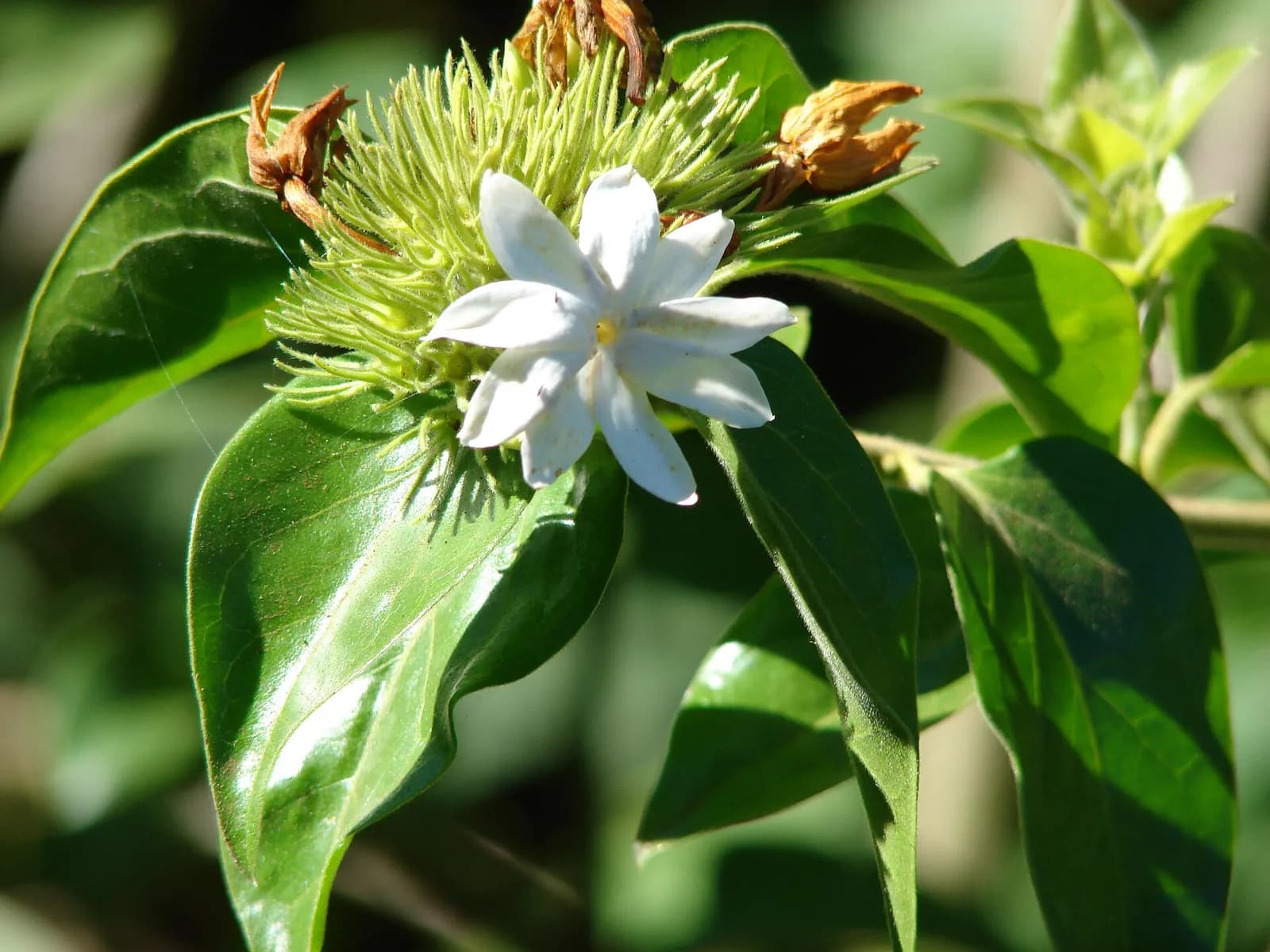
Kunda: flowers, buds and shrub
Sources
We build Vrajapedia together – with stories, verses, photographs and parikrama experience. If you know something more, tell us and it will appear on this page.


