Mallika
A small white flower that opens not towards morning but towards night and fills the dark forest with a thick sweet scent. This is the mallika, the mogra, the Arabian jasmine. Its whiteness and its night fragrance made it the flower of night in Vraja. That is why, of all the jasmine kin, it is the mallika that opens the account of the rasa-lila: the autumn nights steeped in its fragrance are what the Bhagavatam names at the point where Krishna resolves to go out to the dance of love. And on the altar it is given almost the highest place: above the mallika the manuals of service set the jati jasmine alone.
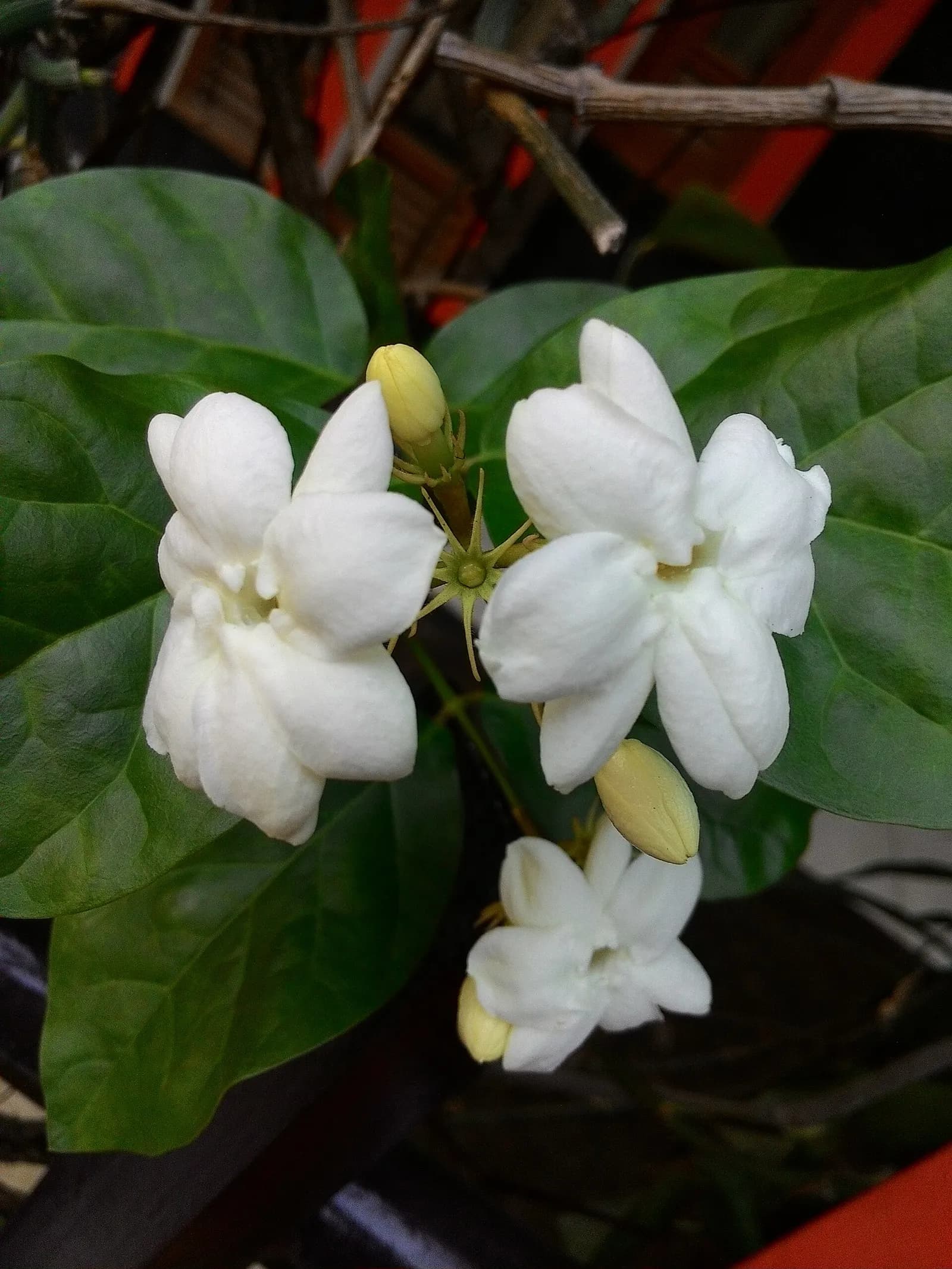
The Flower in Vrindavan
The mallika owes its fame to one night. Setting out on the account of the rasa-lila, Shukadeva describes that night – and names it by a flower:
bhagavān api tā rātrīḥ śāradotphulla-mallikāḥ
vīkṣya rantuṁ manaś cakre yoga-māyām upāśritaḥ
“Sri Badarayani said: Sri Krishna is the Supreme Personality of Godhead, full in all opulences, yet upon seeing those autumn nights scented with blossoming jasmine [mallika] flowers, He turned His mind toward loving affairs. To fulfil His purposes He employed His internal potency.”
Why the Mallika Is Named
Why, of all the flowers of Vrindavan, it is the mallika that is named, the commentators explain in different ways. Srila Jiva Gosvami notes that the mallika does not usually flower in autumn: by that very combination the verse speaks of the unprecedentedness both of that autumn and of those flowers. Srila Sanatana Gosvami takes the thought another way: in Vrindavan, where all the seasons live at once, everything is always in flower, and the mallika is named for something else – for its opening at night1. Srila Vishvanatha Chakravarti adds to this that on that night the kunda opened too, and even the lotuses, which have no business flowering at night.
The mallika is recalled in the scene of the search as well. The gopis, out of their minds with separation, rush about the night forest and ask after Krishna plant by plant: first the great trees – the ashvattha, the plaksha, the nyagrodha, after them the kurabaka, the ashoka, the naga, the punnaga and the champaka, then the tulasi, and only fourth the jasmines, each called by name:
mālaty adarśi vaḥ kaccin mallike jāti-yūthike
prītiṁ vo janayan yātaḥ kara-sparśena mādhavaḥ
“O malati, O mallika, O jati and yuthika, has Madhava gone by here, giving you pleasure with the touch of His hand?”
In the jasmines the gopis see fellows in service: they too give Krishna their finest flowers, and so they are His maidservants as well. That is why they are asked as equals – has the beloved passed by here, did He touch them with His hand while picking their flowers.
The mallika appears once more where Krishna and Balarama meet the coming of night and honour it together with all that adorns it:
niśā-mukhaṁ mānayantāv uditoḍupa-tārakam
mallikā-gandha-mattāli-juṣṭaṁ kumuda-vāyunā
“The two Lords praised the nightfall, signalled by the rising of the moon and the appearance of stars, by a lotus-scented breeze and by bees intoxicated with the fragrance of the mallika.”
Srila Sanatana Gosvami notes: the flowers of Vrindavan are past counting, yet only the mallika and the kumuda water lily are named here – both of them night flowers, both of them opened for this particular occasion. The mallika is the flower of night; and night in Vraja is the time of Krishna.
Worship
The mallika is offered to Krishna as well, and in the manuals of service it stands almost above every flower. Srila Sanatana Gosvami gathered in the Hari-bhakti-vilasa a whole selection on the greatness of flowers out of the Skanda, the Narada and the Vishnu Purana, and there a real ladder of worth is built. One lotus flower is worth a thousand kunda flowers, one mallika flower a thousand lotuses, and above the mallika only the jati rises2. What is reckoned here is not beauty but the fruit of the offering: whoever offers Krishna a fragrant mallika is, in the word of the Skanda Purana, freed from all sins and gains the abode of Vishnu.
The mallika has a liberty of its own as well. Other flowers are offered only at their own hour – the sondali and the yuthika at night, the malati in the morning – whereas the mallika, says the Vishnu-rahasya, may be offered to Krishna both by day and by night3. The flower that opens in the dark turned out to be fit for the altar at any hour of the day.
The White Tryst
In one scene the mallika finds itself at the very centre – in a night tryst. Setting out to Krishna on a moonlit night, Radha goes all in white, and a garland of mallika crowns Her attire:
haṁsāṁśukā sa-śaśi-candana-lipta-kāyā
muktā-vibhūṣaṇa-citā dhṛta-mallikā-srak
“In white silk that melted into the moonlight, anointed with white sandal, in pearl ornaments and a garland of mallika, with the bells of Her anklets hushed, Radha set out with Her friends for the bower.”
This is shukla-abhisara, “the white going out”: on a moonlit night Radha dresses to the colour of the moon so as to pass unseen, and the white mallika here is not an ornament but part of that concealment.
The mallika enters the verses in another way as well – as a token of a happiness that is no more. In the Padyavali, the anthology of Srila Rupa Gosvami, there is a verse about how Radha, finding Herself beside Krishna again, recognizes everything around Her as it was and does not find the former joy:
seyaṁ nadī kumudabandhu-karas ta eva
te mallikā-surabhayo marutas tvam eva
“The same river, the same moonlight, the same bank of the Yamuna, the same forest, the same winds steeped in the fragrance of mallika – O beloved, dearer than life, and yet You have become unattainable for me.”
The Fragrance in Poetry
The very winds that once breathed of the tryst now only sharpen the memory of separation.
On the scent of the mallika rests the picture of a living, singing Vrindavan too: in the Vidagdha-Madhava of Rupa Gosvami Krishna tells his friend that this forest gladdens the senses in every way – “here the vines are dancing, there the pure fragrance of mallika, there the juice of pomegranates pours in streams”4. And the flute of Krishna, in the word of the Padyavali, sounds most regal of all on a moonlit night in a forest steeped in the fragrance of mallika.
Through the mallika the god of love enters the verses as well. Srila Jayadeva Gosvami in the Gita-Govinda paints the spring forest all in the white pollen of the half-opened mallika vines, and the wind from the Malaya hills, the friend of Kamadeva, that burns the hearts of the separated with that fragrance5. The mallika stands among the five flower arrows of Kamadeva as well: the Sanat-kumāra-saṁhitā, which Srila Vishvanatha Chakravarti Thakura quotes in his Mantrārtha-dīpikā, gives it the letter i of the kāma-bīja – together with the mango blossom, the ashoka, the madhavi and the bakula6. There is another five as well, the lexical one: the Amara-koṣa names aravinda (lotus), ashoka, cūta (mango), navamallika and nilotpala (blue lotus) – and there the mallika stands under the name navamallika. The lists do not quarrel: one counts flowers, the other reads a mantra.
Chaitanya Mahaprabhu
In His last years, in Jagannatha Puri, Sri Chaitanya Mahaprabhu lived through that same scene of the night search anew. In the derangement of love He, like the gopis, addressed the vines and the trees, and among them the mallika:
tulasi, mālati, yūthi, mādhavi, mallike
tomāra priya kṛṣṇa āilā tomāra antike?
“O tulasi! O malati! O yuthi, madhavi and mallika! Krishna is dear to you – surely He has passed near you?”
A few verses earlier the Chaitanya-charitamrita quotes the very verse of the gopis from the Bhagavatam – the one that stands above in this article. Mahaprabhu repeated it in separation, and then called out to the flowers in words of His own.
Beyond Vraja
The mallika flowers far from Vrindavan as well. In the description of Dvaraka the same flowers hang in the quarters of Queen Rukmini:
mallikā-dāmabhiḥ puṣpair dvirepha-kula-nādite
“Garlands of mallika and other flowers hung here and there, attracting swarms of humming bees.”
The same flower that in Vraja was woven into a garland for a night tryst here adorns royal chambers.
Ayurveda
The mallika has no article of its own in Ayurveda: it goes together with the other jasmines under the common name jati, and under that name it is above all Jasminum grandiflorum that is described. The taste (rasa) of the jati is bitter and astringent, its potency (virya) warming, its post-digestive effect (vipaka) pungent; the plant balances all three doshas. It is taken for diseases of the mouth and the skin – mouth ulcers, inflamed gums, wounds – and also for inflammation of the eyes, headache and fever. The mallika stands in the same group, but is used by physicians more rarely.
Botany
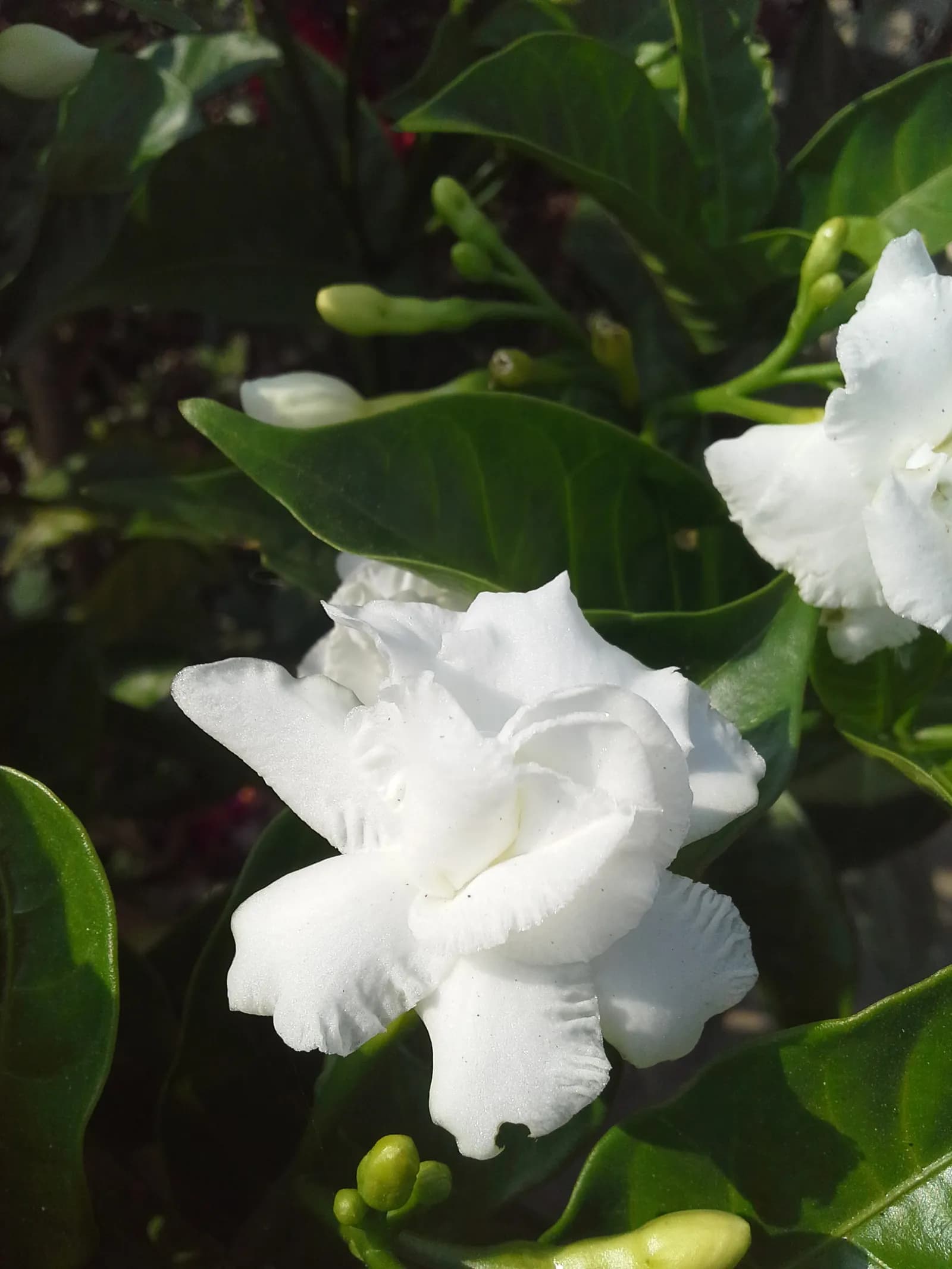
The mallika is Jasminum sambac, the Arabian jasmine. The name deceives: “Arabian” it was called after Arabia, where it has long been grown, while its home is elsewhere – India and the Eastern Himalayas. Its shoots now stand upright, now stretch out and cling, and in gardens the mallika is often trained up a support like a vine. The flowers sit three to twelve at the ends of the shoots, double in the garden forms; they open at about six to eight in the evening. In India it is grown everywhere for its flowers – for garlands, for adorning the hair and for temple service.
Mallika: flower, shoot, bush
Sources
We build Vrajapedia together – with stories, verses, photographs and parikrama experience. If you know something more, tell us and it will appear on this page.


