Madhuka (Mahua)
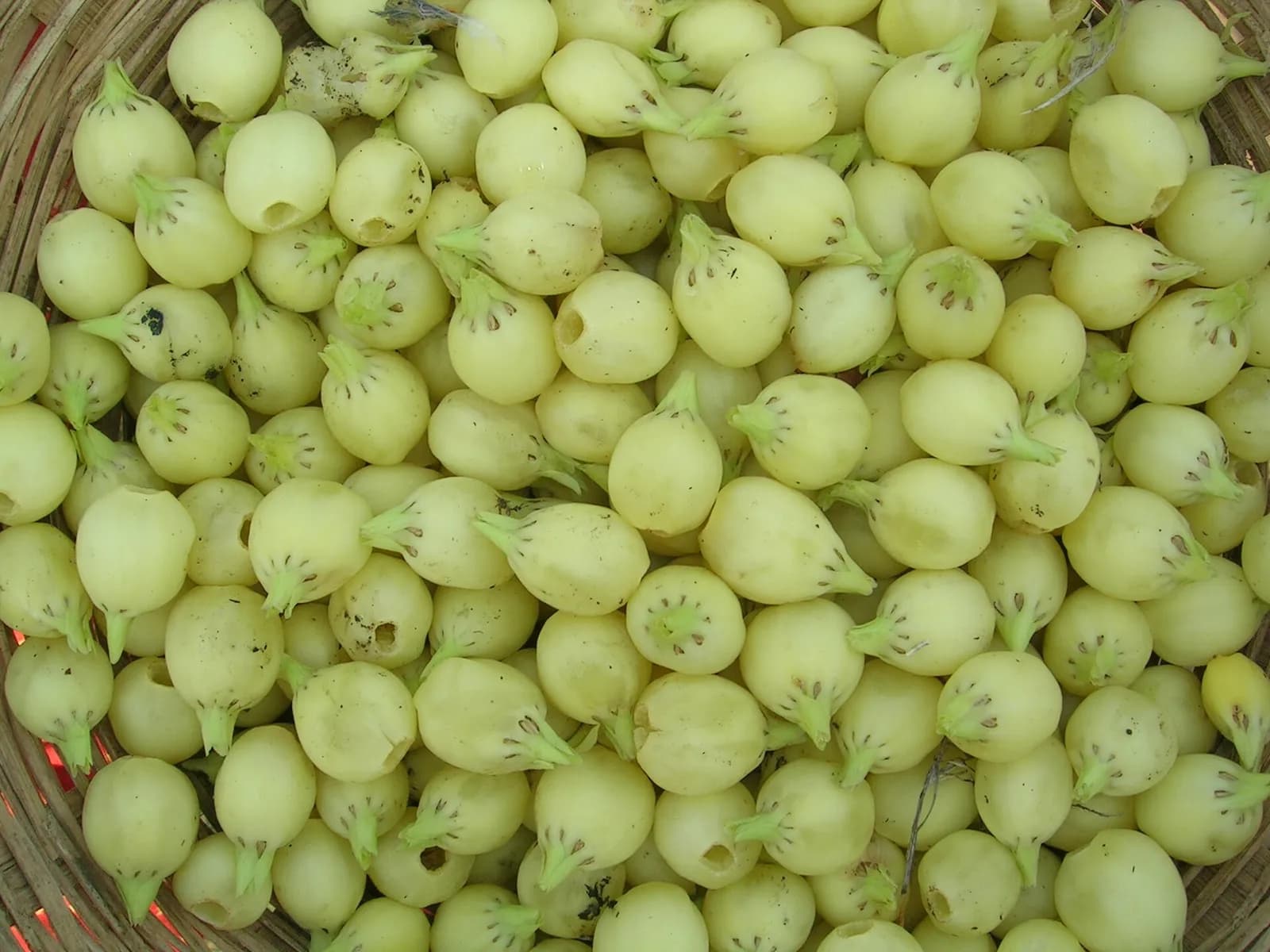
There is a tree in Vraja whose flowers are famed not for their colours but for their sweetness. Heavy with nectar, they open at night and fall at dawn, and their juice is so sweet that sweets are cooked from these flowers and liquor is distilled out of them. This is the madhuka, in Hindi mahua; its name comes from madhu, “honey”. In Jayadeva Gosvami's verse Krishna goes over the features of Radha's face and for Her cool cheeks finds a single comparison – the lustre of the madhuka flower; in that verse it becomes one of the five flower arrows of the god of love.
Madhuka in the Poetry of Vraja
In the verse of Vraja the madhuka is recalled when Radha's face is described. In the Gita-Govinda of Srila Jayadeva Gosvami there is a scene where Krishna, making peace with His angry beloved, goes over the features of Her face and finds a flower for each of them; together they make up the five arrows of Kamadeva, the god of love:
bandhūka-dyuti-bāndhavo ’yam adharaḥ snigdho madhūka-cchavir
gaṇḍaś caṇḍi cakāsti nīla-nalina-śrī-mocane locanam
nāsābhyeti tila-prasūna-padavīṁ kundābha-danti priye
prāyas tvan-mukha-sevayā vijayate viśvaṁ sa puṣpāyudhaḥ
“My beloved Chandi, O hot-tempered woman, your enchanting red lips are friends with the lustre of a bandhuka flower. Your cool cheeks have assumed the splendour of a madhuka flower. Your eyes eclipse the beauty of a blue lotus flower. Your nose is like a sesame flower. Your teeth are as radiant as jasmine blossoms. O beloved, the flower archer Kamadeva worshipped your face with his five flower arrows and then conquered the entire universe.”
The Five Arrows from Radha's Face
Srila Bhaktivedanta Narayana Gosvami takes these five arrows one by one. Radha's cheeks, he says, have “the elegant golden-white lustre of a madhuka flower, as if nectar is just about to ooze from within” – this is the honey-coloured arrow of vashikarana, the arrow of subjugation by enchantment1. The gold is brought into the cream-white flower by the comparison itself: as nectar ripens under the skin of the corolla, so under the softness of the cheek there hides a power that conquers the universe.
The same sweetness is taken up by Srila Rupa Gosvami in the play Lalita-Madhava. The madhuka flower is famous for its honeyed juice madhvika, and yet, Krishna says here, the bee, drunk on the fragrance of His beloved's face, goes blind to all the rest:
paśya paśya palāśe nollāsaṁ vahati viphalaṁ vetti phalinīṁ na vāsaṁ
vāsantyāṁ śrayati kumude yāti na mudam madhūke mādhvīkaṁ na dhayati
navaṁ naiti lavalīṁ madenābhūd andhas tava vadana-gandhān madhukaraḥ
“Look, only look: the bee takes no joy in the palasha, sets no value on the phalini, will not settle in the vasanti, is not drawn to the kumuda, does not even drink the madhvika honey of the madhuka flower, passes by the fresh lavali – it has gone blind with drunkenness, having breathed in the fragrance of Your face.”
The madhuka is taken here as the very measure of natural sweetness, and only so that something still more intoxicating may outdo it2.
In both verses the madhuka is named for one thing only – for the beauty of Radha. The commentary on the Gita-Govinda says that Kamadeva does not own these arrows but borrows them from Her: he conquers the universe with weapons lent from Her face, and only by Her mercy. So a honey-bearing forest tree becomes a mark of Her beauty.
Worship
From the forest the madhuka comes to the chest of the Lord Himself. In the Hari-bhakti-vilasa Srila Sanatana Gosvami quotes the words of Krishna about twenty-five forest flowers that He loves as He loves the goddess Lakshmi, and out of which He Himself once wove His vanamala, the forest garland. The madhuka flower stands in that list on a par with malati, nagakeshara, kunda, kadamba and ketaki:
…madhu madhuka-puṣpam… pañcaviṁśati-puṣpāṇi lakṣmī-tulya-priyāṇi me
madīyā vanamālā ca puṣpair ebhir mayā purā grathitā…
“…[among them] madhu is the flower of the madhuka… These twenty-five flowers are dear to Me as Lakshmi; of them I Myself wove My forest garland of old.”
The unremarkable word madhu in this list Sanatana Gosvami explains on the spot: madhu is the flower of the madhuka3. Not only the flower is used: the same book counts the tender leaf of the madhuka among the greenery fit for offering.
And Sanskrit lexicons set the madhuka in a class of its own: kshira-vrikshas, “milk trees”, is what they call the nyagrodha, the udumbara, the ashvattha and the madhuka, and some add the plaksha as a fifth. All of them but the madhuka are figs.
Beyond Vraja
Outside the poetry of Vraja the madhuka is one of the trees with which the shastras people the sacred gardens and mountains. In the Eighth Canto of the Bhagavatam, in the lila of the liberation of Gajendra, in a valley of Mount Trikuta spreads the Ritumat garden that belongs to Varuna: the trees in it flower and bear fruit in every season, and the madhuka is named there beside the tamala, the arjuna and the udumbara4. In the Fourth Canto the same tree grows on Kailasa, the abode of Lord Shiva – among date palms, mangoes and priyalas.
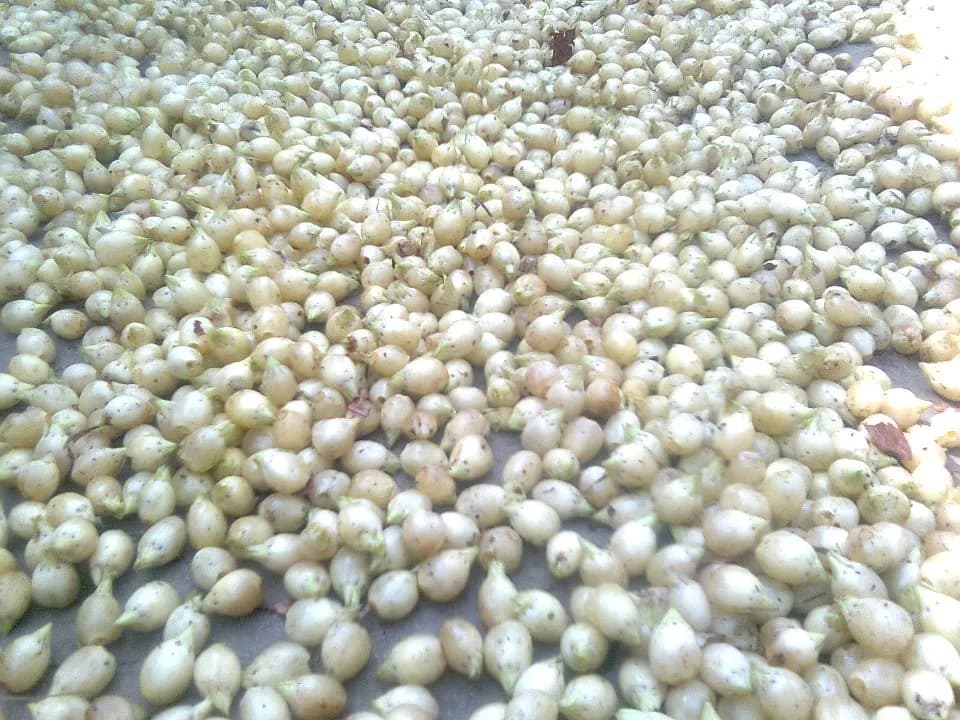
The shastras know the household fame of the madhuka as well: a thick oil is pressed from its seeds. The Hari-bhakti-vilasa, listing what one may renounce for spiritual merit, names the giving up of madhuka oil too – by it, it is said, one gains incomparable good fortune5. The renunciation is no accident: mahua oil was in use all over India for centuries – people cooked with it, anointed themselves with it, burned it in lamps.
Ayurveda
The nighantus, the Ayurvedic lexicons of plants, count the madhuka among the fruit trees: in the Bhavaprakasha it stands in the section of “the mango and its like”. Its taste (rasa) is sweet and astringent, its potency (virya) cooling, its post-digestive effect (vipaka) sweet.
The flowers are credited with an astringent, mildly laxative and strengthening action: with them the burning in the body is soothed and strength is restored after exhaustion. The flowers are taken for cough and cold, the bark for skin diseases, wounds and diabetes, the seed oil for rheumatism and for the skin.
Botany
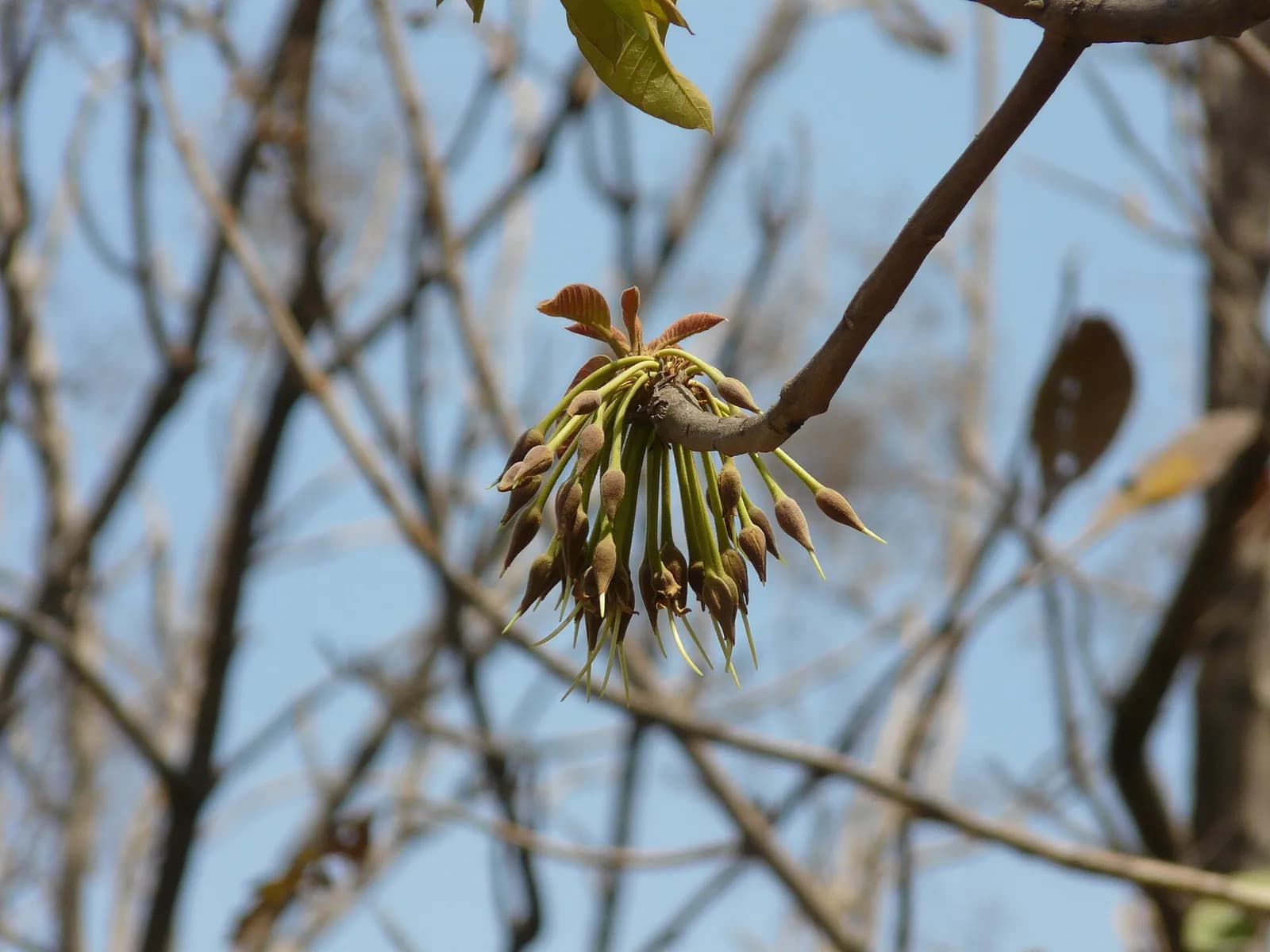
The madhuka is a kinswoman of the bakula; its bark is thick and grey, cracked vertically. The tree sheds most of its leaves by the end of winter and flowers at that same time, while the new foliage unfolds only towards the end of the flowering. The flower takes one not by its look but by its make: a globular fleshy corolla about a centimetre and a half across, with a musky smell. The fallen corollas are eaten fresh and dried, sweets are cooked from them and liquor is fermented out of them. The fruit is a fleshy green berry with one to four brown seeds, from which an edible and lamp oil is pressed; for that oil the tree was nicknamed the Indian butter tree. The madhuka is native to India, Nepal, Bangladesh, Myanmar and Sri Lanka; its regional names differ: mahua in Hindi, illupei in Tamil, ippa in Telugu, maul in Bengal.
Madhuka: bark, leaf, crown
Sources
We build Vrajapedia together – with stories, verses, photographs and parikrama experience. If you know something more, tell us and it will appear on this page.


