Ketaki
A thorny fragrant shrub from the river banks; its golden inflorescences bristle out in every direction, and the spring wind carries their scent so far that the poets of Vraja call that wind itself an arrow of the god of love. Ketaki’s fate is a strange one: an angered Shiva banished it from his worship for ever, while the Vaishnavas, on the contrary, lovingly offer its golden flowers to Krishna. And Radha too is called by its name: kanaka-ketaki, “the golden ketaki” – it is She, shining with gold beside a Beloved dark as an emerald.
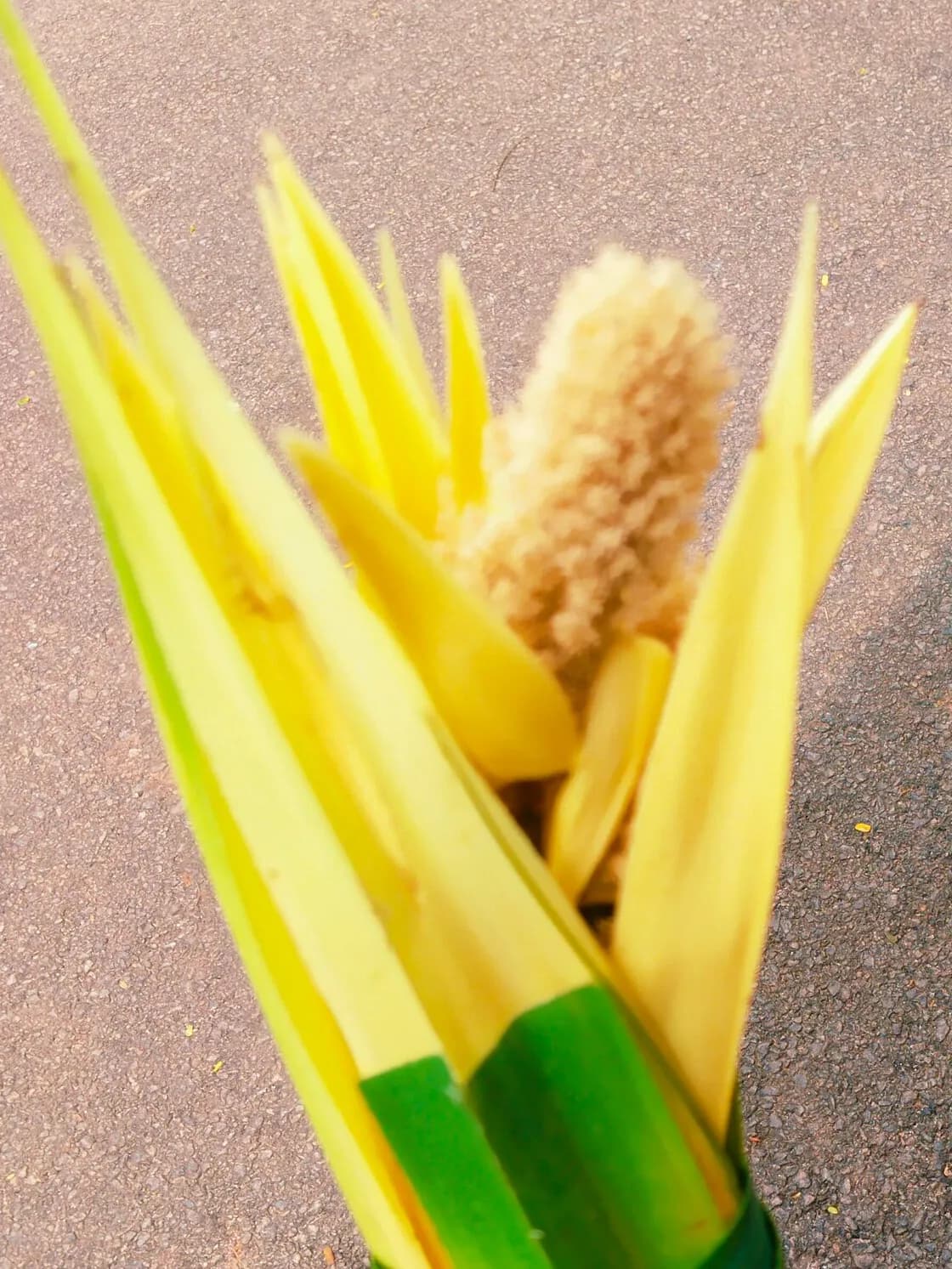
Ketaki in Vraja
Ketaki grows at the very edge of the water, on aerial prop roots, and its leaves are long, stiff and thorny along the margin. But once it flowers, a thick, almost fruity scent fills the whole forest.
Ketaki has flowered in Vraja since the first day of Krishna’s life. Srila Jiva Goswami in the “Gopala-champu” relates that at the hour of His birth all the seasons appeared at once, against every order: the jasmines opened together with the spring creepers, the lotuses with the night lilies, and “the summer ketaki blossomed together with the spring ketaki”1. The world could not contain its rejoicing, and ketaki flowered out of season, in two times of the year at once.
With the golden inflorescences of ketaki the Divine Couple are adorned: the gopis weave them into Krishna’s hair and set crowns of its petals into Radha’s coiffure, while on His chest they hang garlands of mallika2.
The scent of ketaki is counted by the poets among the fragrances of Radha Herself: Srila Krishnadasa Kaviraja Goswami in the “Govinda-lilamrita” writes that from Her sides, Her hips and the tips of Her nails comes the scent of ketaki anointed with sandal.
The golden ketaki: an image of Radha
The inflorescence of ketaki is golden – and with this gold the poets describe Radha. Srila Rupa Goswami puts such a comparison into the mouth of Krishna Himself:
kanakādri-niketa-ketakī
kalikā-kalpā-kalevara-dyutiḥ
hṛdi sā mudirāli-medure
capalā māṁ kim alaṅkariṣyati
“Her body shines like an unopened bud of ketaki on a golden mountain. When will She, like lightning, adorn the dense thundercloud of My chest?”
Srila Kavikarnapura unfolds the same image in the “Ananda-Vrindavana-champu”: Radhika, he says, is “the golden ketaki in the garden of prema, the lightning in the cloud of sweetness, the golden streak on the touchstone of beauty”. And Srila Narottama das Thakur compressed it all into one line that is still sung today: kanaka-ketaki rai, shyama marakata kai – “Radhika is the golden flower of ketaki, Krishna is the dark emerald”3.
The spears of separation
For those in separation everything turns the other way: both the scent and the inflorescences sharp as pikes, which gladden lovers at their meeting, become a torment. Srila Jayadeva Goswami speaks of this in the “Gita-govinda”, painting the spring in Vraja:
vigalita-lajjita-jagad-avalokana-taruṇa-karuṇa-kṛta-hāse
virahi-nikṛntana-kunta-mukhākṛti-ketaki-danturitāśe
viharati harir iha sarasa-vasante
“Shaped like javelins for piercing the hearts of lonely lovers, the flowers of ketaki bristle brightly in all directions of the horizon; and here, in the height of the sweet spring, Hari plays.”
The poet compares the inflorescences of ketaki with the kunta, the spear, whose point is aimed at the heart of one who is apart from the beloved. The scent turns into an arrow as well: the Malaya wind, “the friend of the ketaki’s fragrance”, sweeps through the forest like an arrow of Kamadeva and burns the lonely4. The “Padyavali” of Srila Rupa Goswami takes up the same image: one in separation sees the sky already grey with ketaki pollen and begs fate to grant him a respite at least by a swoon5. While ketaki is in flower, the trouble will not let go.
Worship
Whether ketaki may be offered to the Lord is an old and difficult question. The flower itself has a heavy reputation: an ancient curse cut it off from the worship of Shiva. The commentators of the “Srimad-Bhagavatam” cite at verse 11.3.53 the current rule: nakshatair archayed vishnum na ketakya maheshvaram – “Vishnu is not honoured with akshata, whole grains, nor Shiva with the flower of ketaki”. Shridhara Swami states it first, and after him Srila Vishvanatha Chakravarti Thakur repeats it. One passage seems to carry this disgrace over into Vaishnava service as well: the “Hari-bhakti-vilasa” cites from the “Vamana Purana” a list of the best flowers for Govinda with a reservation:
etāni supraśastāni kusumāny acyutārcane
surabhīṇi tathānyāni varjayitvā tu ketakīm
“These – and other fragrant – flowers are excellent for the worship of Achyuta, except for ketaki alone.”
But the commentary removes the contradiction at once. What is meant is vana-ketaki, Srila Sanatana Goswami explains at verse 141: what is excluded is the wild, forest ketaki, the whitish one. The golden one is not only permitted but especially dear to the Lord: whoever offers Janardana its golden flower gains a merit equal to the giving of gold6.
For the rest, the “Hari-bhakti-vilasa” is full of praise for ketaki. In a conversation with Narada, Bhagavan names twenty-five flowers as dear to Him as Lakshmi – ketaki among them, and all these forest flowers He once wove into a garland Himself7. According to the “Skanda Purana”, offered in the month of Kartika together with a ghee lamp, ketaki saves ten thousand generations of the family of the one who offered it8. And the “Harita-smriti” draws the circle tighter still: its short list of the ten praised flowers for the Lord includes ketaki9. The very flower that is closed to Shiva is open to Krishna – one need only take the golden one, not the wild.
Beyond Vraja
Ketaki’s disgrace goes back to a well-known Puranic story. When Brahma and Vishnu fell to arguing about seniority, an endless pillar of light rose before them, the jyotirlinga of Shiva, and both set out to find its ends. Failing to find the top, Brahma lied that he had reached it and called as witness a ketaki flower that was falling from above. The flower confirmed the lie. For this Shiva cursed it: from that day ketaki lost its place among the finest flowers and was cut off from the worship of Shiva – so the “Saura Purana” tells it. The rule “Shiva is not honoured with the flower of ketaki” is the echo of that curse. Outside Shaivism ketaki’s fate is another: its flowers and leaves are an important part of the worship of the goddess Manasa.
Ayurveda
Ayurveda knows ketaki above all as an aromatic and warming plant. Its taste (rasa) is bitter and pungent, in part sweet; its potency (virya) is ushna, hot; its after-taste (vipaka) is pungent. It pacifies chiefly kapha and vata. The male inflorescences, the leaves and the roots are used. Ketaki is applied as a calming and aromatic remedy, in headache and skin diseases, while kewda water and the attar of its flowers entered both cosmetics and the kitchen long ago.
Botany
Ketaki is Pandanus odorifer of the pandanus family, with a crooked trunk on stilt-like prop roots. The leaves sit in rosettes, up to two metres long, and along the margin and the midrib they are set with yellow curved spines. Ketaki grows by the water: on beaches and at the edge of mangrove thickets, along rivers and canals.
The male inflorescence is a large branched bunch 25–30 cm long and 18–25 wide. The spathe around it is three times larger, 80–100 cm, and is made of yellow papery bracts. Its scent is rosy, with a fruity note; from these inflorescences kewda oil and kewda water are distilled. In Odisha ketaki flowers three times a year: May and June account for about three flowers in ten, October and November for one, while the best and most abundant come with the rains, from July to September.
Ketaki’s native range is wide: from the Maldives and Sri Lanka through India, the Andamans and the Nicobars to Indochina, Java, Borneo, southern China, Taiwan and the Philippines. Its name runs across India almost unchanged: Bengali and Telugu ketaki, Tamil ketakai, Kannada kedage; in Hindi, alongside ketaki, there goes kevda, also keora.
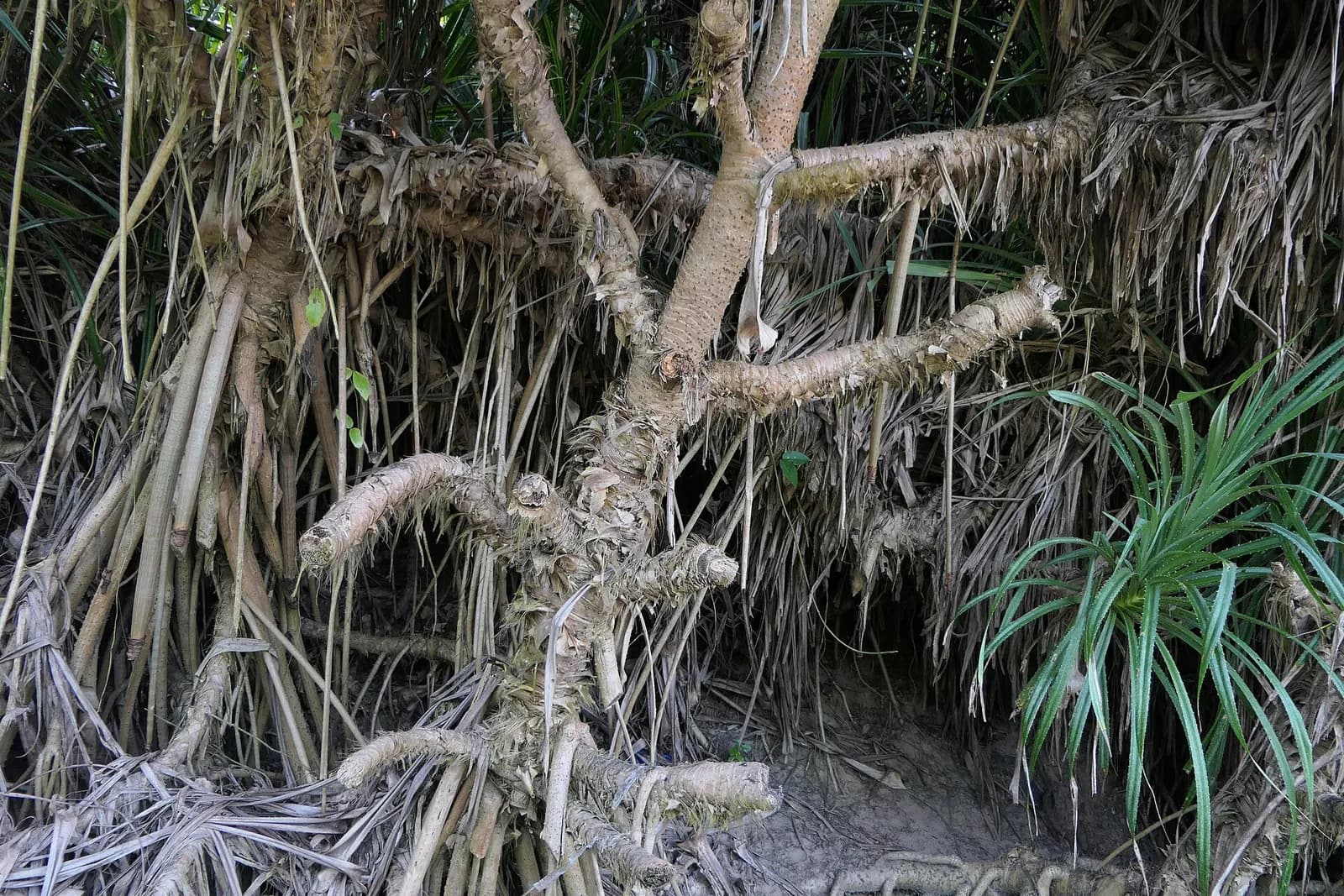
Ketaki: thickets, fruit, inflorescence
Sources
We build Vrajapedia together – with stories, verses, photographs and parikrama experience. If you know something more, tell us and it will appear on this page.


