Karavira
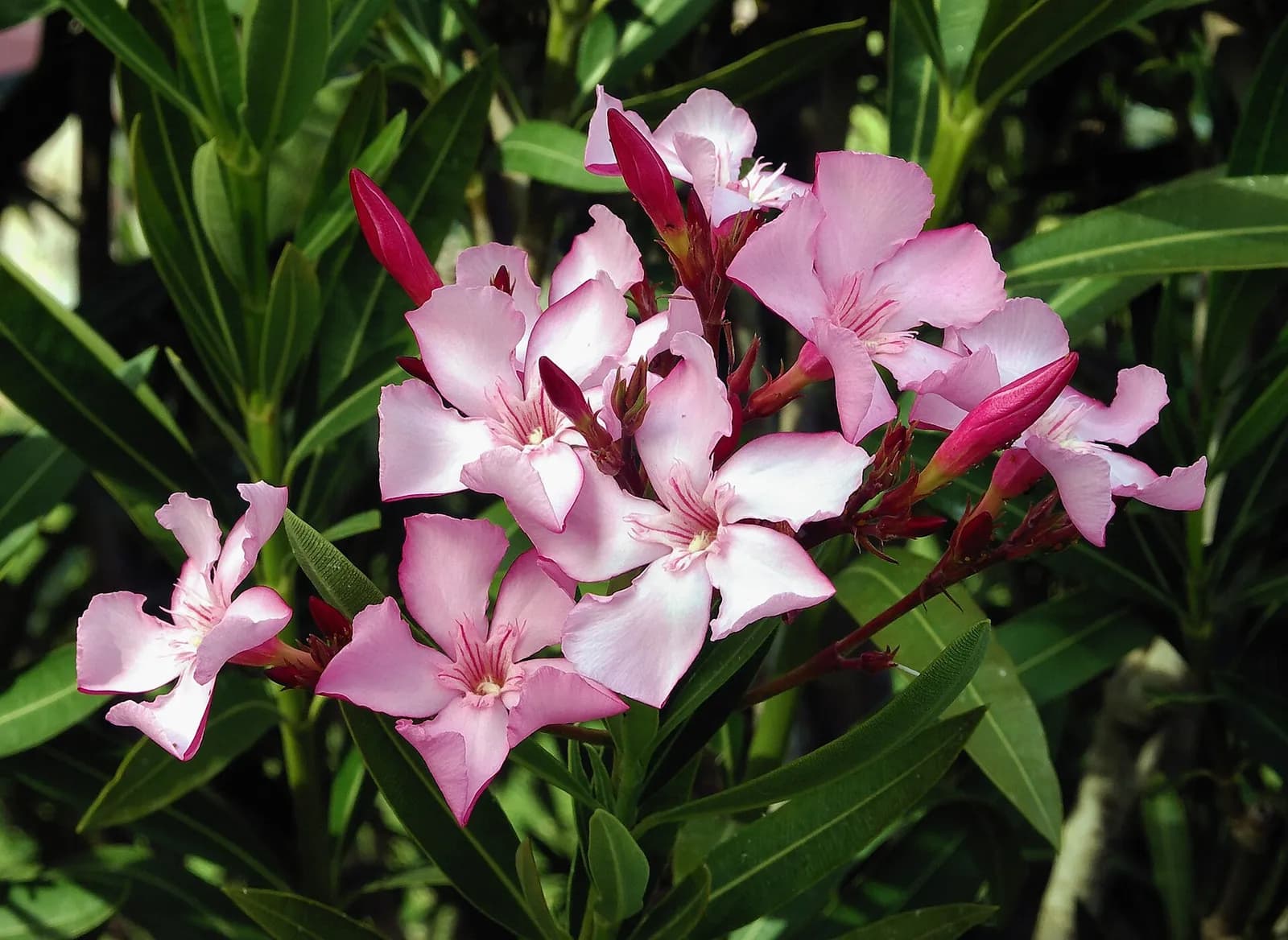
Karavira, also called kaner and oleander, is a showy shrub covered in funnels of white, pink and red flowers; in warm lands it blooms almost all year round. The beauty is deceptive: the whole plant is poisonous, and Sanskrit calls karavira ashvamara, “the killer of horses”. And yet in Vraja these flowers are brought to Krishna: karavira grows in the kunjas of Vrindavan and is among the flowers with which the Lord is honoured. Its standing, though, is odd: some texts place karavira among the finest flowers, others among those that are not offered to the Lord at all.
Contents
Karavira in Vrindavan
Karavira has no lila of its own: unlike the tamala or the kadamba, the poets give it no separate tale – it simply grows in the thicket of the eternal forest. When Srila Prabodhananda Sarasvati lists the flowering adornment of Vrindavan, karavira comes in one row with karnikara, ashoka and bakula – among the trees that bloom in every season, with ever new fragrances:
punnāgaiḥ karavīrakair maruvakaiḥ sat-karṇikārair lasat-
kubjaiḥ kunda-vanair aśoka-bakulair bhūcampakaiś campakaiḥ |
amlānaiḥ sthala-paṅkajair damanakair divyaiḥ śirīśa-drumaiḥ
sarvartu-pravikāśibhir nava-navāmodair manohāriṇi
“Vrindavan is enchanting with punnagas, karaviras, maruvaka, beautiful karnikaras, shining kubjas, groves of kunda, ashokas and bakulas, bhu-champakas and champakas, amlanas, land lotuses, damanaka and the divine shirisha trees – which bloom in every season, with ever new fragrances.”
The same place is given to it in the “Krishna-bhavanamrita” of Srila Vishvanatha Chakravarti Thakur: the trees of Vrindavan – bakula, karavira, kesara, kadamba – stand in fours, wreathed with pairs of creepers, and out of these weavings the kunjas are made, the bowers for the pastimes of Radha and Krishna1. Karavira is not the chief flower of the adornment here, but part of the forest itself.
Worship
In worship, however, karavira’s fate is a double one: it is offered with great reward, and it is also warned against.
First of the reward. Srila Sanatana Goswami in the “Hari-bhakti-vilasa”, sorting out which flowers please Vishnu, cites a verse from the “Skanda Purana”:
yer arcayanti surādhyakṣaṁ karavīraiḥ sitāsitaiḥ
catur-yugāni viprendra prīto bhavati keśavaḥ |
sitā raktair mahā-puṇyaiḥ kusumaiḥ karavīra-jaiḥ
yo 'cyutaṁ pūjayed bhaktyā sa yāti garuḍa-dhvajam
“Lord Hari remains pleased for four yugas with those who honour Him with white or red karaviras. And whoever with devotion worships Achyuta with pure white or red flowers of karavira attains the shelter of Him whose flag bears Garuda.”
Praise and reservations
Nearby it is said still more definitely: one who honours Keshava with karavira gains the merit of giving away ten pieces of gold, and one who offers a red karavira even once gains the merit of giving away ten thousand cows.
That is why karavira came into the short list of the “Harita-smriti”: ten praised flowers for the Lord, or rather five pairs – tulasi, two lotuses, the jati jasmine, ketaki and karavira2. It stands high on the flower ladder of the “Hari-bhakti-vilasa” as well: one of its flowers is worth more than a thousand flowers of nandyavarta, and the white one is the best of all3. Here too it is plain that the texts do not agree about the colour: one passage promises a special reward for the red, another sets the white above it.
But the same book adds a reservation. From the “Vishnu-dharmottara” Sanatana Goswami cites a rule: karavira grown by one’s own house should not be taken for the worship of Hari.
na gṛhe karavīra-sthaiḥ kusumair arcayed harim |
patitair mukulair mlānaiḥ śvāsair vā jantu-dūṣitaiḥ
“One should not honour Hari with flowers of karavira grown by one’s own house – nor with fallen, unopened or withered ones, nor with those already smelled or spoilt by insects.”
The matter here is not the flower itself but where it is taken from. Karavira, Sanatana Goswami explains, ought not to be planted by a house at all, and he refers to the “Varaha Purana”: “never plant bandhuka and karavira by the house”. A flower from one’s own fence is not the offering that is dear to the Lord.
There is a sharper note as well. In the list of flowers that are not offered to Janardana at all, beside the dhustura thorn-apple, the kutaja and the arka, stands an obscure “krakara” – and Sanatana Goswami explains in two words: krakara means karavira4. So one and the same flower turns up both in the list of the praised and in the list of the rejected. The texts of worship do not undertake to smooth this contradiction over.
Beyond Vraja
The name “karavira” does not always mean a flower. In the Fifth Canto of the “Bhagavatam”, in the description of the build of the world, Karavira is a mountain, one of the eight giant peaks that stand around golden Meru in pairs, on four sides. To the south of Meru, Shukadeva relates, two ranges stretch from west to east, Kailasa and Karavira, eighteen thousand yojanas long5.
Karavira grows in the heavenly gardens too. Describing the slopes of Kailasa, the abode of Kuvera, the commentator of the “Bhagavatam” Vamshidhara Pandit explains: the tree called vara in the verse is karavira, and it stands there beside the kubja and the madhavi.
There is a city of this name as well – Karavirapura, the present-day Kolhapur in the south. Going over the wanderings of Krishna and Balarama after the battle at Gomanta, Srila Jiva Goswami and Srila Sanatana Goswami recall from the “Hari-vamsha” that it was by Karavirapura that the demon Shrigala-Vasudeva was killed, after which the brothers returned to Mathura6. A bush by a fence, a mountain of the world axis and a city in the south – all of it is one name.
Ayurveda
Karavira is handled with care: the whole plant, from root to petal, contains cardiac glycosides. That is why in folk and Ayurvedic practice it is used not internally but externally, above all for skin diseases; the root and the leaves go into remedies only after thorough processing.
Botany
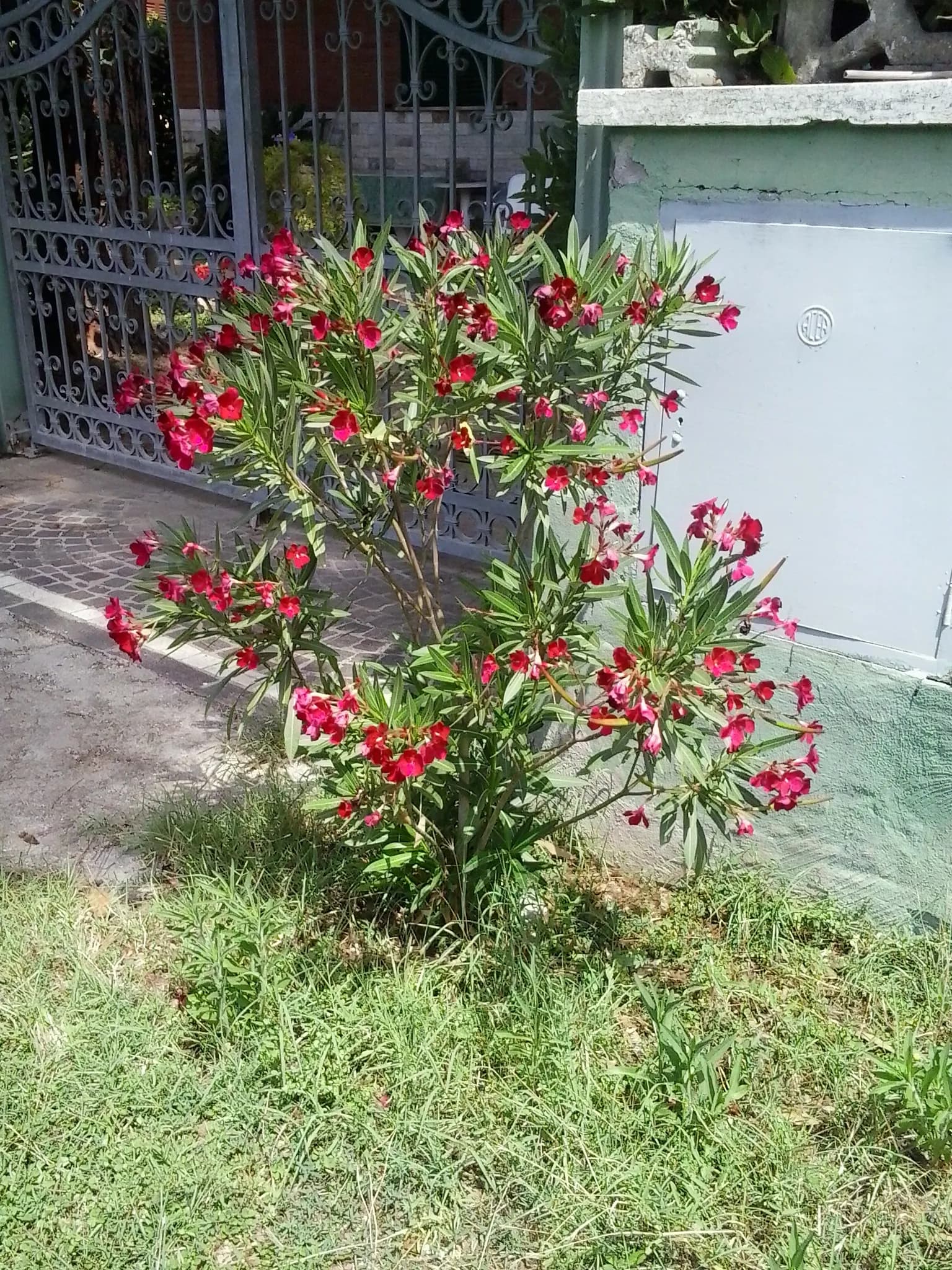
Karavira is Nerium oleander, an evergreen shrub of the dogbane family, kaner in Hindi. Its leaves are narrow and leathery and sit around the shoot in threes or in pairs. The colour of the flowers gave the shastras of worship their division into shveta and rakta, white and red karavira; in the wild pink ones occur as well.
Karavira: white, red, fruit
Sources
We build Vrajapedia together – with stories, verses, photographs and parikrama experience. If you know something more, tell us and it will appear on this page.


