Rajnigandha
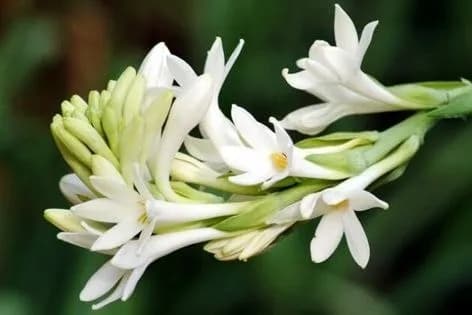
Waxy white flowers are strung along a tall spike, and towards evening, as the heat lets go, they give the air a thick, almost intoxicating scent — which is how the tuberose came by the name rajnigandha, “she who smells at night.” The tuberose is a guest from Mexico, and the classical scriptures say nothing of her. Yet today her garlands are offered to the Deities of Radha and Krishna alongside jasmine.
A Place Among the Night Flowers of Vraja
Rajnigandha is a New World plant: it comes from Mexico, where the Aztecs are thought to have grown it already. It reached India only in modern times, and it is not to be found in the verses of the scriptures. Its Sanskrit-looking name is a late popular coinage from rajani (night) and gandha (scent) — not a Vedic term.
She does have kin in spirit, though: the white night flowers that Vraja loves for the very same things — their whiteness and a scent that strengthens as night comes on. First among them is kunda, the white jasmine of which Krishna’s night garland is woven. When the gopis search for Krishna in the night forest, it is the scent of that very garland that gives Him away:
apy eṇa-patny upagataḥ priyayeha gātrais
tanvan dṛśāṁ sakhi su-nirvṛtim acyuto vaḥ |
kāntāṅga-saṅga-kuca-kuṅkuma-rañjitāyāḥ
kunda-srajaḥ kula-pater iha vāti gandhaḥ ||
“O friend, wife of the deer, has Lord Acyuta been here with His beloved, bringing great joy to your eyes? Indeed, blowing this way is the fragrance of His garland of kunda flowers, which was smeared with the kuṅkuma from the breasts of His girlfriend when He embraced Her.”
Centuries later the tuberose joined that company of white night flowers.
In Srila Prabhupada’s Garlands
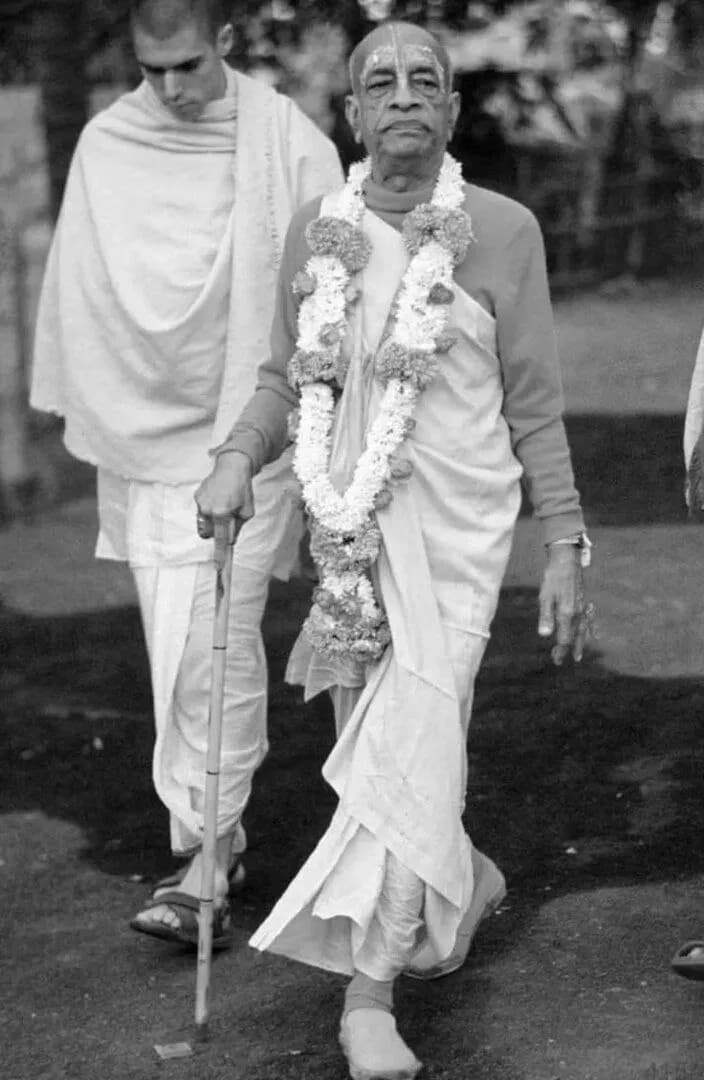
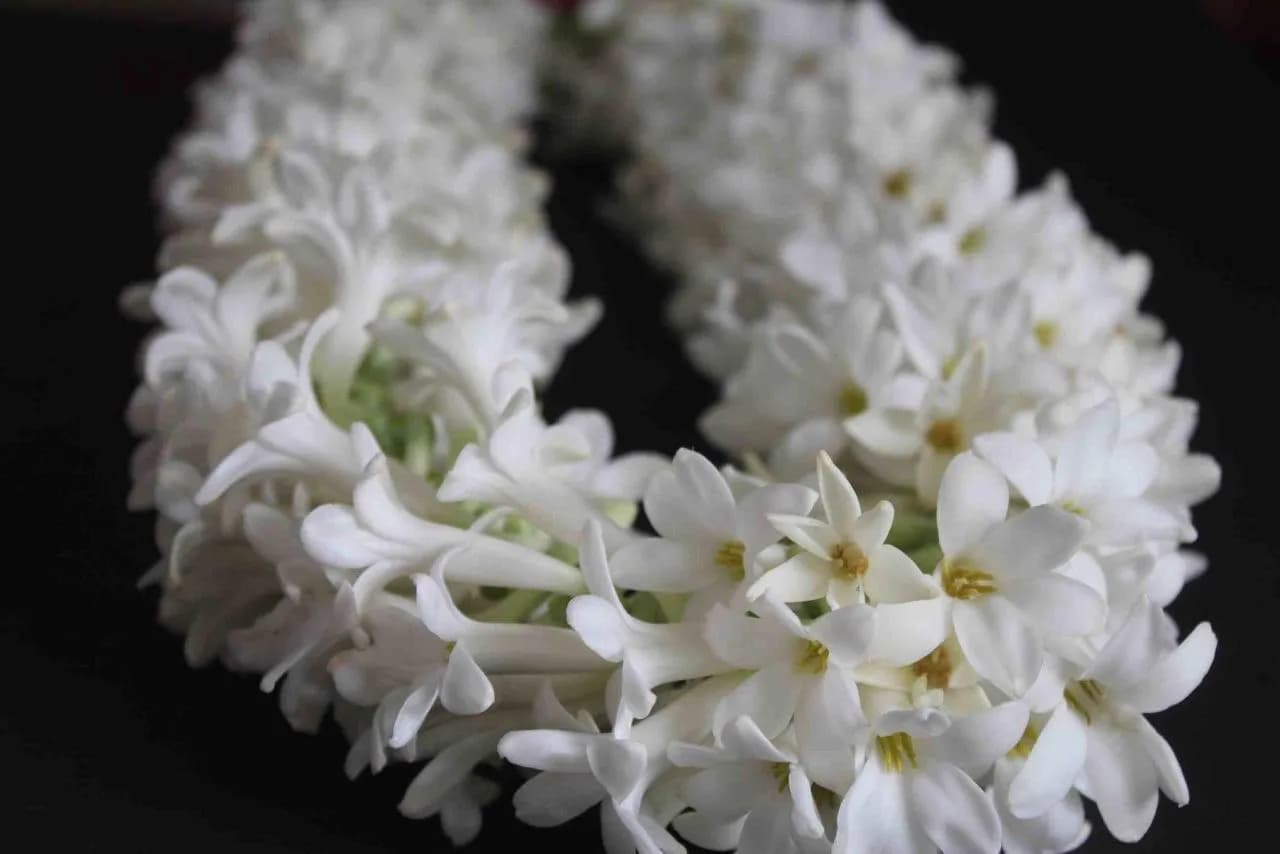
In Chasing Rhinos With The Swami, Shyamasundar Prabhu recalls how Srila Prabhupada began preaching in Bombay in 1970, and rajnigandha is there at every turn: garlands of fresh tuberoses were placed on Prabhupada himself, “strings of fresh tuberoses and jasmine hung before the Radha-Krishna Deities,” and the halls where he spoke were full of their scent. The scent of tuberose, he admits, is bound up with Bombay for him for ever.
Ayurveda Does Not Know Her
Classical Ayurveda does not know the tuberose: as a New World plant she remained outside Charaka, Sushruta and the nighantu lexicons, and no one ever assigned her a taste-rasa or a potency-virya. Her place today is in perfumery and aromatherapy, where that heavy floral scent has a name for calming and “warming.” For the medicinal fame of Vraja’s white night flowers one should turn not to the tuberose but to the true jasmines.
Botany
Rajnigandha is Polianthes tuberosa of the asparagus family; for a time it was moved to the agave genus, under the name Agave amica. The leaves are narrow and long, thirty to fifty centimetres, with a reddish base; the flowers have a long corolla tube, up to six centimetres. It is the sheer strength of the scent that gave her both names — “she who smells at night” in Hindi, “king of fragrance” in Kannada. Both are easy to mistake: “king of fragrances,” gandharaja, is what Vraja calls the gardenia, and the true “night jasmine” of the scriptures is parijata.
Rajnigandha in bloom
Sources
We build Vrajapedia together – with stories, verses, photographs and parikrama experience. If you know something more, tell us and it will appear on this page.


