Gandharaj
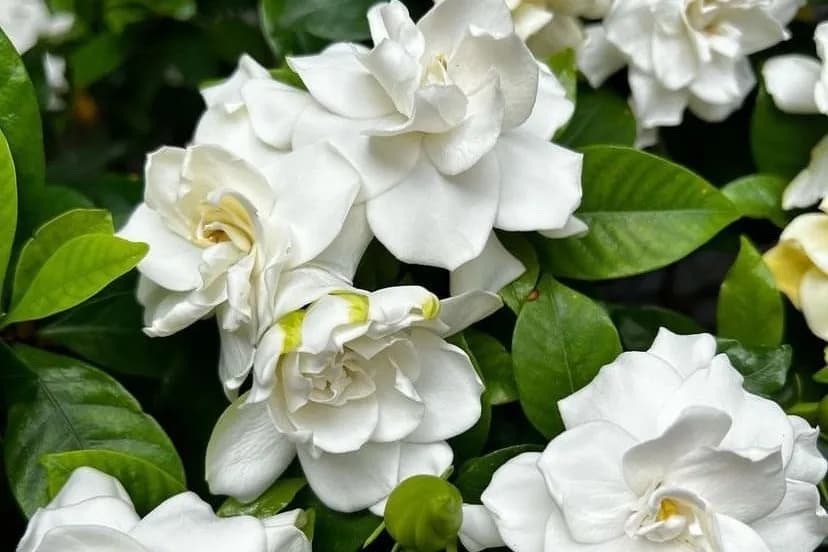
Gandharaj means “king of fragrances” — the Indian name for the gardenia. Its flowers are white and so powerfully sweet that a single bunch will scent a whole room. The shrub itself is absent from the scriptures: gandharaj is not the name of a species but a travelling title, given at different times to sandalwood and to jasmine.
May It Be Offered to Krishna?
Having listed dozens of flowers dear to the Lord in the Hari-bhakti-vilasa, Srila Sanatana Goswami cites from the Vishnu-dharmottara a rule that the gardenia also satisfies:
evaṁ ādīni deyāni gandhavanti śubhāni ca |
kecid varṇa-guṇād eva kecid gandha-guṇād atha ||
anuktāny api ramyāṇi tathā deyāni kānicit |
deśe deśe kāle yāni puṣpāṇy anekaśaḥ ||
“…and others like them — fragrant and auspicious — are to be offered. Some are prized for their colour, others for their scent. Beautiful flowers not named here may be offered as well: those that bloom in every land and season.”
The verse divides flowers into those prized for colour and those prized for scent, and in Vraja the second counts for more. When Krishna and Radha slip away from the rasa-mandala, the gopis follow Them by scent1: here fragrance is no ornament — it gives away the One who cannot be seen.
Garlands for Srila Prabhupada
Srila Prabhupada loved gardenia garlands. Bhavananda Prabhu recalls one such welcome; his words are quoted by Yadubara Prabhu in Following Srila Prabhupada:
“I asked all the temple presidents to spend a hundred dollars each on the white gardenias Prabhupada loved so much. And every president, during the welcome, would step forward and offer Prabhupada an enormous garland of fragrant gardenias. Prabhupada stood there, completely covered in gardenias.”

Medicinal Use
In China the medicine is not the flower but the dried fruit, zhi zi. It is classed among the “bitter and cold” remedies and given for jaundice, swelling and fever, to draw off inflammation and bring the temperature down.
Ayurveda, by contrast, never took the gardenia up as a medicinal plant, and here the tangle of names tells again: the properties recorded there under “gandharaja” belong to sandalwood or to jasmine.
Botany
Gandharaj is Gardenia jasminoides, an evergreen shrub of the madder family. Its flower is short-lived: within a day or two it deepens to creamy yellow, so a glance at the bush tells you what opened today and what opened the day before. It blooms in late spring and summer. Its home is the eastern Himalayas, southern China and Japan, and the countries of Indochina, where it grows in the understorey along streams and on mountain slopes. In China it has been cultivated since at least the Song dynasty (10th–13th centuries).
Gandharaj in bloom
Sources
We build Vrajapedia together – with stories, verses, photographs and parikrama experience. If you know something more, tell us and it will appear on this page.


