Pipal (Ashvattha)
A tree whose foliage is never still: even without a breath of wind the heart-shaped leaves tremble on their long petioles, as if whispering to one another. In Sanskrit it is called aśvattha, and that name comes to the fore twice. In the Bhagavad-gita Krishna lists what marks Him out among all that exists, and of trees He names Himself the ashvattha. And in Vraja, when the gopis, out of their minds with separation, search the forest for the departed Krishna, they rush with their questions to the tallest trees – and the first of them named is the pipal.
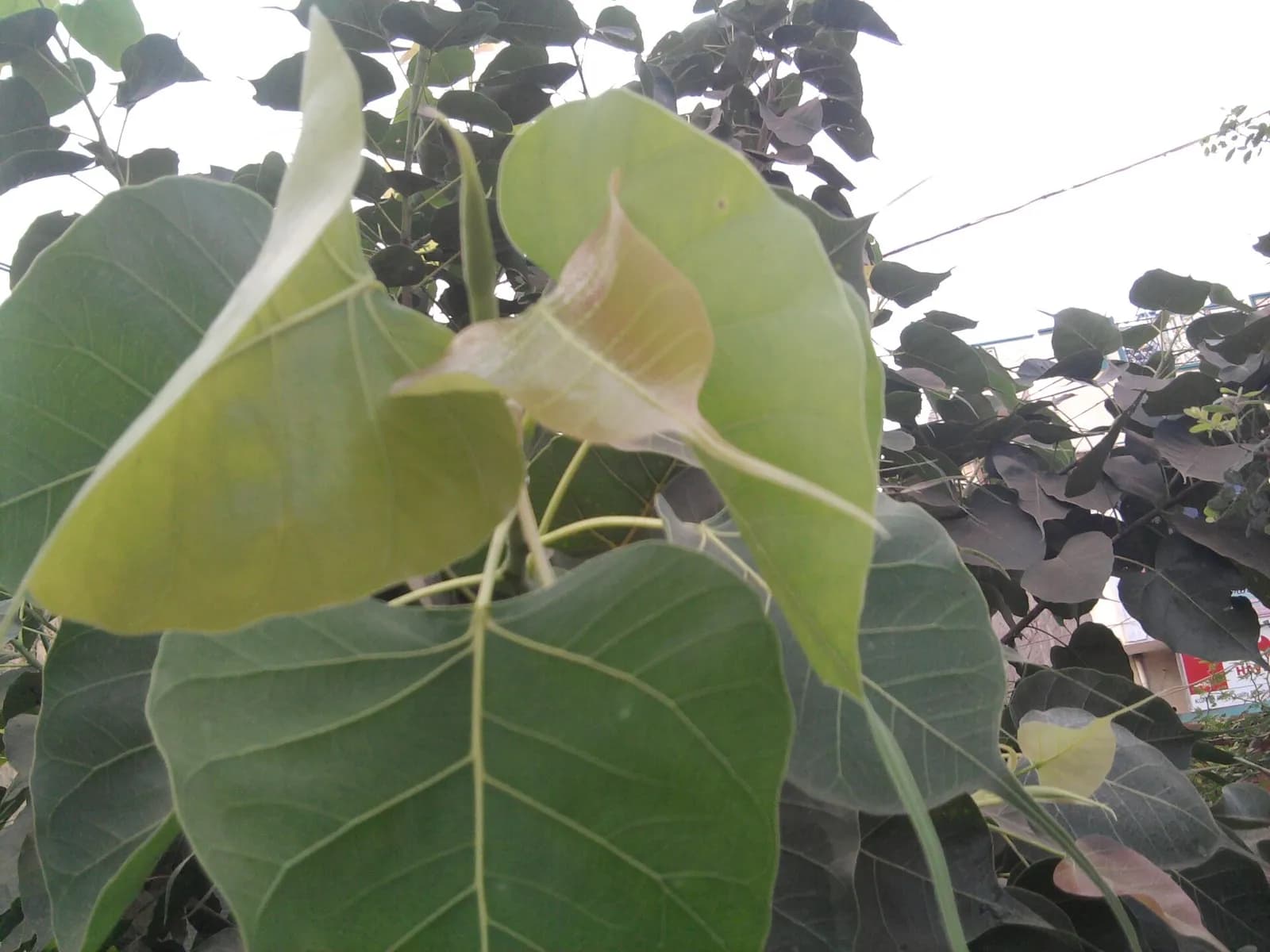
The Tree in Vrindavan
At the height of the rasa-lila Krishna disappears, and the gopis, out of their minds with separation, rush about the forest questioning every living thing about Him. The first they call out to are the great trees:
dṛṣṭo vaḥ kaccid aśvattha
plakṣa nyagrodha no manaḥ
nanda-sūnur gato hṛtvā
prema-hāsāvalokanaiḥ
“O ashvattha, O plaksha, O nyagrodha! Have you not seen the son of Nanda? He stole our hearts with His loving smiles and glances – and went away.”
Three Trees of Three Gods
The gopis begin with the tallest: these trees stand above the rest, the commentators reason, and could have seen Krishna even from far off.
There is a second explanation for the choice as well. Narayana Bhatta Gosvami and Vamshidhara Pandita say that the three trees named are the abodes of three gods: the ashvattha, that is our pipal, belongs to Vishnu (Krishna Himself named this tree as His own in the Gita), the plaksha, also called the pilkhan, to Shiva, and the nyagrodha banyan to Brahma. Srila Sanatana Gosvami cites this opinion, but at once qualifies it: the gopis, maddened by separation, were thinking of nothing of the kind – they call out to the trees simply as to Vaishnavas, each by name and with reverence1.
They do not wait for an answer. The trees are silent, and, in the words of Srila Vishvanatha Chakravarti, the gopis wave them off – “enough of these, with their small fruits, who know nothing of helping others” – and run on, to those that stand in bloom.
In Vraja the pipal is known by the trembling of its foliage. Srila Jiva Gosvami in the Gopala-champu paints Krishna entering the forest of Vrindavan for the first time with the cowherd boys and the mothers, and everyone naming the trees as they go, as in a game of question and answer: “– And what is that tree whose leaves tremble without end? – That is the pipal. – And the one that bears myriads of buds? – The udumbara. – And the one with long matted locks? – The banyan”2.
And the trees of Vraja in the poetry of the Gosvamis are themselves great devotees. Srila Sanatana Gosvami in the Brihad-bhagavatamrita says that the pipals and the other trees along the riverbanks give shade and fruit to all without distinction, like the generous elders of a noble house, while they themselves shed tears – their oozing sap – because the nectar of Krishna’s lips has not been theirs3.
The Ashvattha Leaf in the Poetry of Vraja
What the poets of Vraja loved most in the pipal is its leaf. Srila Rupa Gosvami holds it up to the belly of Krishna, describing in the Bhakti-rasamrita-sindhu how His youthful beauty emerges out of boyhood:
tundaṁ vindati te mukunda śanakair aśvattha-patra-śriyaṁ…
“O Mukunda, Your belly little by little takes on the beauty of an ashvattha leaf; Your neck, O lotus-eyed one, is marked with three lines, like a conch…”
The comparison rests on two things: the lean belly of a boy really does resemble a pipal leaf in outline, and the fine line of down upon it, the romavali, lies like the petiole to the leaf. And that belly stirs faintly with the breath – as a pipal leaf stirs in the wind. The same image Srila Krishnadasa Kaviraja Gosvami transfers to Radha in the Govinda-lilamrita, and Srila Jiva Gosvami in the Gopala-champu.
Worship
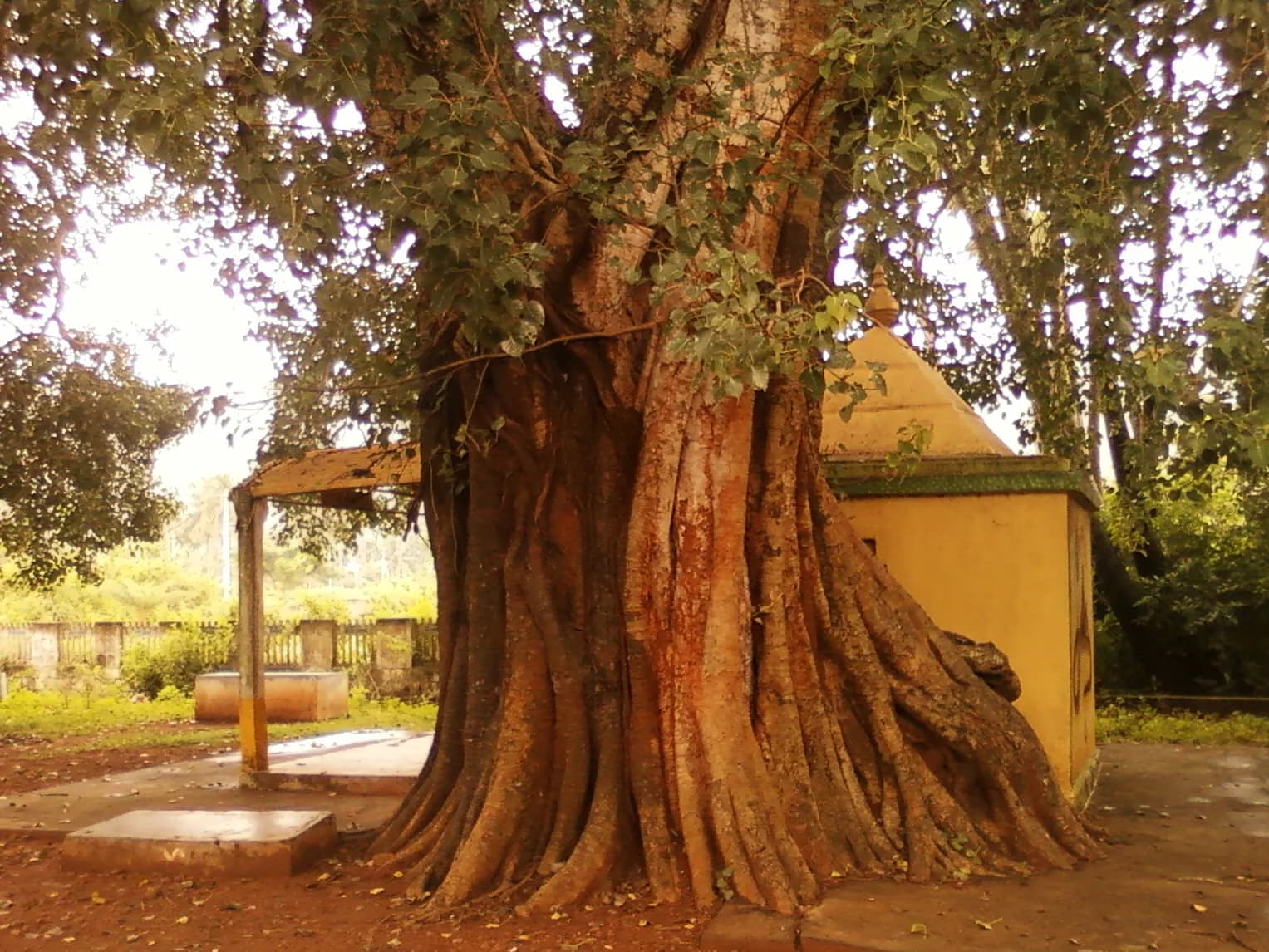
In India people bow to the pipal every day, and the custom has a name of its own: the lexicons call the pipal a caitya-vṛkṣa, “a tree by the shrine”. The word caitya itself comes from the burial mound and means a sanctuary – a stupa, an altar, a place of worship by the village; and such a tree is a village tree too: it grows by the houses, is honoured by the people, is seen as the dwelling of gods and yakshas, and may not be felled.
Why it is the ashvattha that receives these bows is explained by the Vaishnava compendia. Srila Sanatana Gosvami in the Hari-bhakti-vilasa cites the words of the Lord Himself from the Hari-bhakti-sudhodaya, where He names His five bodies in this world:
tīrthāny aśvattha-taravo gāvo viprās tathā svayam
mad-bhaktāś ceti vijñeyāḥ pañca te tanavo mama
“The holy tirthas, the ashvattha trees, the cows, the brahmanas and My devotees – know them as My five bodies.”
Hence the custom of circling the pipal, bowing to it, remembering it. The Skanda Purana, quoted by Srila Rupa Gosvami in the Bhakti-rasamrita-sindhu, places the ashvattha in one row with tulasi, the amalaki, the cow, the brahmana and the Vaishnava: worshipping them, bowing to them and remembering them lift the burden of sins from a person4. Srila Jiva Gosvami explains it briefly: the ashvattha is worthy of worship because it is a vibhūti of the Lord.
The pipal leaf enters the service of the Deity as well: offerings are made to Lord Madhava upon it, and to one who does this day after day with devotion the Hari-bhakti-vilasa promises the merit of offering ten thousand lotuses5. And the night vigil in honour of Hari in the month of Kartika, according to the same compendium, may be kept “in a temple of Vishnu or of Shiva, or at the root of an ashvattha, or in the groves of tulasi”.
In prayer, too, the tree is named as one of the forms of the Lord. Srila Sanatana Gosvami in the Krishna-lila-stava bows to Krishna through a succession of His forms in this world:
namo brāhmaṇa-rūpāya nija-bhakta-svarūpiṇe
namaḥ pippala-rūpāya go-rūpāya namo ’stu te
“Obeisance to You in the form of the brahmanas, in the very form of Your devotees; obeisance to You in the form of the pipal, obeisance in the form of the cows.”
Beyond Vraja
Beyond Vrindavan another memory is bound up with the pipal – that of the departure. It is by this tree that Krishna spends His last moments before returning to His own abode. Uddhava, coming to take his leave, finds the Lord seated beneath a young ashvattha:
vāma ūrāv adhiśritya dakṣiṇāṅghri-saroruham
apāśritārbhakāśvattham akṛśaṁ tyakta-pippalam
“Placing His right lotus foot upon His left thigh and leaning against a young ashvattha, He sat – having given up the fruits of the pipal, yet full of bliss.”
The Tree That Will Not Stand Till Tomorrow
Srila Vishvanatha Chakravarti Thakura reads a whole parable into this scene through the very name of the tree. Ashvattha comes from na śvaḥ tiṣṭhati, “that which will not stand even till tomorrow”: so the perishable, material world is called. Krishna leaned against it with His back, that is, turned away from the passing universe; and the words “having given up the fruits of the pipal” (tyakta-pippalam) mean that He had completed His pastimes here and given up all sense enjoyment. The lexicons do indeed give pippala, besides the tree itself, two further meanings: “berry” and “sense enjoyment”. The same tree meets Krishna at the end of the Eleventh Canto as well: the charioteer Daruka finds the Lord resting at the root of an ashvattha, in the radiance of His weapons, and falls at His feet in tears.
Through the “fruit of the pipal” the famous image of the two birds enters the shastras as well. The Vedas speak of two friend-birds sitting on one pipal tree: one eats its sweet berries, the other, not eating, only looks upon its companion. These are the soul and the Supersoul: the living being absorbed in the fruits of its deeds, and the Lord beside it, who does not eat but silently watches. The same verse is recalled where Shri Chaitanya Mahaprabhu discusses with Sarvabhauma Bhattacharya how the Master of the energies differs from one who is subject to those energies6.
And in the fifteenth chapter of the Gita the whole of creation appears as an immense ashvattha tree, only turned inside out: its roots are above, its branches grow downward, and its leaves are the Vedic hymns7. This tree looks indestructible, and it can be cut down, in Krishna’s words, only with the weapon of detachment.
One nicety of translation is worth noting. The Sanskrit here has aśvattha, that is the pipal, while translations of the Gita usually render the word as “banyan” – and the commentary of Srila Vishvanatha Chakravarti explains why: the ashvattha is called there “a particular kind of banyan tree”. Botanically they are indeed kin, both figs; but the tree the verse speaks of is the pipal.
Ayurveda
Ayurveda counts the pipal among the milky figs – those same trees with sticky sap as the banyan and the udumbara; Sushruta gathers them into the nyagrodhādi group, used for chronic ulcers and women’s ailments. The taste of the bark is astringent and sweet (kaṣāya, madhura), its potency cooling (vīrya śīta), its aftertaste pungent (vipāka kaṭu) – a combination with which kapha and pitta are pacified. The bark and young shoots, the leaves, the figs and the milky sap are all used: with them skin diseases, chronic wounds and inflammations of the mouth are treated. The classical lists of herbs place the leaves of the pipal among the edible greens (śāka), and the tree itself is valued as a means of long life: it is planted and cared for by houses and temples.
A tooth-stick of ashvattha, however, is not an everyday matter but a vow. The compendia name it for a few days only: in the months of Margashirsha, Pausha and Jyeshtha, at the vows of Krishna-ashtami and Ananga-trayodashi. For the daily danta-kāṣṭha the Hari-bhakti-vilasa orders a twig of a tree of bitter or astringent taste – and expressly excludes the ashvattha from that list.
Botany
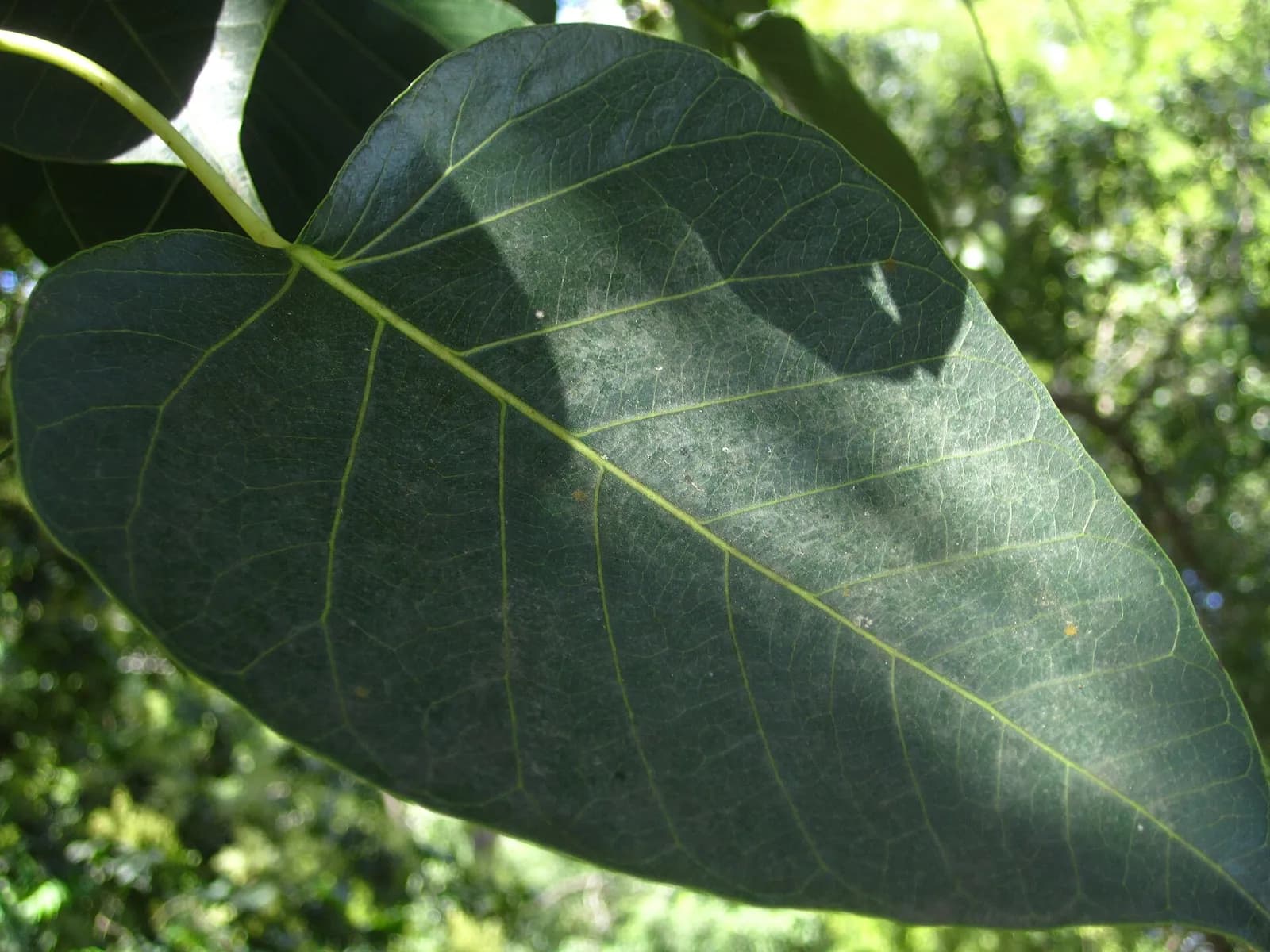
Botanists know the pipal as Ficus religiosa – a relative of the banyan, the pilkhan, the udumbara and the Krishna fig. Its homeland is the Indian subcontinent, from Pakistan and Nepal to Assam and Bangladesh, and eastward Myanmar and the Malay Peninsula; through the rest of Southeast Asia the tree has spread with people. The trunk grows up to three metres across. In the dry season the pipal sheds its leaves, but not everywhere and not entirely: the handbooks call it now deciduous, now evergreen. The young leaves often come out pink, then take on a coppery sheen and only afterwards turn green; the mature leaf is leathery, with a long drawn-out tip. The fruit is a small fig, ripening from green to purple. The pipal often begins life as a hemi-epiphyte, sprouting on another tree, but, unlike the other strangler figs, it does not wind around the host trunk from outside: its roots enter within and in time tear the support apart from inside. It lives extraordinarily long – three thousand years and more are spoken of – and behind one tree there stands an exact date: the Sri Lankan Jaya Sri Maha Bodhi was planted around 288 BC, and it is over two thousand two hundred years old. It was under a pipal that the Buddha attained enlightenment, and for this the tree is also called the bodhi-vṛkṣa, “the tree of awakening”.
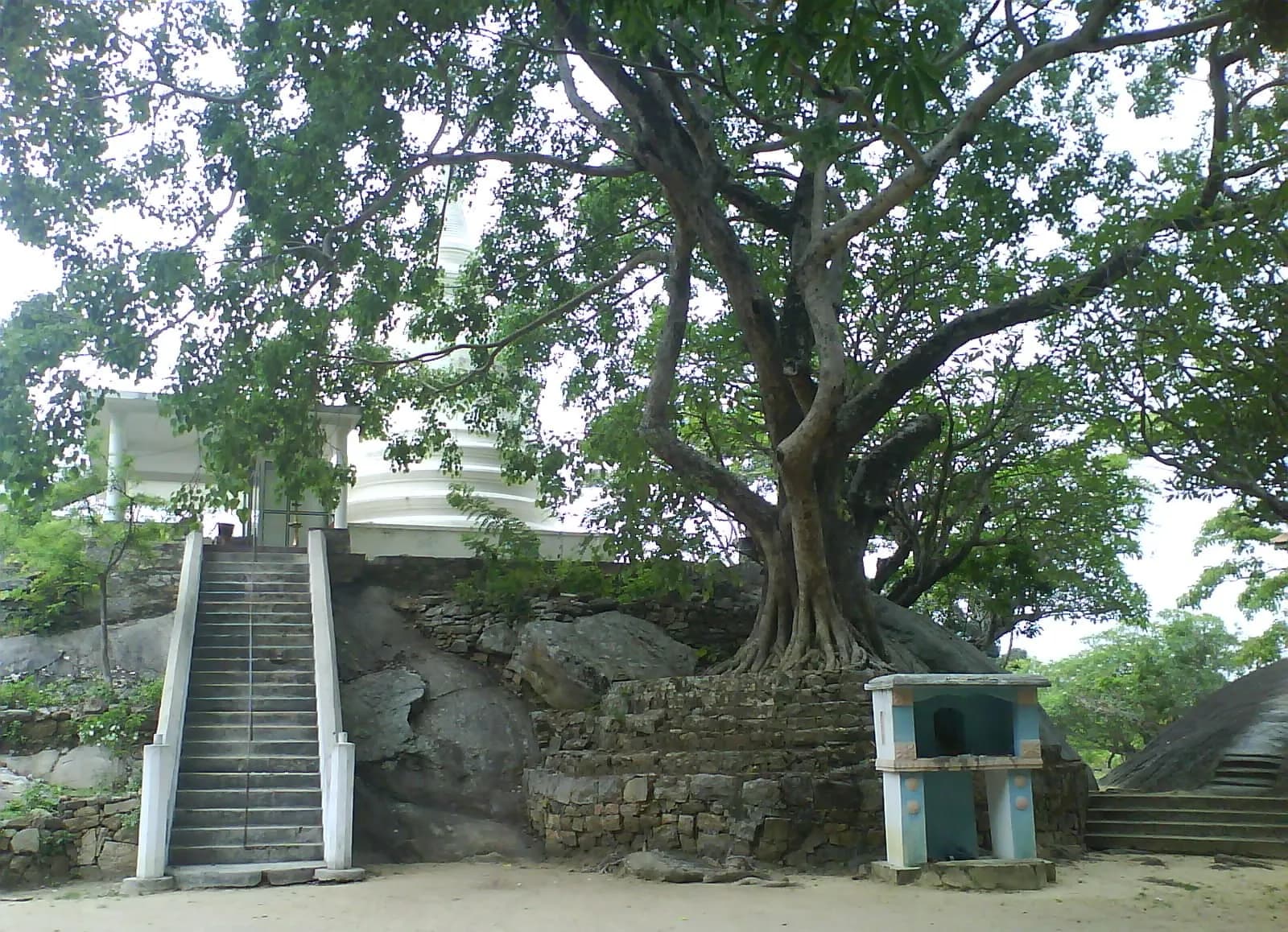
Pipal: trunk, leaf and crown
Sources
We build Vrajapedia together – with stories, verses, photographs and parikrama experience. If you know something more, tell us and it will appear on this page.


