Pilkkhan
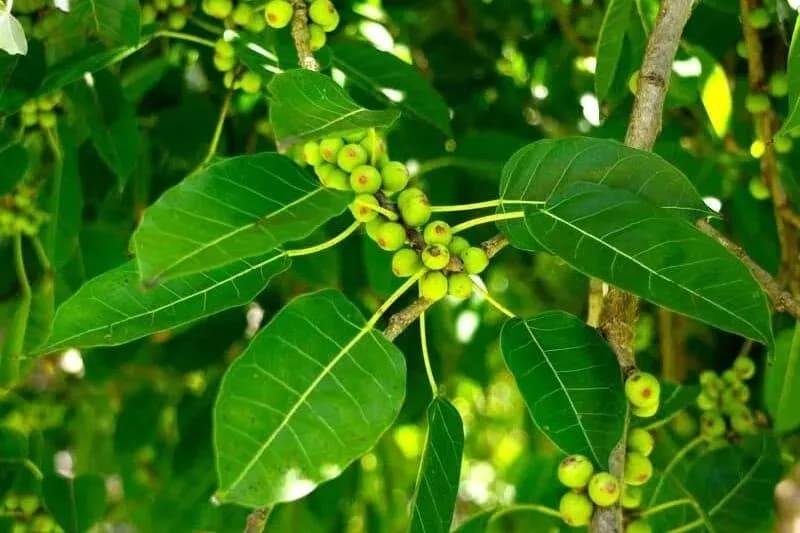
Pilkkhan is a tree of the banyan kin, the “white fig”, whose young leaves flare red and bronze in spring. It makes no show of flowering and bears no sweet fruit for poets to sing of. And yet at the hour when the gopis, after a night of dancing, go looking for the vanished Krishna, they call out to it as well — by its Sanskrit name, plaksha. And the acharyas, reading that same verse, see in the three trees it names the unseen thrones of Brahma, Vishnu and Shiva — and on one reading pilkkhan falls to Lord Brahma.
The Tree in Vrindavan
When Krishna suddenly vanishes from the circle of the rasa dance, the gopis, out of their minds with separation, wander the forest calling out to the trees: did you not see where He went? The first they ask are three trees, and plaksha is among them:
dṛṣṭo vaḥ kaccid aśvattha plakṣa nyagrodha no manaḥ
nanda-sūnur gato hṛtvā prema-hāsāvalokanaiḥ
“O ashvattha tree, O plaksha, O nyagrodha, have you seen Krishna? That son of Nanda Maharaja has gone away, having stolen our minds with His loving smiles and glances.”
The Silent Witness
Plaksha is pilkkhan itself: in his commentary on this verse Srila Vishvanatha Chakravarti Thakur says plainly that the plaksha is called pilukhanvu, and the nyagrodha is the vata. He also explains why the gopis chose these three trees in particular: they stand taller than all the rest, and so they must surely have caught sight of Krishna even if He was far off1.
There is no answer. The gopis decide the trees are simply proud, and run on to the next ones. And so pilkkhan remains in the tradition a silent witness to their longing.
Plaksha is there in the lists of the trees of Vraja as well. Painting the garden of Vraja in Govinda-lilamrita, Srila Krishnadasa Kaviraja Goswami names plaksha among the shala, the tala, the tamala and the bakula2. And in Ujjvala-nilamani Srila Rupa Goswami sets it in the row of trees whose very sight kindles the mood of love — beside the rasala, the nyagrodha and the tapinchha3. It has no pastime of its own, yet a stranger it is not: pilkkhan is one of the trees of the very forest through which Krishna walks.
The Throne of the Three Gods
That same verse has a second bottom to it. The acharyas agree: ashvattha, plaksha and nyagrodha are the unseen thrones of the trimurti, the three ruling deities of the universe. The ashvattha is given to Vishnu, and the ground for that is direct: “Of all trees I am the ashvattha,” says Krishna Himself in the Bhagavad-gita4.
Which of the two remaining gods receives the plaksha, though, the acharyas read differently. Srila Sanatana Goswami in Brihad-vaishnava-toshani and Narayana Bhatta Goswami in Rasikahladini see in it the throne of Shiva. Vamshidhara sets the three out in the order of the trees: Vishnu, Brahma, Rudra. On that reading the plaksha falls to Brahma and the nyagrodha to Shiva. It is by this second reading that pilkkhan is called the tree of Brahma.
Worship
Pilkkhan is one of the “milk” trees, whose branches weep white sap where they break: pipal, vata, udumbara, the Krishna fig and pilkkhan itself. Their wood goes into the sacred gateways around the altar. Citing the Matsya Purana, the Hari-bhakti-vilasa of Srila Sanatana Goswami sets four of them at the four quarters around the sacrificial mandapa — and gives the east to pilkkhan:
plākṣaṁ dvāraṁ bhavet pūrvaṁ yāmyam auḍumbaraṁ bhavet
paścād aśvattha-ghaṭitaṁ naiyagrodhaṁ tathottaram
“Let the eastern gateway be of plaksha, the southern of udumbara, the western built of ashvattha, and the northern of nyagrodha.”
So pilkkhan stands guard at the eastern gate of the sanctuary — the side the sun rises from. The Matsya Purana itself calls the plaksha the lord of the forest trees (vanaspati), and the Raja-nighantu counts it among the pious trees that grant long life to whoever cares for them. Plaksha wood has long been taken for ritual use — down to the twig for cleaning the teeth on the fast of Krishna Janmashtami.
Beyond Vraja
The name of the plaksha has stepped far beyond Vraja — to the very edges of creation. In the cosmology of the Bhagavatam one of the seven concentric continents of the universe is called Plaksha-dvipa: there grows a colossal plaksha tree5. According to Srila Sanatana Goswami’s Brihad-bhagavatamrita, the dwellers of Plaksha-dvipa worship the Lord in the form of the sun god, Surya.
Plaksha grows on Kailasa too, the abode of Lord Shiva: together with the panasa, the udumbara and the ashvattha it covers the slopes of the mountain. Here the commentator gives it, in passing, one more name: the plaksha is the parkati6. And it stands green in Ritumat, the heavenly garden on Mount Trikuta, where the pastime of the elephant Gajendra’s deliverance was played out.
Ayurveda
In Ayurveda pilkkhan is put to work not on its own but together with its kin. Its bark goes into panchavalkala, the “five barks” — a compound for healing wounds and ulcers. Four of the five are figs: nyagrodha, udumbara, ashvattha and pilkkhan itself; the fifth, parisha, is no relation at all — it belongs to the hibiscus family. Plaksha bark is astringent in taste (kashaya) and cooling in potency (shita) — which is why it belongs in such a compound. Charaka, for his part, places the plaksha in the shaka-varga, the class of greens and vegetables: its young parts are eaten.
Botany
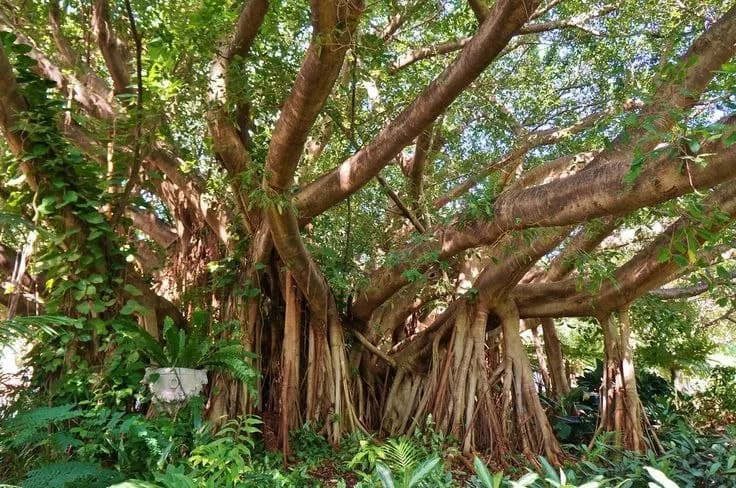
Pilkkhan is Ficus virens, the “white fig” of the mulberry family, a close relative of the banyan and the pipal. It is a large tree: usually over twenty metres, and in damp places over thirty. The crown is broad and spreading, often wider than the tree is tall; its aerial roots more often wind about the trunk than come down to the ground as props. Like its kin it is a strangler fig: a seed may sprout in the fork of another tree and, lacing it about with roots, in time throttle its host.
The leaf is large, eight to nineteen centimetres, with a whitish midrib; the figs come in pairs, pea-sized, greenish white to brown, freckled, and edible. But the brightest mark of all is the spring change of dress: by mid-February the tree drops almost every leaf, and in March and April it clothes itself anew, the young leaves burning purple, red and bronze before they turn green. Pilkkhan grows from India and Sri Lanka right across South-East Asia to New Guinea and northern Australia.
Photographs of pilkkhan
Sources
We build Vrajapedia together – with stories, verses, photographs and parikrama experience. If you know something more, tell us and it will appear on this page.


