Parijata (Harsingar)
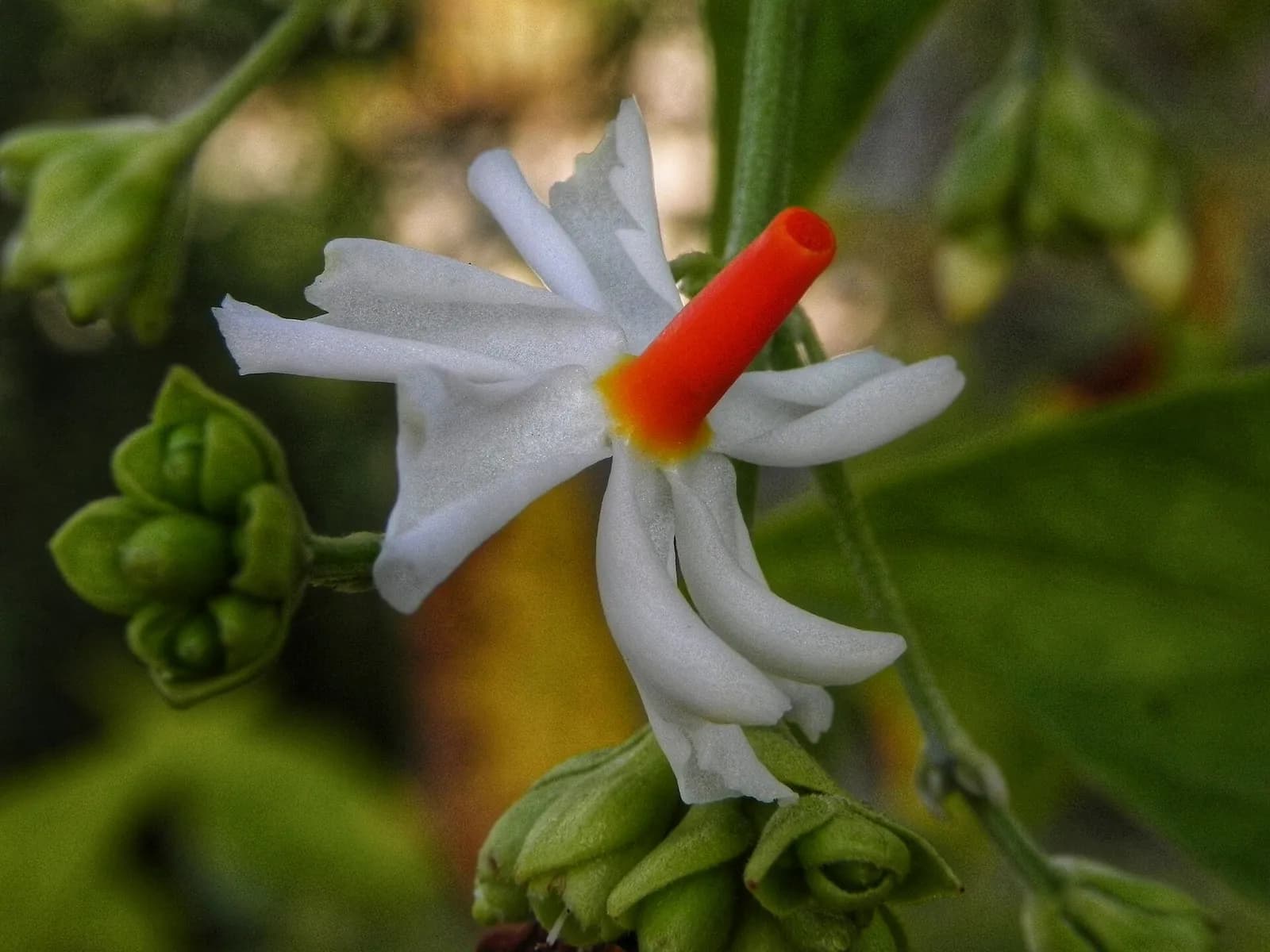
A tree that flowers only by night. From dusk until dawn it opens small white flowers with a bright orange tube in the middle, filling the air with a thick sweet fragrance – and as soon as the morning light touches the sky, it drops them all at once. The botanists saw sorrow in this: in the Latin name of the tree, Nyctanthes arbor-tristis, the second part means “the sorrowful tree”, and the first “night flower”. In the Sanskrit books it is called the śephālikā. In Vrindavan, though, they see not sorrow but a gift: the autumn gathers the fallen flowers and spreads a bed of them in a forest bower – for Radha and Krishna.
The Tree in Vrindavan
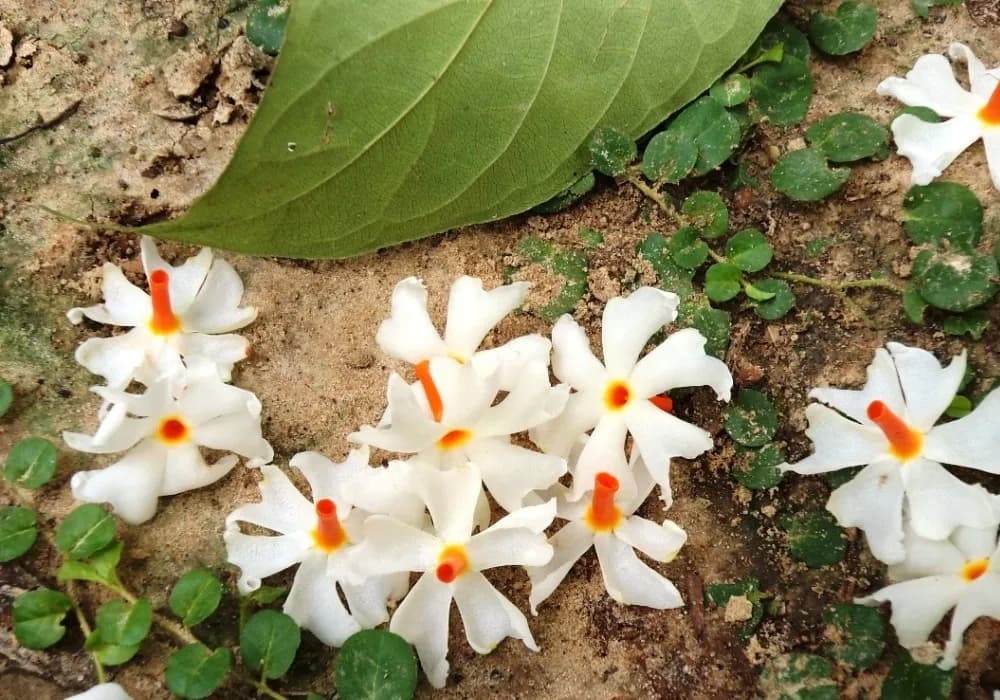
The flowers of the parijata are not picked: the tree drops them itself. All night it fills the darkness with fragrance, and by dawn it strews the ground with a heap of fresh, still living flowers. On this its place in Vrindavan rests. In the Govinda-lilamrita of Srila Krishnadasa Kaviraja Gosvami the autumn herself comes out to make ready the bower for the arrival of the Divine Couple and, like a caring friend, spreads a bed of the fallen flowers for the Lovers:
jātībhiḥ saha raṅgaṇābhir akhilāṅgālaṅkṛtīḥ kairavair
uttaṁsān avataṁsakāṁś ca subhagau raktotpalendīvaraiḥ
śayyāṁ kuñja-gṛhe svayaṁ nipatitaiḥ śephālikā-sañcayair
nirmāyārpayituṁ śarat sahacarī vāṁ vartma saṁvīkṣyate
“The autumn has woven ornaments of jasmine and rangana, crowns of kunda, earrings of red and blue lotuses – and in the forest bower she has spread you a bed of the śephālikā flowers that fell of themselves. And now the friend-autumn looks upon your path, wishing to offer all this to you.”
The bed is spread of flowers the tree let fall itself – and in this is the whole difference: the petals of the parijata are not torn off, she brings them herself.
Life in the bower does not cease at night either: a bee greedy for nectar flits from cluster to cluster of the shephalika, and at every touch the flowers break away and fall – just like shy friends, the sakhis, who scatter as soon as they are called1. Both the night flowering and the morning fall are fixed in the Sanskrit names of the shephalika themselves: niśāhāsā, “she who laughs at night”, and puṣpavarṣiṇī, “she who rains flowers”.
But if the beloved has not come, the same flowers count out the waiting. In the Padyavali of Srila Rupa Gosvami there is preserved the lament of a gopi who waits for Krishna all night in vain:
sakhi sa vijito vīṇā-vādyaiḥ kayāpy apara-striyā
paṇitam abhavat tābhyāṁ tatra kṣapā-lalitaṁ dhruvam
katham itarathā śephālīṣu skhalat-kusumāsv api
prasarati nabho-madhye 'pīndau priyeṇa vilambyate
“Friend, surely some other woman has captivated Him with her playing on the vina? Or won Him at dice? The night is so fine, the śephālī flowers have already opened, the moon has crossed half the sky – why else would my Beloved delay so?”
The same turn is found in Rupa Gosvami’s Lalita-Madhava: while the fresh flowers were opening in the evening, the waiting friend blossomed with joy as well, and as they began to droop towards dawn, she drooped with them2.
Under the same name the tree enters the five deva-taru, the trees of the gods: the mandara, the parijata, the santana, the kalpa-vriksha and the harichandana. Srila Prabodhananda Sarasvati recalls the parijata in his hymns to Vrindavan again and again – among the groves of kalpa-vrikshas, santana, harichandana and mandara – and once he seats the Divine Couple in its shade:
śrī-vṛndāvana-pārijāta-viṭapi-cchāyā-maṇi-maṇḍape
ratna-projjvala-kuṭṭime kusuma-sad-gucchaitad-ullocini
āsīnaṁ saha rādhayā su-militaṁ tat tūla-paṭṭāsane
puṣpāḍhye mahitāḥ sakhīr vana-kathāḥ pṛcchantam ikṣe harim
“In the shade of a parijata tree in Vrindavan, in a jewelled mandapa with a shining floor of precious stones and a canopy of flower clusters, on a silken seat strewn with flowers I see Hari – He sits beside Radha and asks Their glorious gopi friends about the doings of the forest.”
And this scent stands not only over the bowers: in the Govinda-lilamrita it is said that the sides, the brows, the thighs and the hair of Krishna Himself are fragrant with parijata3.
Worship
The flowers of the parijata are brought to the temple as well: in the Hari-bhakti-vilasa of Srila Sanatana Gosvami, among the flowers with which the Lord is honoured, the śephālī stands too. Here he also gives the key to the name: the śephālī, Sanatana Gosvami explains, is commonly called sehalī – and so the bookish Sanskrit name is tied to that very tree which in North India is known as the harsingar4.
Mandara and Parijata Are Not One Tree
The parijata is constantly confused with the mandara, the coral tree – a shared name is to blame. The lexicon feeds the confusion too: in Monier-Williams the first meaning of the word pārijāta is “the coral tree, Erythrina indica”, that is, precisely the mandara, and the Ayurvedic compendia likewise count “parijata” among the names of that same tree. But in the shastras these two trees stand apart. Srila Prabodhananda Sarasvati, in his lists of the groves of Vrindavan, places the “forests of the wondrous parijata” and the “hosts of mandara” side by side, but separately, and Srila Krishnadasa Kaviraja Gosvami enumerates the parijata and the mandara as two different trees of desire5. They are named apart in the Srimad-Bhagavatam itself as well – in the verse about the gardens of Vaikuntha, where the flowering trees breathe in the fragrance of the tulasi in the Lord’s garland and bow before her austerity. Sridhara Swami and Vishvanatha Chakravarti explain it directly: both the mandara and the parijata are special heavenly trees (sura-taru), but two different ones:
mandāra-kunda-kurabotpala-campakārṇa-
punnāga-nāga-bakulāmbuja-pārijātāḥ
gandhe 'rcite tulasikābharaṇena tasyā
yasmiṁs tapaḥ sumanaso bahu mānayanti
“Although the mandaras, kundas, kurabakas, utpalas, champakas, arnas, punnagas, nagakesharas, bakulas, lilies and parijatas emit a transcendental fragrance, they unceasingly honour the austerity of the tulasi, for the Lord shows her evident preference, adorning Himself with a garland of her leaves.”
The same thought is repeated by Sanatana Gosvami in the Brihad-bhagavatamrita: he lists the fragrances of the mandara, the parijata, the kunda, the champaka, the punnaga, the nagakeshara and the bakula only in order to say that above all Hari loves the scent of the tulasi.
Beyond Vraja: the Parijata-harana
The loudest story of this name happened not in Vraja but in Dvaraka, and it is not about the forest harsingar but about its heavenly namesake – the tree of desire that rose from the waters at the churning of the Ocean of Milk and fell to Indra. Sanatana and Jiva Gosvami, discussing this lila, quote the description from the Vishnu Purana: the bark of that tree is golden, its young shoots coppery pink. The fragrance of its flowers carries for three yojanas and awakens in people the memory of past lives, any desire is fulfilled near it, and the tree itself becomes at will now huge, covering the whole of Dvaraka, now tiny, the size of a thumb. Once Krishna went up to the abode of Indra – to return to Aditi, the mother of the gods, her earrings; there Queen Satyabhama saw this tree in the heavenly garden and wished to wear its blossom in her hair:
gatvā surendra-bhavanaṁ dattvādityai ca kuṇḍale
pūjitas tridaśendreṇa mahendryāṇyā ca sa-priyaḥ
codito bhāryayotpāṭya pārijātaṁ garutmati
āropya sendrān vibudhān nirjityopānayat puram
“The Lord went to the abode of Indra and gave mother Aditi her earrings; there Indra and his wife honoured Krishna and His beloved Satyabhama. Then, urged on by His wife, the Lord uprooted the heavenly parijata tree, set it upon Garuda and, having defeated Indra with all the gods, brought the tree to His capital.”
Out of this lila Rupa Gosvami draws a play on words. In the Bhakti-rasamrita-sindhu he says that Krishna “made Indra apārijāta” – and this word means at once “deprived of the parijata” and, if applied to Yudhishthira, “deprived of enemies”: by one and the same deed the Lord fulfilled His promises, gladdening both Satyabhama and Draupadi6.
It is only worth remembering that the tree of desire from the heavenly garden and the night harsingar of the bowers of Vrindavan are namesakes, not one and the same tree.
Ayurveda
In healing it is above all the leaves of the parijata that are used. Their taste (rasa) is bitter, their potency (vīrya) hot, their aftertaste (vipāka) pungent. Hence the chief use: the name vātāri, “the enemy of vata”, stands among the synonyms of the tree for good reason – the leaves are used for sciatica and joint pains, and also for lingering fevers and intestinal worms; in fever the juice of boiled leaves is given with honey.
From the orange centre of the flowers a lasting saffron-orange dye is obtained: with it silk and cotton were dyed, and in the Buddhist countries the robes of monks. In the Sanskrit medical books the tree is mentioned under the name shephalika: the Yogamrita of Gopala Sena, an eighteenth-century compendium, gives a pārijātādi preparation in the chapter on urinary disorders.
Botany
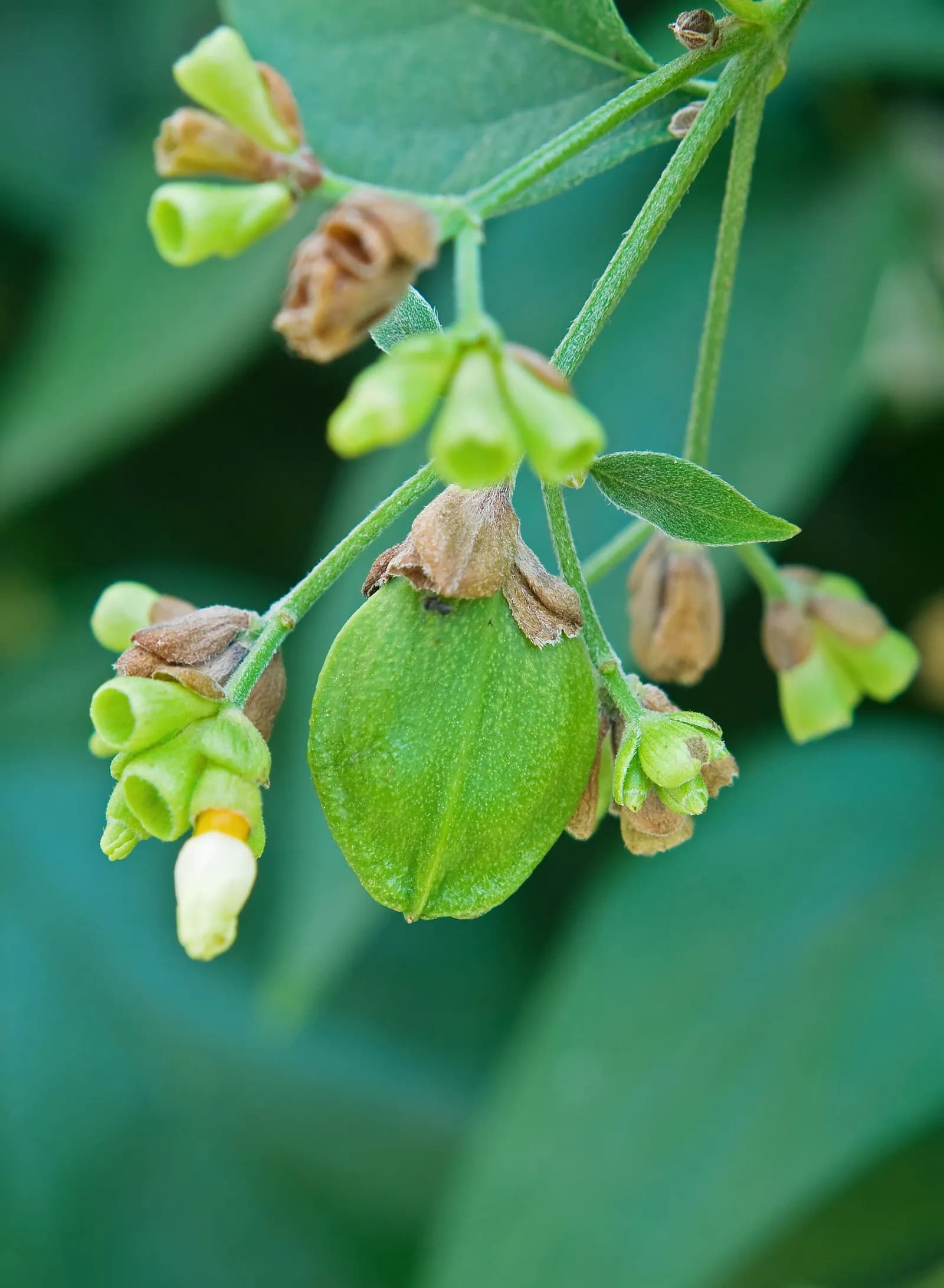
The parijata is Nyctanthes arbor-tristis, a close relative of the jasmines and the olives. Its bark is grey and flaking, its leaves opposite and rough to the touch. Everything in this tree is subject to the night, and both of its Latin names say the same: Nyctanthes is Greek for “night flower”, arbor-tristis is Latin for “sorrowful tree” – for the flowers that live a single night. The flowers are gathered in bunches of two to seven. The parijata flowers in exactly that autumn of which the poems of Vrindavan sing. The fruit is inconspicuous: a flat brown capsule shaped like a heart, of two halves, with a single seed in each. Its homeland is the Eastern Himalayas, India and Southeast Asia as far as Java and Sumatra; in India the parijata is planted by houses and temples for the sake of the flowers, which go into garlands and into worship.
Parijata: the flower, the tree and the fruit
Sources
We build Vrajapedia together – with stories, verses, photographs and parikrama experience. If you know something more, tell us and it will appear on this page.


