Krishnachuda
Fiery orange clusters on long stalks, stamens like little tongues of flame — and for all that brilliance, not a trace of scent. A flower without fragrance would seem to have nothing to hope for in Vraja. Yet its name is krishnachuda, “Krishna’s crown”: the finest place a flower can hold at all.
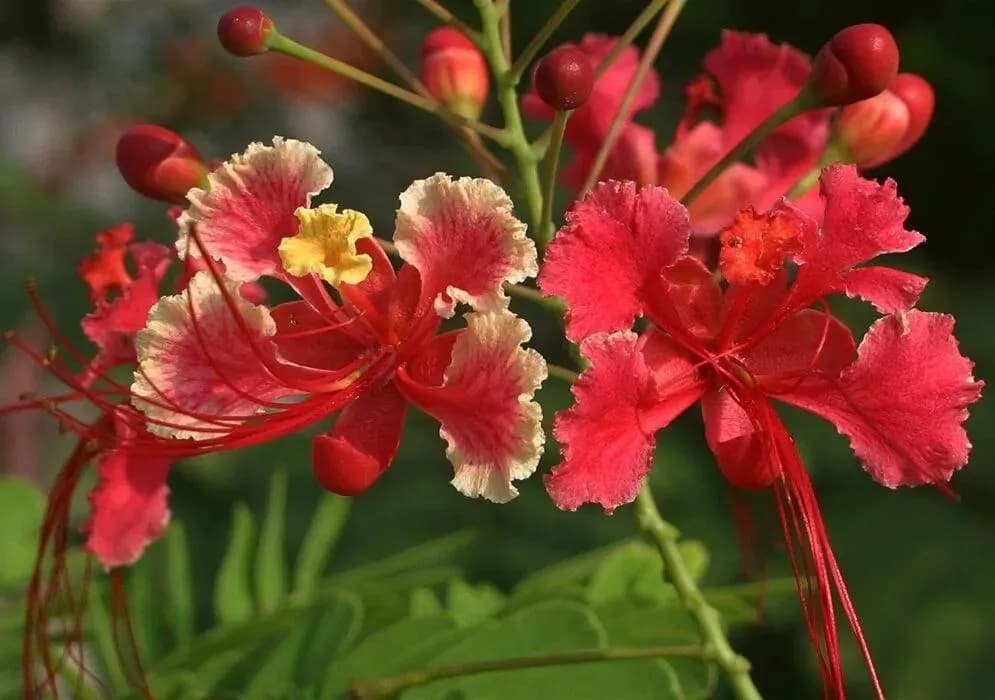
Krishnachuda in Vrindavan
In Vraja the krishnachuda is a foreigner. You will not find it in any Sanskrit scripture, nor in the old nighantus, the Ayurvedic lexicons of medicinal plants: the shrub came to India from the New World and settled into local gardens only in modern times. And so it is not the scriptures that tell of it but the Vrajavasis themselves — that is how stories gather around a plant already flowering at the doorstep.
The story runs like this. The krishnachuda blazed with colour brighter than most, but it had no scent at all — and this tormented it. In Vraja fragrance is the signature of love: the body of Krishna is fragrant, the garland on His chest is fragrant, and from a single breath of air the gopis know that He has passed by. It seemed to the flower that there was no place for it in this world, and it resolved on something desperate: as Radha and Krishna were walking a forest path, the krishnachuda threw itself under Their feet, to end its life at Their feet. But Radhika bent down, picked up the fallen flower and set it in Krishna’s hair. So a desperate act turned into the highest destiny, and the flower’s name — krishnachuda, “Krishna’s crown” — fixed its place forever at the very crown of His head. Among Bengalis the same shrub bears a twin name: radhachura, “Radha’s crown.”
The ending is no accident. A wild flower woven into the chuda, the crest-crown of the hair of the Divine Couple, is something the poets of Vrindavan love in a particular way. Srila Rupa Goswami has a verse in which Radha, in separation, grieves over a fresh karnikara on the bank of the Yamuna — grieves because Krishna once wove her a crown in her hair from the flowers of that tree:
rāsāt tirohita-tanuḥ sakhi yasya puṣpaiś
cūḍāṁ cakāra cikure mama piñcha-cūḍaḥ
kūle kalinda-duhitur dhṛta-kandalo'yaṁ
māṁ dandahīti sa muhur nava-karṇikāraḥ
“My friend! He whose curls are crowned with a peacock feather has vanished from the rasa dance — and once, with the flowers of this very tree, He made a crown in My hair. And now this young karnikara, putting out fresh shoots on the bank of the Yamuna, burns Me again and again.”
The verse is about the karnikara, not the krishnachuda. But it explains what the unhappy krishnachuda was after, and why its desperate gesture ended so happily: in Vraja, to become a flower that adorns Krishna’s hair is the highest fortune anything that blooms there can have. Krishna is called here piñcha-cūḍa, “He whose curls are adorned with a peacock feather.” And perhaps it is not for nothing that a peacock nickname follows the krishnachuda across India — the Tamil mayurkonrai, the English peacock flower: a flower with a peacock’s name found shelter in a peacock crown.
A Flower Without Fragrance
The subtlest thing in this legend is what drove the flower to despair. It seemed to it that without fragrance Krishna had no use for it. But the scriptures answer the opposite, and answer with an example every Vrajavasi knows — tulasi. In the Yugala-gita of the Tenth Canto of the Srimad Bhagavatam the gopis sing of how swarms of bees go mad from the fragrance of the tulasi in Krishna’s forest garland:
darśanīya-tilako vana-mālā-
divya-gandha-tulasī-madhu-mattaiḥ
ali-kulair alaghu gītām abhīṣṭam
ādriyan yarhi sandhita-veṇuḥ
“Maddened by the divine, honeylike aroma of the tulasī flowers on the garland Kṛṣṇa wears, swarms of bees sing loudly for Him, and that most beautiful of all persons thankfully acknowledges and acclaims their song by taking His flute to His lips and playing it.”
And commenting on the verse, Srila Vishvanatha Chakravarti Thakur notes at once that ordinary people do not consider tulasi fragrant at all — it is never listed among the “sweet-scented” flowers beside the lotus and the jasmine. To them its fine fragrance is barely perceptible. But to liberated souls, to the bees circling Krishna’s garland, it is otherwise1. So the world and Vrindavan judge by different measures: what common opinion rejects as “scentless,” Krishna accepts and raises above the celebrated fragrances. Which means the krishnachuda’s timidity was needless: to have no scent is no defect that cuts one off from Him.
Botany
The krishnachuda of the gardens of Vraja is Caesalpinia pulcherrima, the “peacock flower” of the legume family, a close relative of the gulmohar. The shrub is almost thornless, with large twice-pinnate leaves divided into a multitude of small leaflets. Its marks are the loose clusters on straight stalks: five wavy petals and very long, far-protruding stamens, which really do make the flower head look like a spread peacock’s tail. It blooms abundantly and almost without a break, flowering already in its first year. Scent it has practically none — despite one of its names, ratnagandhi, “jewel-fragrant”: the very trait around which the legend took shape. The plant is native to Central America; it was brought to India as an ornamental, and now it flowers all over the country, from village fences to the gardens by the Taj Mahal.
In the Bengali lands the name has become tangled. Krishnachura, “Krishna’s crown,” is there applied above all to the gulmohar — quite another tree, whose scarlet clusters are taken as the sign of the month of Boishakh. The Indian flower handbooks give both names to our species at once; the Bengali encyclopaedia gives it only “radhachura.” To whom the name belongs by right the sources do not settle: one and the same word sits on different plants in Vraja and in Bengal.
Folk Medicine
The krishnachuda did not make it into the classical nighantus — there was no room there for a shrub from overseas, and no Ayurvedic characteristics are recorded for it. In folk herbal practice, however, the whole plant is in use: the bitterish astringent root is applied for stomach upset, the leaf as a febrifuge and a tonic (in large doses it acts as an abortifacient), the flower to bring down fever and induce sweating, and infusions for constipation and urinary stones. The seeds of caesalpinias are generally poisonous and are used with caution.
Krishnachuda in bloom
Sources
We build Vrajapedia together – with stories, verses, photographs and parikrama experience. If you know something more, tell us and it will appear on this page.


