Krishna Fig (Krishna’s Butter Cup)
This tree carries a mark you cannot mistake: every young leaf is folded at its base into a neat little cup — a tiny pocket, as though a child’s hand had shaped it on purpose. In India it is called just that: mākhan kaṭorī, “the butter cup.” Little Krishna, caught by His mother stealing butter, hid the loot in a leaf of this fig, and the leaf has stayed folded ever since. The tree has no name of its own in the scriptures, but popular memory has tied it to the most homely of the childhood pastimes — mākhan-corī, the stealing of butter.
A Tree in Vraja
Everything in Vraja keeps the memory of Krishna, but this tree wears it on itself. Its leaf grows to the size of a palm and larger, and right at the stalk it is folded into a tight pocket-cup. The people have no doubt where it came from: it is the imprint of the Lord’s most famous childhood mischief. As a very small boy Krishna took to carrying off butter and yoghurt from the cowherd women’s houses; once, nearly caught, He folded the first leaf that came to hand into a cup and hid the loot in it — and ever since the tree folds every young leaf that way.
The butter theft itself is no longer popular memory but a pastime told in the Srimad Bhagavatam. In the eighth chapter of the Tenth Canto the cowherd women, half cross and half laughing, come to complain to Yashoda about her son:
vatsān muñcan kvacid asamaye krośa-sañjāta-hāsaḥ
steyaṁ svādv atty atha dadhi-payaḥ kalpitaiḥ steya-yogaiḥ
markān bhokṣyan vibhajati sa cen nātti bhāṇḍaṁ bhinnatti
dravyālābhe sagṛha-kupito yāty upakrośya tokān
“Our dear friend Yaśodā, your son sometimes comes to our houses before the milking of the cows and releases the calves, and when the master of the house becomes angry, your son merely smiles. Sometimes He devises some process by which He steals palatable curd, butter and milk, which He then eats and drinks. When the monkeys assemble, He divides it with them, and when the monkeys have their bellies so full that they won’t take more, He breaks the pots. Sometimes, if He gets no opportunity to steal butter or milk from a house, He will be angry at the householders, and for His revenge He will agitate the small children by pinching them. Then, when the children begin crying, Kṛṣṇa will go away.”
“Stolen Is Sweet”
The commentators linger over two words — steyaṁ svādu, “what is stolen is sweet.” Yashoda might object: then feed Him your fill yourselves, and there will be nothing to steal. Srila Vishvanatha Chakravarti Thakur gives the cowherd women’s answer: you feed Him without end, He knows no hunger — it is the stealing itself that is sweet to Him1. What His mother gives Krishna does not want; only what is got by cunning tastes good to Him. And so the cup-leaf speaks not of butter but of Krishna, who hides His loot, glances aside and fears being caught exactly as much as He wishes to be.
No one caught that sidelong glance better than the poets of Vraja. In the Padyavali, the anthology gathered by Srila Rupa Goswami, the whole minute of the theft fits into four lines:
savye pāṇau niyamita-ravaṁ kiṅkinī-dāma dhṛtvā
kubjī-bhūya prapada-gatibhir manda-mandaṁ vihāsya
akṣṇor bhaṅgye vihasita-mukhīr vārayan sammukhīnā
mātuḥ pāścād aharata harir jātu haiyāṅgavīnam
“He gripped the belt of little bells in His left hand so that they would not ring, stooped low, stole forward on tiptoe, laughing softly, and with a sidelong glance held back the smiling gopis standing before Him. So it was that little Hari once stole the fresh butter behind His mother’s back.”
It is to this minute that the tradition ties the leaf: the butter is stolen, the bells are clenched in a fist, and the loot has to go somewhere. From the same scene, it seems, comes Krishna’s epithet in the Stava-mala: dhṛta-haiyaṅgava-gandha, “keeping about Him the smell of fresh butter”2.
Botany
The Krishna fig is Ficus krishnae of the mulberry family (Moraceae), the closest relative of the banyan. Just how close, the botanists have not agreed: the survey of the Royal Botanic Gardens, Kew keeps it as a species in its own right and treats the name Ficus benghalensis var. krishnae as an outdated synonym; other handbooks see in it only a variety of the banyan, or do not separate it from the banyan at all. In India it is usually named together with the four venerated figs: the pipal (ashvattha, Ficus religiosa), the banyan or vata (Ficus benghalensis), the pilkhan (Ficus virens) and the udumbara (Ficus racemosa).
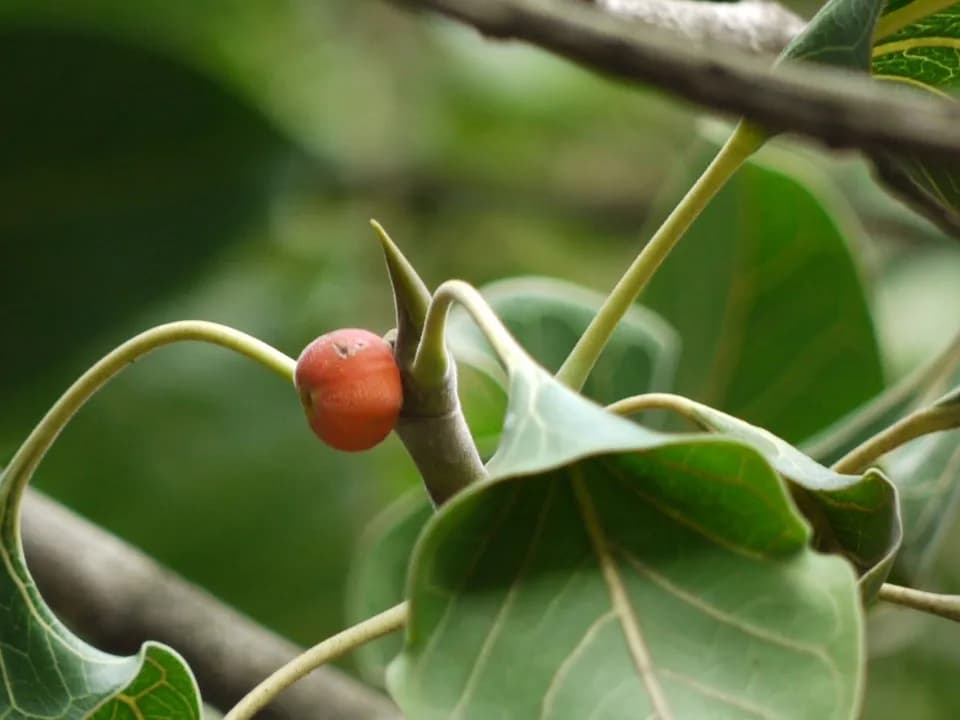
It is an evergreen tree up to thirty metres tall, with a broad crown and aerial roots — the same as the banyan’s. From the great banyans of Vraja, Bhandira-vata among them, it differs only in the leaf. The leaves are stalked, ovate and heart-shaped, three-veined, leathery and glossy green, velvety on young shoots; their chief peculiarity is the pocket-cup folded at the base, which gave the tree all its names. In figs the flowers are hidden inside the receptacle, and the fruits are small, up to two and a half centimetres, sitting in pairs in the leaf axils and reddening as they ripen. It is native to India, from where it also reached Sri Lanka; it is usually planted by temples — for the sake of that very story, which lives in every one of its leaves.
To Ayurveda It Is the Banyan
This fig has no entry of its own in the classical nighantus, the Ayurvedic lexicons of medicinal plants: the physicians assign it to the banyan (vata, the nyagrodhadi group in Sushruta) and give it the same properties — an astringent taste (rasa: kashaya), a cooling potency-virya, and use in complaints of the skin, the digestion and the breath. On the medicinal properties of this genus see the article on the banyan.
Photographs
Sources
We build Vrajapedia together – with stories, verses, photographs and parikrama experience. If you know something more, tell us and it will appear on this page.


