Lotus
Verses about Krishna are full of lotuses. This flower names everything best in His form: the eyes are lotus petals, the face is a lotus, the palms and the feet are lotuses, the navel is the lotus from which the creator Brahma rose. Chaitanya Mahaprabhu, in separation, counted eight lotuses on Krishna’s body at once. And the land of Vraja itself, as the shastras describe it, has the shape of a giant thousand-petalled lotus with Gokula at its heart. So the lotus in Vraja is no ornament of the landscape: it speaks both of Krishna’s beauty and of the way His abode is built.
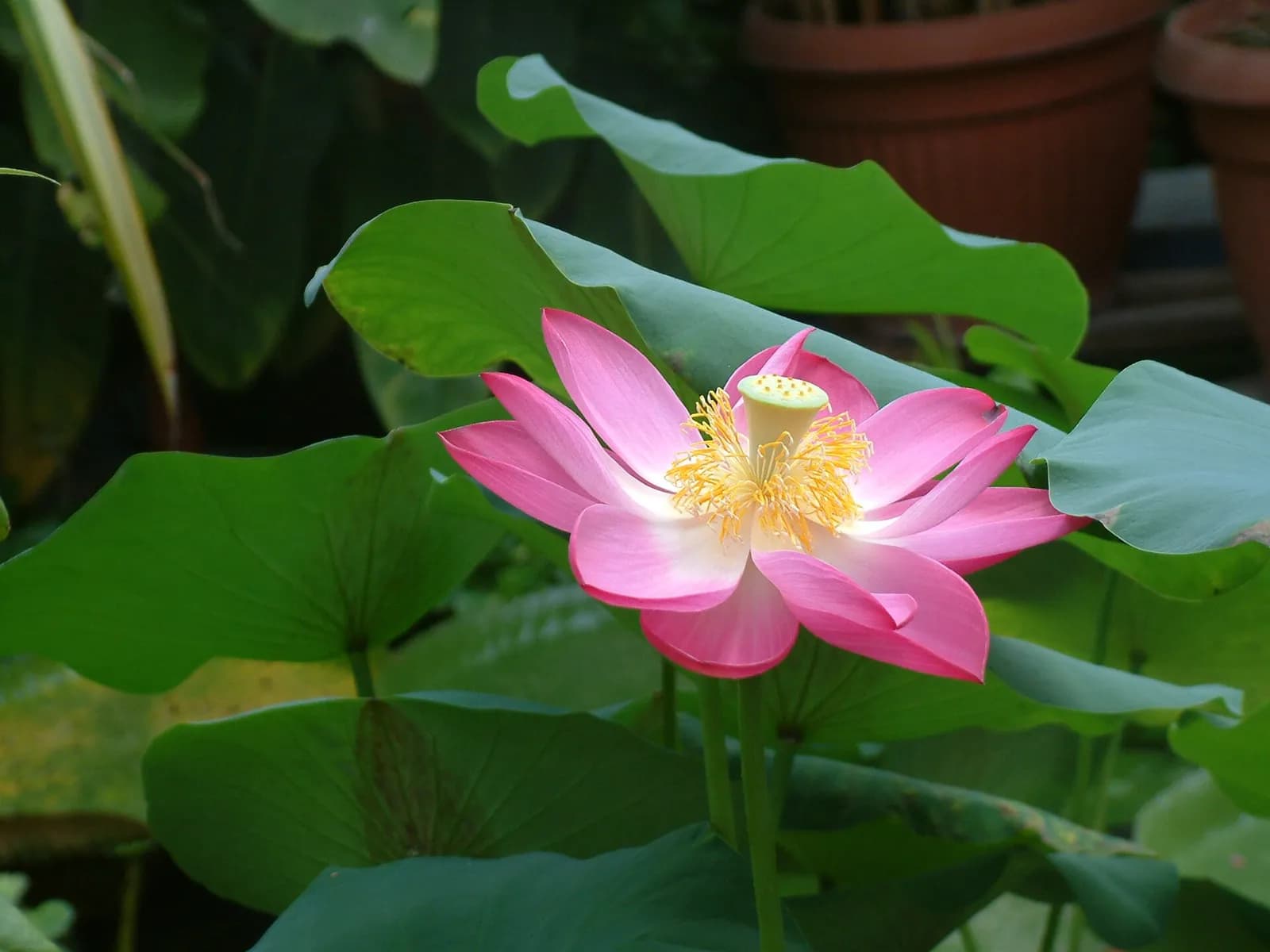
The lotus in Vrindavan
It all begins with the eyes: Krishna’s standing epithets in the “Bhagavatam” are kamala-patraksha and aravindaksha, “He whose eyes are like the petals of a lotus”. The flower has two chief names. Kamala is broken down by Monier-Williams into kam and ala – “adorning the water”; padma in the same dictionary means the flower itself, and its pink shade, and the auspicious mark on the body – the very one discerned on the body of Krishna.
The same epithet sounds when Balarama returns to Vraja. The cowherds crowd around Him and, with voices trembling with love, ask after their kinsmen left behind in Dvaraka:
pṛṣṭāś cānāmayaṁ sveṣu prema-gadgadayā girā
kṛṣṇe kamala-patrākṣe sannyastākhila-rādhasaḥ
“With voices faltering out of love for Him, those cowherds, who had dedicated everything to lotus-eyed Krishna, asked about the health of their dear ones.”
Srila Sanatana Goswami in the “Brihad-vaishnava-toshani” dwells on the word kamala-patraksha: Krishna is as beautiful as a lotus petal, and with a single glance of those eyes He carries away every sorrow – and that is why the Vrajavasis gave Him everything.
But the count does not end with the eyes. Chaitanya Mahaprabhu, going over in separation what it is that makes Krishna’s body fragrant, speaks in Radha’s words and counts eight lotuses on Him at once:
netra-nābhi, vadana, kara-yuga caraṇa,
ei aṣṭa-padma kṛṣṇa-aṅge
karpūra-lipta kamala, tāra yaiche parimala,
sei gandha aṣṭa-padma-saṅge
“Krishna’s eyes, navel and face, hands and feet are like eight lotus flowers on His body. From those eight lotuses emanates a fragrance like a mixture of camphor and lotus.”
The lotus and the beauty of the Divine Couple
Set beside Krishna, the living flower is left with nothing every time, and the lotus gets it worst of all from His feet. Srila Rupa Goswami in the “Hamsaduta” paints a whole scene: the lotuses, envying the pink of His feet, perform austerities and stand up to their necks in water, and every year the winter punishes them for the imposture until they wither. The flower strains to become what the Lord’s feet already are by nature.
The same is said of Radha. Her face is called a fragrant lotus, and Srila Jiva Goswami in the “Madhava-mahotsava” unfolds the image to its limit: Radha’s whole body is a lake for Krishna’s delight, where lotus stems run from the thighs to the lotuses of the navel, the feet, the palms, the breast, the face and the eyes.
And Srila Vishvanatha Chakravarti Thakur in the “Krishna-bhavanamrita” makes the rivalry of the flower and the face into a whole scene. Krishna takes a lotus from Vrinda’s hands, kisses it and praises it: “you have defeated everyone on earth with your fragrance!” Radha frowns, and He, pleased, promises to smell both the flower and Her face – and to sing on His flute of whichever is sweeter. And then, having kissed Her face, He turns to the flower and scolds it: “are you not ashamed to bloom before Her who has defeated you in beauty and fragrance? You behave like one born of mud”1.
The lotus also names a colour. In the “Ujjvala-nilamani” Rupa Goswami runs through what the white bud of the flute seems to be: at Radha’s breast it looks like a golden champaka, in a palm dyed with sindura – like the red lotus kokanada, in dark locks – like a blue one. One and the same bud changes colour from whatever it touches.
The abode in the shape of a lotus
The lotus is not only Krishna’s form but the very build of the dhama. The chief verse about this is in the “Brahma-samhita”, the prayer of Lord Brahma:
sahasra-patra-kamalaṁ gokulākhyaṁ mahat padam
tat-karṇikāraṁ tad-dhāma tad-anantāṁśa-sambhavam
“The abode of Krishna known as Gokula is the supreme realm. It is the pericarp of a thousand-petalled lotus that rests upon the potency of Ananta.”
Jiva Goswami specifies in his commentary: this lotus is made of chintamani stone, which fulfils desires. The verses that follow lay it out down to the petal: the stamens are the cowherd gopas, the petals are the kunja groves of Radha and the gopis. He repeats the same plan in the “Krishna-sandarbha”: the petals are the abodes of Krishna’s beloveds, the roads run between the groves, the villages stand at the ends of the roads. Every petal is the place of someone’s love.
At the heart of this lotus stands another, a smaller one. The Yogapitha, the place of the highest meeting of Radha and Krishna, is seen by Vishvanatha Chakravarti in the “Krishna-bhavanamrita” as an eight-petalled ruby lotus on a jewelled platform at the root of the desire tree. In its whorl the Divine Couple take Their pleasure. And once this lotus rises in the mind of a devotee seized by anuraga, unrelenting love, a festival begins in the heart. From the giant lotus of Gokula to the ruby lotus of the Yogapitha, the abode is built as a flower within a flower.
Worship
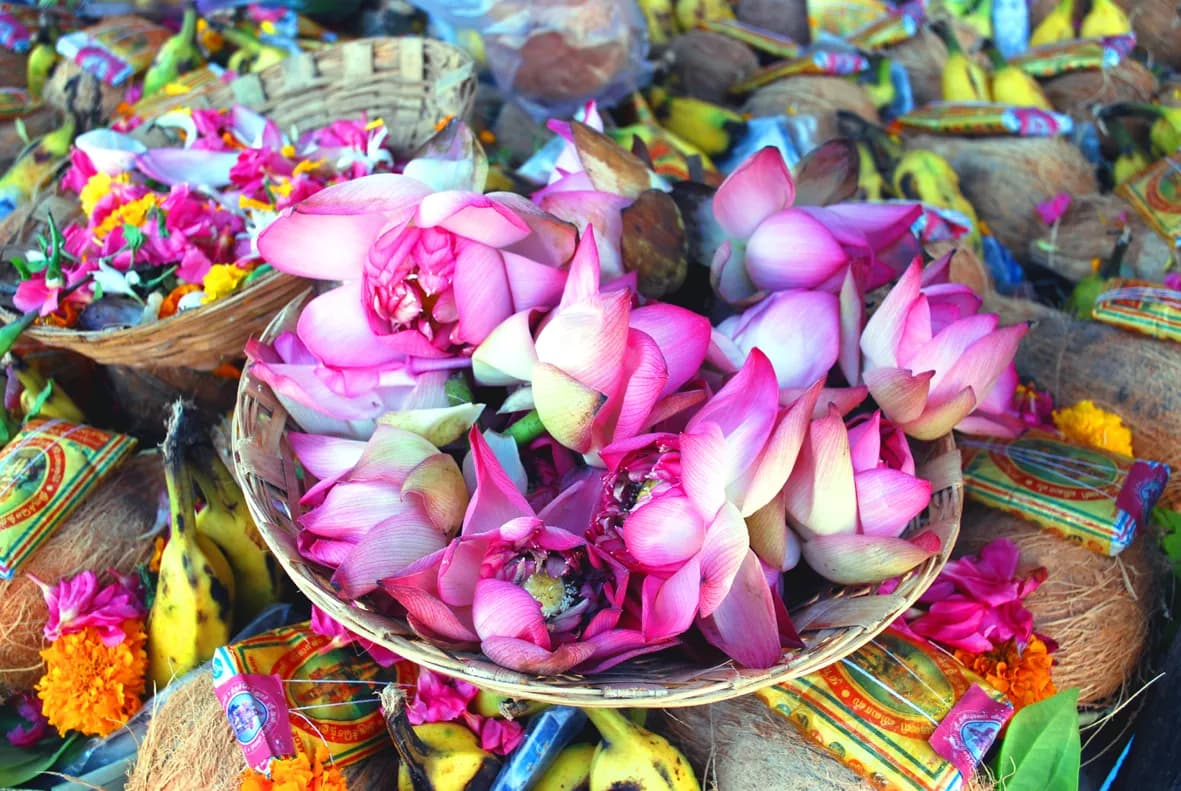
The lotus is not only sung – it is offered to the Lord, and the codes of Vaishnava practice set it above other flowers. Srila Gopala Bhatta Goswami and Sanatana Goswami gathered in the “Hari-bhakti-vilasa” a separate section on the greatness of the lotus, especially in the month of Kartika:
padmenaikena deveśaṁ yo'rcayet kamalā-priyam
varṣāyuta-sahasrasya pāpasya kurute kṣayam
“Whoever offers even a single lotus to the lord of the gods, the husband of Kamala, destroys the sins of ten million years.”
The same code promises: whoever honours the Lord with lotuses during Kartika is accompanied by Lakshmi herself, life after life. And in a conversation between Shiva and Uma it is said that an offering of a lotus brings a hundred times more benefit than any other flower.
Beyond Vraja
In Vraja the lotus speaks of beauty, while in the rest of the universe it holds up creation. The “Vishnu-sahasra-nama” calls the Lord padma-nabha – “He from whose navel a lotus grows”: at the beginning of creation this lotus rose from Vishnu’s navel, all the worlds fitted inside its stem, and in its whorl Brahma was born. Rupa Goswami weaves the same image into the “Hamsaduta”: the lake of Madhusudana’s navel is the source of life for the little fish that are the gopis’ eyes, and out of it grew the lotus-cradle of the creator. So a single flower carries both the tenderness of Vraja’s similes and the whole plan of the universe.
Ayurveda
Ayurveda assigns the lotus to the shaka-varga – the class of vegetables and greens: the rhizome (mrinala), the seeds, the stamens and the leaves are used as food and as medicine. According to the “Madhava-chikitsa” the lotus is used in treating fevers (jvara). The flower is counted as cooling and therefore useful in heat and burning, while the taste (rasa), the potency (virya) and the post-digestive effect (vipaka) differ from one nighantu to another. The lotus’s own names – jalaja, “born in water”, and pankaja, “grown from mud”, – speak of its watery nature.
Botany
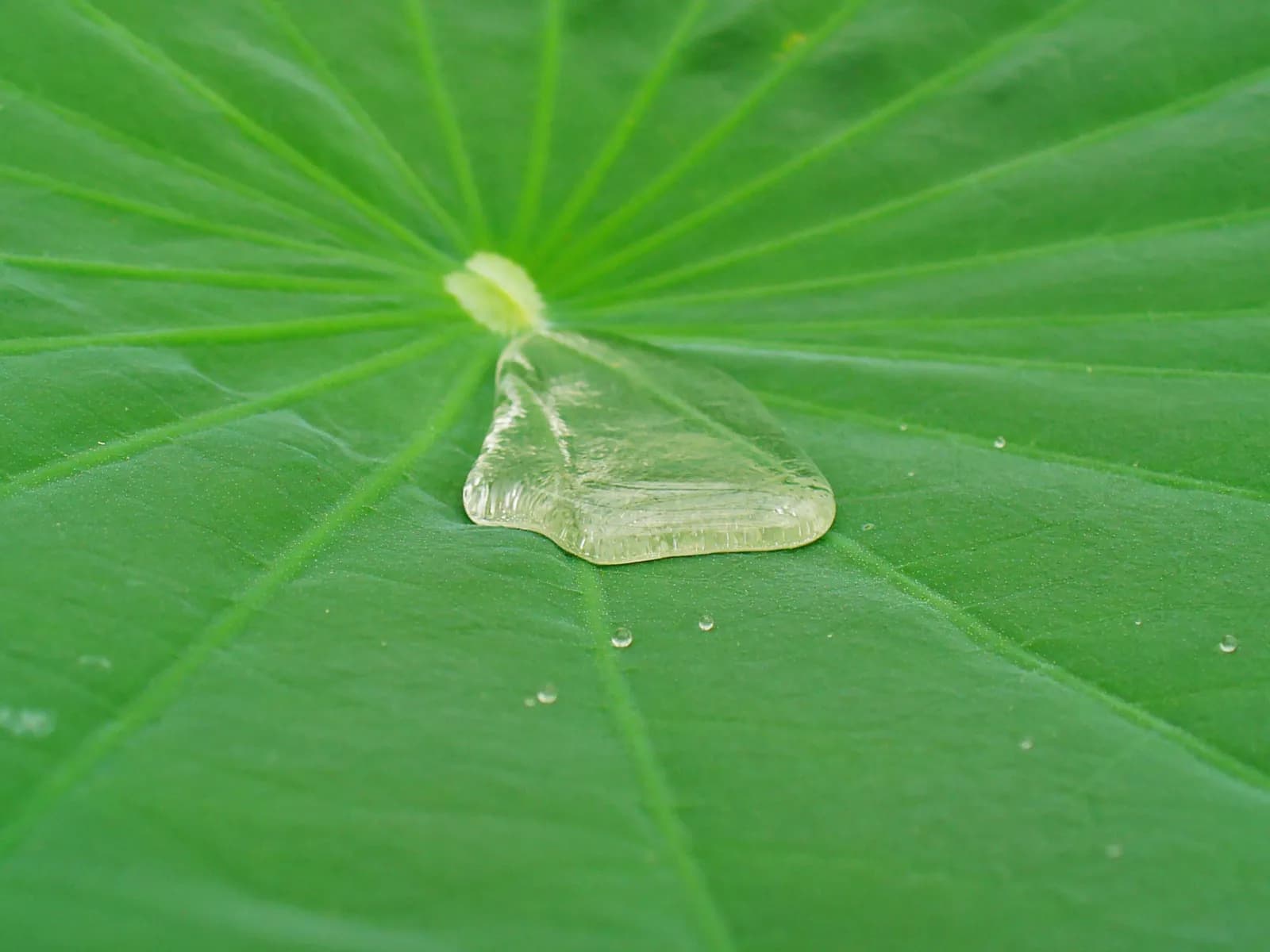
Botanists know the lotus as Nelumbo nucifera, of the lotus family. In the water lily the leaves and the flowers lie on the very surface of the water, whereas in the lotus both are raised above it on long stalks. The stalk also shows the depth: the lotus can grow where the bottom is two and a half metres down. Water rolls off the leaf, covered with microscopic hairs, without wetting it. After flowering a flat receptacle remains, broken into cells like a wasp’s nest – in them the nut-like seeds ripen. The lotus grows in still waters over an enormous range – from Iran and the Caspian to the Amur region, Japan and Australia; in Hinduism and Buddhism it is sacred, and in India it was chosen as the national flower. The pink lotus, padma, is not the same as the blue lotus nilotpala, a water lily of another family, nor the same as the “land lotus”, sthala-padmini, with which the poets of Vraja also like to compare Radhika.
The lotus: flower, bud, fruit
Sources
We build Vrajapedia together – with stories, verses, photographs and parikrama experience. If you know something more, tell us and it will appear on this page.


