Jai
Having lost Krishna in the night forest, the gopis question the flowers about Him and call four jasmines by name. One of them is jai, in Sanskrit jati: the white jasmine that the scriptures set above every other flower for the altar, one blossom of which is worth a thousand flowers of mallika, its neighbour. The poets of Vraja barely separate jati from her sister malati — they are two kinds of one night-blooming jasmine, and both go into the garlands on Krishna’s neck and into Radha’s braid.
A Vine in Vrindavan
It all begins with a single scene at night. In the thirtieth chapter of the Tenth Canto of the Srimad Bhagavatam the gopis, driven out of their senses by separation, rush about the forest and question every plant they meet about Krishna. First they turn to Tulasi, but she keeps silent. Tulasi is dearer to Krishna than anyone, and the gopis decide she simply does not notice them. So they turn to those not marked by such closeness — to the jasmine bushes. Jati is named among them:
mālaty adarśi vaḥ kaccin mallike jāti-yūthike
prītiṁ vo janayan yātaḥ kara-sparśena mādhavaḥ
“O mālati, O mallikā, O jāti and yūthikā, has Mādhava gone by here, giving you pleasure with the touch of His hand?”
Krishna’s Maidservants
The gopis speak to the jasmines as equals: they too give Krishna their best flowers, and the commentators call them outright His maidservants, dāsīs. The bushes stand with their branches bowed to the ground, and in that humility the gopis see hope of an answer. They ask not simply “did you see Him” but “did He touch you with His hand”: Krishna picked the flowers with His nails, and the branches were left with the very marks a lover leaves on the body of his beloved. That is why the question carries envy and laughter at once1.
There is a botanical detail in the verse as well. Sridhara Swami notes that jati and malati are two subvarieties of one plant, and Srila Vishvanatha Chakravarti Thakur adds the mark by which they are told apart: malati blooms more fully in the rains, jati in the autumn.
Vraja remembers that kinship. Describing in the Brihad-bhagavatamrita how the cowherd boys weave garlands for Krishna, Srila Sanatana Goswami puts them in a single list: tulasi, malati and jati, mallika, kunda jasmine and kubjaka. And he explains at once: malati and jati are two varieties of the white jasmine that blooms at night2. Krishna puts these garlands on Himself and hands them out to His friends, so that jati comes to rest on His very chest.
And in Vraja jati grows not singly but in whole thickets. In the Krishna-bhavanamrita Srila Vishvanatha Chakravarti Thakur lists the vines from which the kunjas are woven — the bowers where Radha and Krishna meet — and names jati among them: together with kunda, ketaki, champaka and madhavi it goes into the walls and vaults of those living bowers and showers them with its flowers.
Worship
Jati has another place as well — on the altar. Among all the flowers offered to Krishna, Vaishnava practice puts it first. In the Hari-bhakti-vilasa Srila Sanatana Goswami gathered from the Skanda, Garuda and Vishnu Puranas a whole body of statements on the greatness of jati. The reckoning there ascends: each flower is worth a thousand of the one before it, and at the top of the ladder stands jati.
mallikā-puṣpa-sāhasryāj jātī-puṣpaṁ viśiṣyate
sarvāsāṁ puṣpa-jātīnāṁ jātī-puṣpam ihottamam
“A single jati flower excels a thousand flowers of mallika. Of all the kinds of flowers, the jati flower is the best.”
The Merit of the Offering
Further on the same book counts not flowers but merits, each greater than the last: eight jati flowers offered to the Lord yield the fruit of the agnishtoma, the ancient Vedic sacrifice; a thousand bring one to whatever world one wishes; a hundred thousand make one worthy of Shvetadvipa, the white island of Vishnu; and whoever weaves Krishna a garland of jati and perfumes it with camphor gains merit that a hundred years would not suffice to describe3. The white jati is prized especially: the compilation calls it the best of all jatis. A span of time is noted too — jati stays fresh for about three hours, which is why it is picked just before the service.
But jati’s chief service is performed by the hands of the manjaris, Radha’s young maidservants: it is they who weave the jasmine garlands for the Divine Couple. In the Utkalika-vallari Srila Raghunatha dasa Goswami speaks of this in the voice of Rupa Manjari: where is my Mistress’s braid now, and when shall I dress it with a garland of jasmine?4 Here one sees what makes jasmine dear in Vraja: it is beautiful not in itself but in Radha’s braid, woven in by a maidservant’s hand.
Jati in Krishna’s Hair
Jati adorns more than the altar: it enters the most intimate scenes, where Radha and Krishna dress one another. In the Ujjvala-nilamani Srila Rupa Goswami describes a scene in which the roles are reversed: with Her own hand Radha gathers and binds Her Beloved’s hair and crowns it with jati flowers mixed with yuthika, bakula and golden yuthi5. The white jasmine the gopis questioned in the forest as Krishna’s maidservant ends up in His hair — woven there by Radha’s own fingers.
Through the same jasmine gold enters the poetry of Vraja. In the Radha-Krishna-ganoddesha-dipika the flower crowns of the Divine Couple are woven partly of yellow jasmine, and Radha has a secret flower garden, Kandarpa-kuhali, where a special shoot of golden jasmine grows, named Tadidvalli — “shaped like lightning.”
Ayurveda
Ayurveda knows jati above all as a remedy for wounds and diseases of the mouth. In taste (rasa) jati is bitter and astringent, light and oily in quality, and in potency (virya) warming, with a pungent post-digestive effect (vipaka); it balances all three doshas, and with its flowers it pacifies kapha and pitta in particular. The Charaka-samhita places jati among the remedies against skin diseases (kushthaghna), the Bhavaprakasha puts it in the section on flowers, and the Dhanvantari-nighantu in the group amradi. Leaves, flowers and roots are all used: the leaf is chewed for mouth ulcers and gum disease, jasmine preparations are laid on wounds and old abscesses, and jati is also used for headache and for eye and skin complaints.
Botany
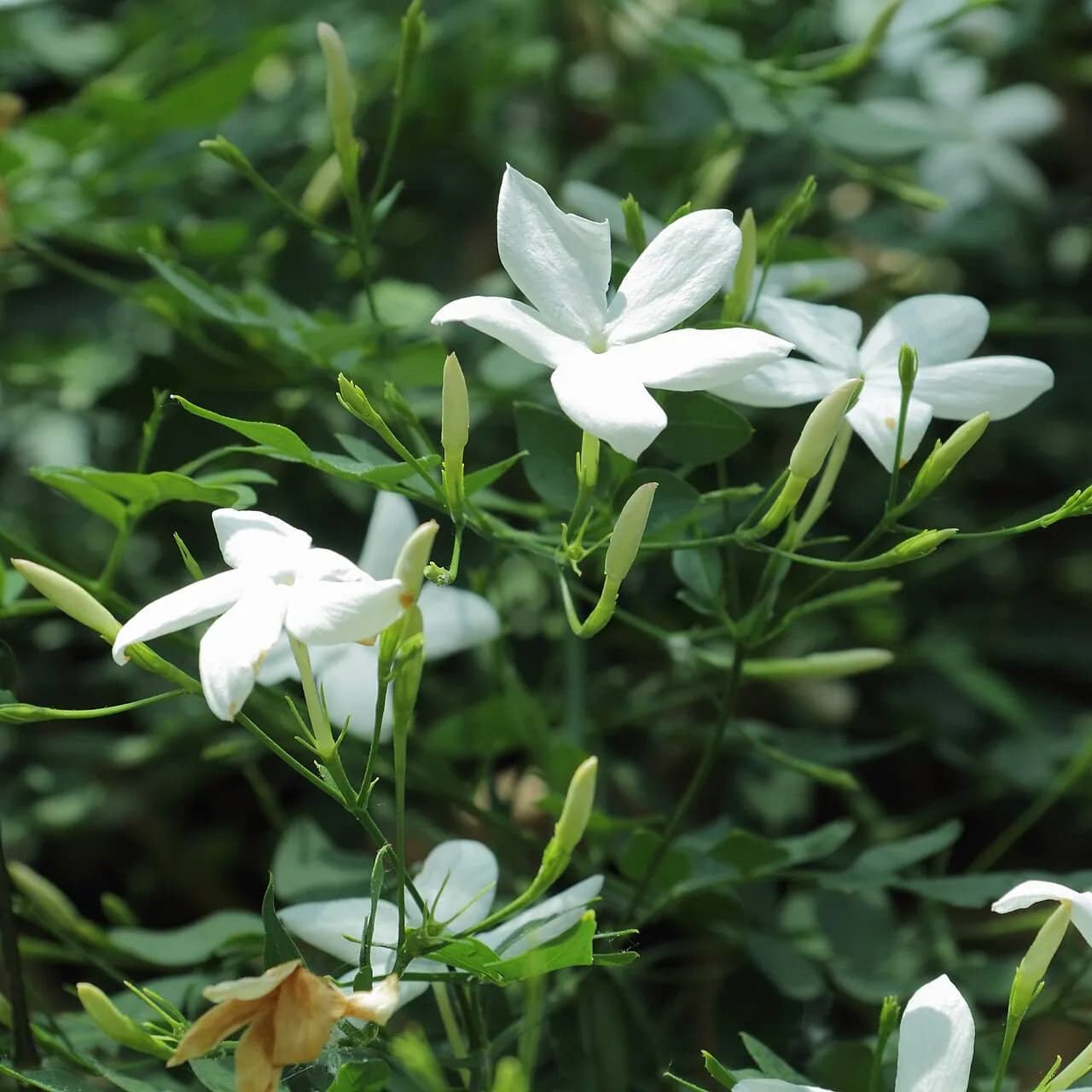
Jai, also called chameli, is Jasminum grandiflorum, the large-flowered jasmine of the olive family. Its neighbour, J. officinale, botanists call the “true jasmine,” and in Hindi both go by the name chameli. The two are indeed close: grandiflorum was once described as a large-flowered variety of officinale, and that old name is still listed among its synonyms. But they are accepted as separate species and grow differently: officinale is a mountain species, from Iran and the Caucasus to the Himalayas and Tibet, while grandiflorum is southern, from Arabia and East Africa to South Asia. It is a spreading deciduous climbing shrub of two to four metres, with pinnate leaves of five to eleven leaflets and large white star-shaped flowers in loose clusters — a long slender tube and a strong, heavy fragrance. Today it is grown in warm countries all over the world. The very scent the poets of Vraja love rests on benzyl acetate and benzyl benzoate — and that same scent made jati the basis of jasmine attar and of perfumery: it was brought to Europe for the sake of perfume as early as the sixteenth century.
Jai in bloom
Sources
We build Vrajapedia together – with stories, verses, photographs and parikrama experience. If you know something more, tell us and it will appear on this page.