Bimba
Bimba is an unassuming climber that twines over the fences and bushes of Vraja. It is famous for its fruit alone: as it ripens, the green oval fills with a scarlet so pure and deep that Sanskrit poetry adopted it as the very standard of red and applied it to the lips. Hence the word the poets of Vrindavan repeat again and again: bimbadhara – “lips like the bimba fruit.” In the verses of Vraja this scarlet belongs to the lips of Krishna and the gopis, while the living fruit beside them proves, every time, only a pale reminder.
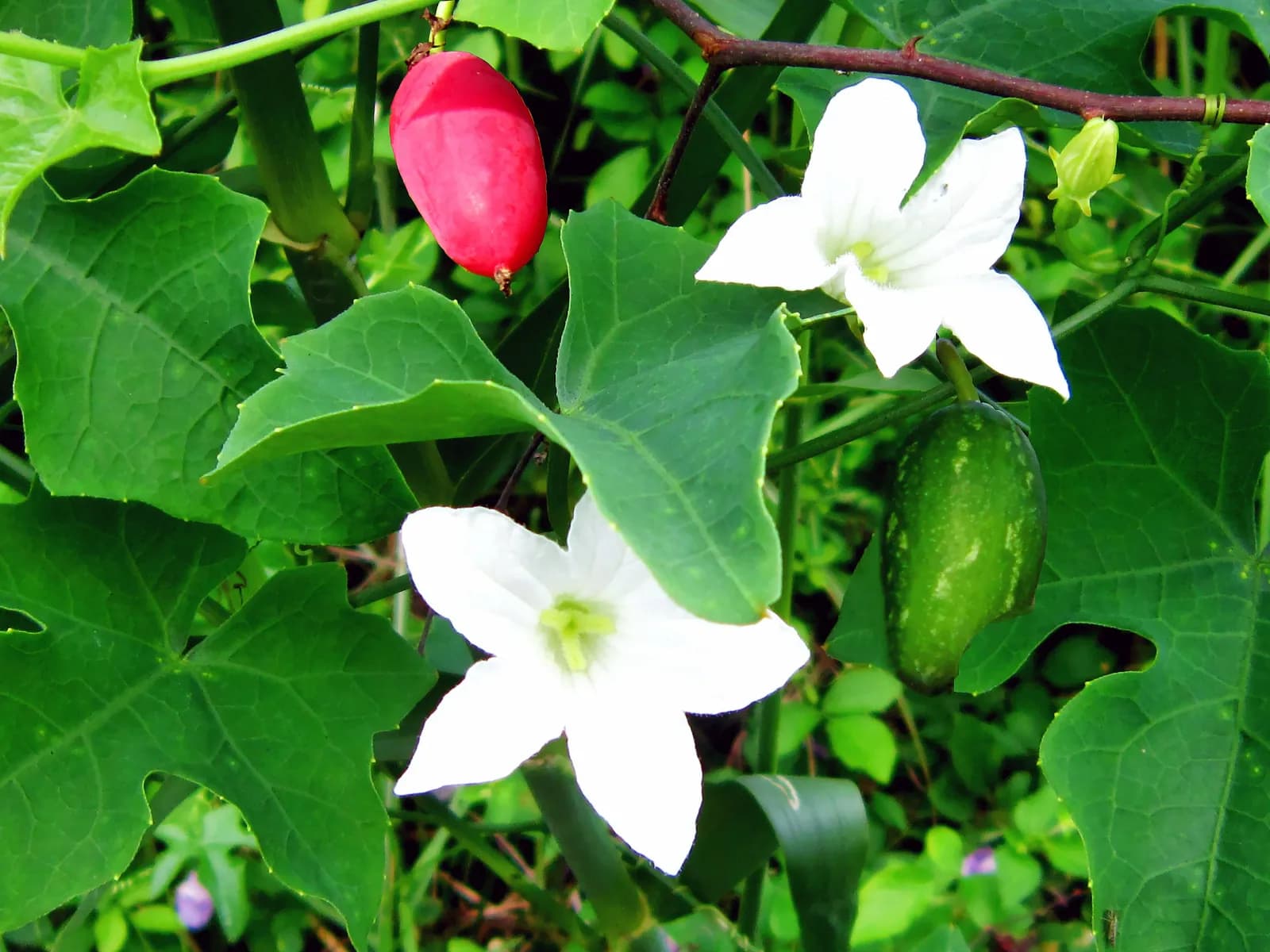
Bimba in Vrindavan
The color of the bimba is distinctive: not the dark red of the pomegranate, nor orange, but that pure scarlet used for painting lips.
Sanskrit poets made bimbadhara, “bimba lips,” a stock ornament in any description of a beauty. The Gaudiya poets took the ready-made image and gave it to the lips of Krishna and His beloveds.
But they immediately turned it around: if Krishna’s lips are the standard of scarlet, then the fruit beside them falls short. In the Govinda-lilamrita of Srila Krishnadasa Kaviraja Gosvami, forest parrots describe Krishna’s beauty, and of His lips they sing:
bimbāti-mañjv-adhara-madhyagatālpa-rekhaṁ
svaṁ paśyatām itara-rāga-hara-svabhāvam |
śaśvan-nijāmṛta-suvāsita-mañju-vaṁśī-
sūkṣmāyata-dhvanibhir āhṛta-viśva-cittam ||
Those lips red, like the bimba fruit with a line in the center, steal one's attraction for seeing any other lips. The minds of everyone in the universe are attracted by the fine sound emanating from the attractive flute touched by the nectar of those lips.
Scarlet on the Lips of Vraja
Here the fruit is not a model but a defeated rival. In the very next verse, Krishnadasa Kaviraja calls those same lips “a treasure chest for the maidens of Vraja” and a cup of nectar that keeps Radha alive. The scarlet of the bimba is only a stepping stone: pushing off from it, the poet moves on to the incomparable.
The same scarlet is on the lips of the gopis. When Krishna, posing as a toll collector, stops the girls on a forest path and demands payment, the jester Madhumangala teases Lalita: “You with your bimba-colored lips have no need of betel. Blessings upon you – you have spared five leaves”1. The joke cuts two ways. Betel stains the mouth red, and Madhumangala is hinting that the gopis’ lips are scarlet because they already chew pan beyond measure. And at the same time he is pleased that the five leaves will not go to waste: he will eat them himself.
The same scarlet belongs to Vrindadevi, mistress of the groves of Vrindavan. Srila Visvanatha Cakravarti Thakura, in his Sri-Vrindadevi-ashtaka, opens his description of her face thus: a tender smile plays on her lips, scarlet as the bimba fruit, and a pearl on the tip of her nose lights up her face2.
Poets’ Play: the Parrot, Kamadeva’s Bow, and Betel
Since the fruit and the lips are so alike, poets carry the likeness all the way to deception – and to a mischievous scene.
One such scene involves a bird that could not tell the one from the other. Srila Prabodhananda Sarasvati, in the Vrindavana-mahimamrita, asks his mind to fix itself on this:
śyāma-manohara-kīraṁ vṛndāraṇye 'dbhutaṁ smarādhīram
rādhādharaṁ daśantaṁ bimba-phala-śaṅkayā madhurataram
Please meditate on the wonderful, handsome, restless, dark parrot who, thinking them to be bimba fruits, bit the very sweet lips of Śrī Rādhā.
The dark parrot is Krishna Himself, and the bird’s “mistake” is a pretext for a kiss.
The same color can also serve as a weapon. In the Vidagdha-madhava of Srila Rupa Gosvami, Krishna confesses that the moment He glances at a maiden with bimba lips, the god of love draws his flower bow against Him:
bhramad-bhrū-vallīkaiḥ pratidiśam apāṅgasya valanaiḥ
kuraṅgībhyo bhaṅgī-bharam upadiśantīm iva dṛśoḥ |
tatas tāṁ bimbauṣṭhīṁ kalayati mayi krodha-vikaṭo
mano-janmā pauṣpaṁ dhanur anupamaṁ sajjam akarot ||
Whenever I look at that girl with bimba-fruit lips, that girl who with the restless flowering-vines of Her eyebrows and with many restless sidelong glances in every direction teaches the graceful does the art of casting waves of crooked glances, cruel and angry Kāmadeva aims at Me his peerless bow of flowers.
A Name of Endearment and a Recurring Image
And sometimes the scarlet fruit is simply an occasion for service. In the Stavamala, Rupa Gosvami speaks in the voice of a manjari, a young maidservant in the eternal pastimes of the Divine Couple: “O Radha, whose lips are bimba fruits! When will the son of the king of Vraja snatch away and taste the betel I place in Your lotus mouth?”3 Here bimba is no longer a comparison but a tender address, a name of endearment.
This image runs through the whole tradition. In Jayadeva’s Gita-Govinda, a companion urges Radha to go to Krishna: languishing in separation, He “thirsts to drink the sweet nectar of your bimba lips”4. And Kavikarnapura, in the Ananda-Vrindavana-champu, finds the same scarlet on an infant’s lips – Yashoda’s milk trickles from Krishna’s “lips red as bimba” down onto His cheek5. The same is sung in the Damodarashtaka, where Yashoda kisses the infant’s face:
idaṁ te mukhāmbhojam atyanta-nīlair
vṛtaṁ kuntalaiḥ snigdha-raktaiś ca gopyā |
muhuś cumbitaṁ bimba-raktādharaṁ me
manasy āvirāstām alaṁ lakṣa-lābhaiḥ ||
O Lord, again and again mother Yaśodā kisses Your lotus face, which is framed by locks of soft black hair tinged with red and beautified by Your lips colored red like the bimba fruit. May this vision of Your lotus face ever be manifest in my heart. Thousands and thousands of other benedictions are of no use to me.
Beyond Vraja
The image of bimba lips is far older than the poetry of Vrindavan: it lived in Sanskrit kavya long before the Gosvamis. Already in Kalidasa’s Meghaduta, the yaksha, separated from his wife, remembers her pakka-bimbadharoshthi – her “lower lip, red as a ripe bimba fruit.” For classical poetry this is a commonplace, an ornament in any portrait of a beauty.
The Gaudiya poets did not invent the comparison – they filled it with meaning: in their hands, a stock metaphor for redness became a sign of the incomparable sweetness of the lips of Krishna and His beloveds.
Ayurveda
In the medical tradition, bimba is known by the same distinguishing feature – its bright scarlet ripe fruit. The Raja Nighantu (3.64–65) places the climber in the guduchyadi varga, the section of creeping plants, and gives it the synonym tiktatundi – “having a bitterish fruit.” The plant is mentioned in the Charaka Samhita and in later compendia such as the Yogasarasangraha; the fruit and the root are the parts used, usually in compound formulations. That same synonym also points to the taste of the fruit – bitterish; the virya (potency) and vipaka (post-digestive effect) of bimba are not definitively assigned. Modern research focuses above all on its hypoglycemic, antidiabetic effect.
Botany
Bimba is Coccinia grandis of the Cucurbitaceae (gourd family), a perennial climber that clings with its tendrils and grows quickly, smothering whatever supports it. The leaves are palmate, five-lobed, five to ten centimeters across. Male and female flowers grow on separate plants, so not every vine bears fruit. The fruit is oblong, three to six centimeters long: unripe, it is green with white stripes and holds pale flat seeds inside. Eaten green as a vegetable, it is a staple of Indian cooking.
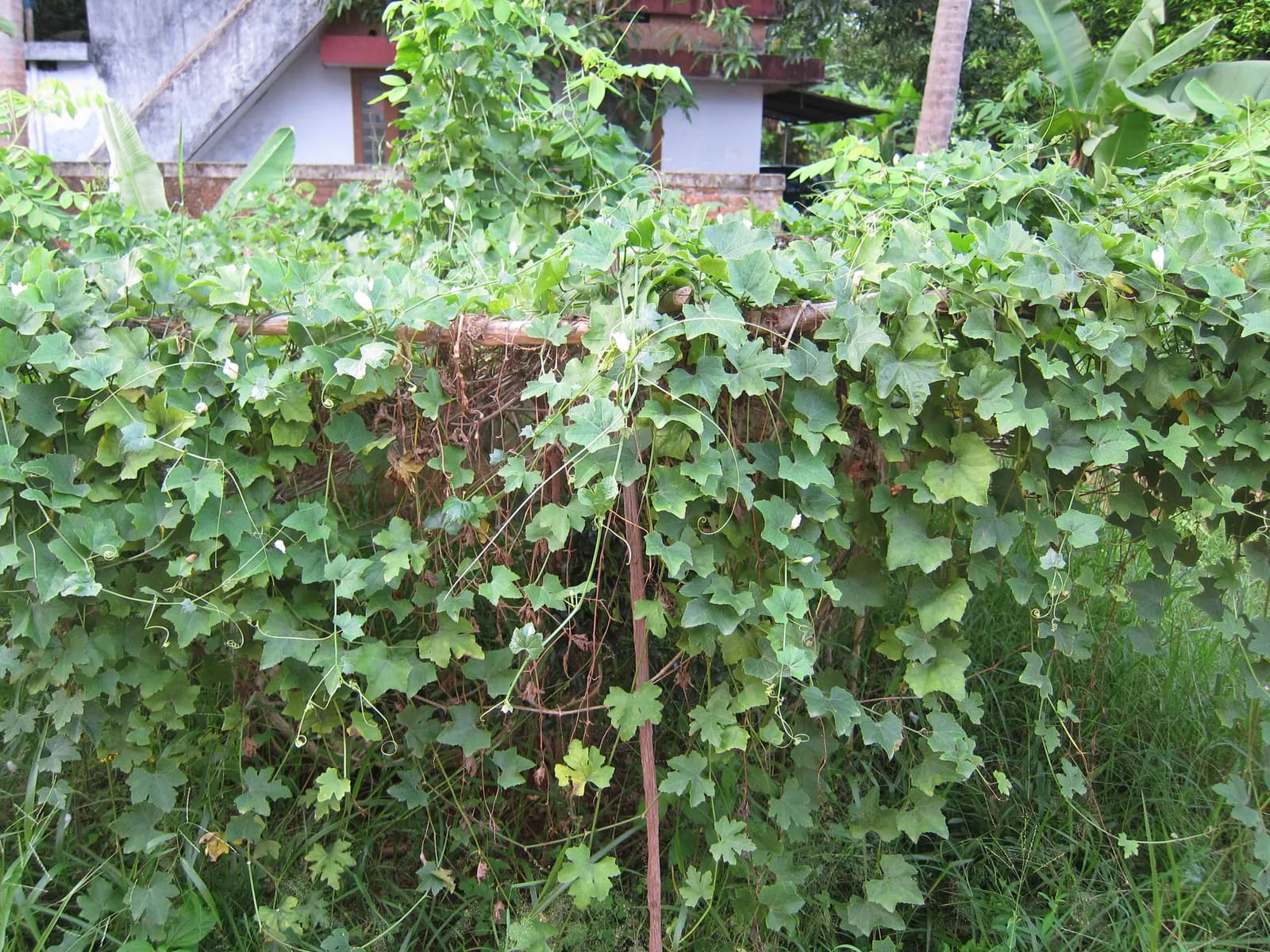
Bimba: fruit, flower, vine
Sources
We build Vrajapedia together – with stories, verses, photographs and parikrama experience. If you know something more, tell us and it will appear on this page.


