Arni
An unremarkable shrub of the dry plains, whose name is louder than its looks. Agnimantha means “that with which fire is churned”: from boards of its wood, rubbed one against another, the brahmanas have from of old drawn the sacrificial fire. Behind this stands the Vedic idea of wood as a womb out of which Agni is born. On the dry plains of Vraja such a shrub is common, while in the shastras it is arani – the fire-drill from which both the sacrificial fire and, in poetry, the Lord Himself flare up.
The fire-drill tree
Arni is the Hindi name; in Sanskrit the shrub is called agnimantha, from two words: agni – fire, mantha – churning, the very churning by which butter is beaten. “That with which fire is drawn by churning”. And so it was done: from the dry wood little sticks were cut, arani, and rubbed one against another until a spark was born. Hence the second and still older name of the shrub – arani: the fire-drill, the board in which fire lies asleep.
Behind this workaday detail stands the Vedic idea of fire. It was not brought from outside and not struck from flint – it was born from wood, as a child from a womb. The board was thought of not as a tool but as the womb of Agni: he is already there, inside, and only needs to be woken by the churning.
The best-known such case is told by the “Srimad-Bhagavatam” of King Pururava. Having lost his beloved apsara Urvashi, he turns even the sacred rite into longing for her: he finds a tree grown from the womb of another tree, cuts aranis from its wood and draws fire, meditating on the churning itself as on conception1.
sthālī-sthānaṁ gato ’śvatthaṁ śamī-garbhaṁ vilakṣya saḥ
tena dve araṇī kṛtvā urvaśī-loka-kāmyayā
urvaśīṁ mantrato dhyāyann adharāraṇim uttarām
ātmānam ubhayor madhye yat tat prajananaṁ prabhuḥ
“When the process of fruitive yajna became manifest within his heart, King Pururava went to the same spot where he had left Agnisthali. There he saw that from the womb of a shami tree an ashvattha tree had grown. He then took a piece of wood from that tree and made it into two aranis. Desiring to go to the planet where Urvashi resided, he chanted mantras, meditating upon the lower arani as Urvashi, the upper one as himself, and the piece of wood between them as his son. In this way he began to ignite a fire.”
In the rite the boards are not two but three: two are rubbed against a third – and it was on all three that Pururava meditated. For this service the agnimantha got its name: it too is an arani, it too carries fire within.
Fire from the arani: the advent of Rama
The poets carry the same image over to the advent of the Lord. Srila Rupa Goswami in the “Laghu-bhagavatamrita”, citing a verse from the “Sri-Ramarchana-dipika”, describes the birth of Ramachandra as the kindling of a great fire. Ayodhya here is the arani, the womb out of which the flame comes; the hosts of demons are the dry fuel, the palasha; and Rama Himself is “a certain single, indescribable radiance” that flared up to burn that fuel away.
uccasthe graha-pañcake sura-gurau sendau navamyāṁ tithau
lagne karkaṭake punarvasu-yute meṣaṁ gate pūṣaṇi
nirdagdhuṁ nikhilāḥ palāśa-samidhaḥ medhyād ayodhyā-araṇeḥ
āvirbhūtam abhūt apūrva-vibhavaṁ yat kiñcid ekaṁ mahaḥ
“On the ninth tithi, when five planets stood in their highest dignity, Jupiter joined the Moon in the constellation Punarvasu under the sign of Cancer, and the Sun was in Aries – from the arani-wood of Ayodhya there blazed up a sacrificial fire of unheard-of might, to burn away the palasha fuel [the hosts of demons]: a single, indescribable radiance.”
The difference is only in what is born: an ordinary arani gives up a fire obedient to the priest, the arani of Ayodhya – the Supreme Lord, obedient to His own will alone.
Ayurveda
In Ayurveda arni is called agnimantha and valued above all as one of the ten plants of the dashamula collection, “the ten roots”: it belongs there among the “five great roots” (brihat-panchamula) of the woody kind. Dashamula itself is a support in recovery after fever, in weakness, swelling and cough.
The taste (rasa) of the root is a complex one: bitter, pungent, astringent and sweet at once; its qualities are light and dry, its potency (virya) hot, its after-taste (vipaka) pungent. Such a combination lowers vata and kapha. Charaka counts agnimantha among the anti-inflammatory remedies (shothahara) and among those that quiet cold. Hence its uses: to kindle the digestive fire, to take down swelling and bloating, to help in haemorrhoids; a paste of the leaves is applied to swellings. Here the fiery name coincides with the work.
Botany
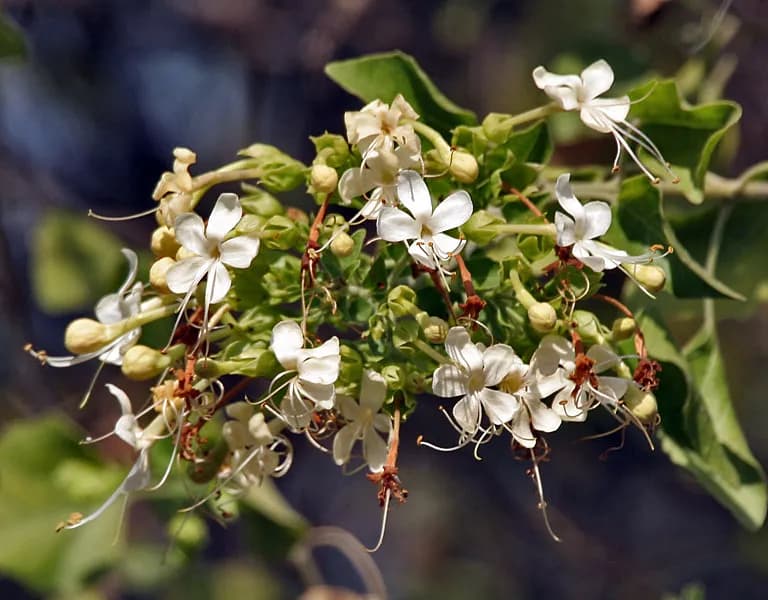
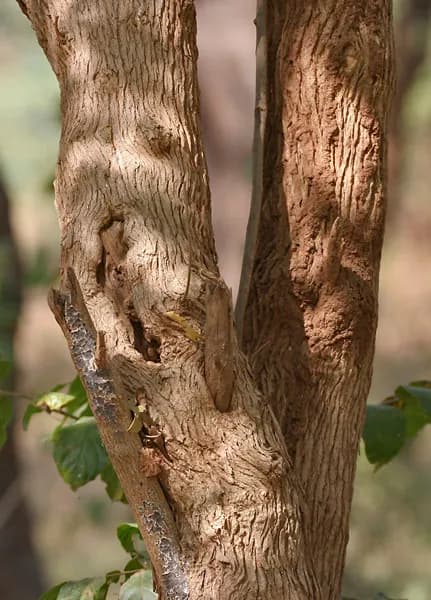
Clerodendrum phlomidis is a spreading shrub, common on dry plains, low hills and in semi-deserts. Its stems are ash-grey, the young branches velvety-downy. The leaves sit in opposite pairs, ovate-rhombic, one and a half to five centimetres, with an entire or wavy margin and downy beneath. The flowers are gathered in small rounded clusters, each with five almost equal petals; they may also be pale yellow or with a pinkish tinge. The fruit is a black wrinkled drupe, usually four-lobed. Arni grows in the dry districts of India, Pakistan, Bangladesh and Sri Lanka.
The name agnimantha itself is not fixed to this shrub firmly. The classical dictionaries – Monier-Williams and the “Shabda-sagara” – give it to the genus Premna, while the Ayurvedic codes call by it Clerodendrum phlomidis. In dashamula both plants serve as local substitutes for each other, so the argument about the name changes little in practice.
Arni: thickets, flowering, leaf
Sources
We build Vrajapedia together – with stories, verses, photographs and parikrama experience. If you know something more, tell us and it will appear on this page.