Arjuna
Two tall arjuna trees that “touched the sky” stood at the gates of Nanda's house in Mahavan – until one day they came crashing down with a deafening roar as a crawling toddler squeezed between them, dragging a wooden grinding mortar behind Him on a rope. Thus Krishna delivered the two sons of Kuvera who had been turned into trees. The same lila gave Him the name Damodara – “He whose belly is bound with a rope” – by which the gopis have sung of Him ever since.
Two Trees at Nanda's House
This story began long before Krishna's advent on Earth, on the bank of the celestial Mandakini. Kuvera, the keeper of the heavenly treasures, had two sons, Nalakuvara and Manigriva, who, drunk on wine, were sporting in the water with young girls. Narada Muni happened to pass by. The girls covered themselves in embarrassment, but the youths, intoxicated with pride, did not even notice their nakedness before the sage. Narada cursed them: since they were as shameless as trees, let them become trees. Yet there was mercy in the curse: they would keep their memory, and after a hundred celestial years they would meet Krishna face to face and attain devotion1. Thus the two denizens of heaven took birth as a pair of arjuna trees at the very gates of Nanda's house in Mahavan.
As foretold, the curse turned into a blessing. The Hari-vamsha says of them briefly: the two arjuna trees prayed for service in Vraja2. And Srila Sanatana Gosvami observes that the name itself was also a mercy: “Arjuna” was the name of one of the cowherd boys, Krishna's friends – so even as trees the two bore a name dear to the Lord.
Years later, mother Yashoda, catching her son stealing butter, tied Him by the waist to a heavy wooden grinding mortar and went back to her chores. Krishna dragged the mortar along behind Him – straight toward those two trees. He squeezed between them, and the moment He entered the gap, the mortar trailing behind turned sideways and got stuck3. The little boy gave another tug.
bālena niṣkarṣayatānvag ulūkhalaṁ tad
dāmodareṇa tarasotkalitāṅghri-bandhau
niṣpetatuḥ parama-vikramitātivepa-
skandha-pravāla-viṭapau kṛta-caṇḍa-śabdau
“By dragging behind Him with great force the wooden mortar tied to His belly, the boy Kṛṣṇa uprooted the two trees. By the great strength of the Supreme Person, the two trees, with their trunks, leaves and branches, trembled severely and fell to the ground with a great crash.”
The Name Damodara
It is here, in the Tenth Canto, that the name Damodara first appears – “He whose belly (udara) is bound with a rope (dama).” The Hari-vamsha says the same: in the cowherd village, the gopis glorify Krishna as Damodara because of this rope. Srila Sanatana Gosvami and Srila Jiva Gosvami draw attention to the first word of the verse – bala, “child.” Krishna uprooted two enormous trees without showing any strain: His childhood lila went on without a moment's interruption. The trees came down with a crash, yet they fell by themselves, pulling nothing down with them – unlike Putana, who swept away everything as she fell.
The same point is made long before the lila itself: in the Second Canto, Lord Brahma proves His divinity by three feats of the infant.
yad riṅgatāntara-gatena divi-spṛśor vā
unmūlanaṁ tv itarathārjunayor na bhāvyam
“…or to uproot a pair of arjuna trees so high that they touched the sky, when He was only crawling? All these activities are impossible for anyone other than the Lord Himself.”
From the split trunks emerged two effulgent denizens of heaven, Nalakuvara and Manigriva, who bowed down and glorified Krishna. In the Gopala-champu, Srila Jiva Gosvami relates a conversation about these trees in Nanda's courtyard. Nanda recalls that even in Vraja they fulfilled desires, like demigods, and the narrator Snigdhakantha replies that even as trees the two remained devotees of the Lord, and afterwards returned to their abode as great bhaktas.
The Place of the Lila
The place of this lila in Vraja is still remembered today. In the Mathura-mahatmya, Srila Rupa Gosvami, retelling the Adi-varaha Purana, names a special tirtha and kunda in Gokula-Mahavan:
yamalārjuna-tīrthaṁ ca kuṇḍaṁ tatra ca vartate
paryastaṁ yatra śakaṭaṁ bhinna-bhāṇḍa-kuṭi-ghaṭam
“There lie the Yamalarjuna tirtha and kunda – beside the place where the cart was overturned and the pots were broken.”
This place, yamalarjuna-uddhara-sthal, is still shown to pilgrims in Mahavan, not far from Nanda's house, beside the spot where Shakatasura's cart was overturned.
Chaitanya Mahaprabhu
When Sri Chaitanya Mahaprabhu was visiting the holy places of Vraja, He also came to the place where the two trees fell:
yamalārjuna-bhaṅgādi dekhila sei sthala
premāveśe prabhura mana haila ṭalamala
“Upon seeing the place where the twin arjuna trees had been broken by Śrī Kṛṣṇa, Śrī Caitanya Mahāprabhu was moved to great ecstatic love.”
In Prayers and Verses
The lila gave Krishna not only the name Damodara but also an epithet by which He is extolled in prayers: yamalarjuna-bhanjana, “the Breaker of the twin arjuna trees.” In the Krishna-lila-stava, Srila Sanatana Gosvami condenses the whole story into a single line:
kṛta-devarṣi-gītārtha-yamalārjuna-bhañjana
dhanadātmaja-sat-stotra-stuta sarveśvareśvara
“O Breaker of the arjuna trees, who fulfilled the words of the devarishi Narada! O You whom the sons of Kuvera glorified with wondrous prayers! O Lord of all lords!”
Where the arjuna is simply a tree of the Vrindavan forest, poets play upon its other name, kakubha. It is the same word as kakubh, “a direction of the sky”; the word also denotes anything lofty and eminent. In the Govinda-lilamrita, Srila Krishnadasa Kaviraja Gosvami paints Vrindavan at the height of the rainy season: flowering arjunas, together with nipa-kadambas, fill every direction, so that kakubhas (the trees) flood the kakubhs (the horizons)4. In verses like these the arjuna stands on equal footing with the kadamba and the tamala.
Beyond Vraja
The word arjuna has many meanings in Sanskrit. The Medini-kosha dictionary, quoted by the commentators on the Bhagavatam, lists: the kakubha tree, Partha (that is, Arjuna the Pandava), King Kartavirya, a peacock, and a mother's only son5. When trees are meant, arjuna means kakubha.
Describing the celestial garden Ritumat on Mount Trikuta, Sukadeva Gosvami places the arjuna alongside the tamala, the asana, and the kadamba, and Vamsidhara Pandit explains: “arjunas [means] kakubhas.”
In the rest of India the arjuna is just a sturdy forest tree. In Vraja it has forever remained the tree of a single lila.
Ayurveda
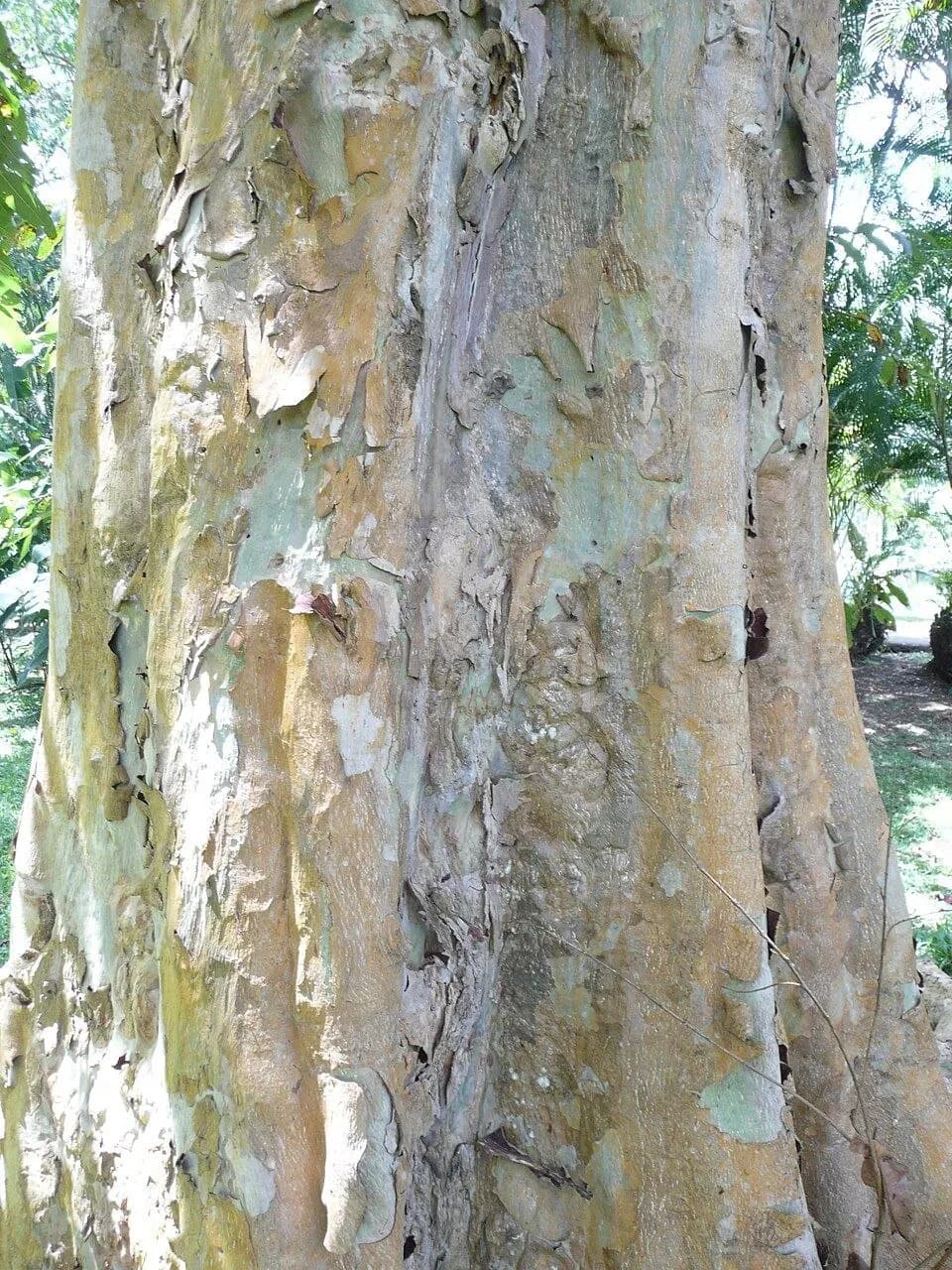
In Ayurveda the bark of the tree is regarded as a cardiac tonic: Charaka places the arjuna in the hridya group of “heart” remedies and among the astringents (kashaya-skandha), while Sushruta assigns it to the salasaradi and nyagrodhadi6 ganas. In rasa (taste) the bark is astringent (kashaya), in guna (qualities) light and dry, in virya (potency) cooling, and in vipaka (post-digestive effect) pungent (katu); it pacifies kapha and pitta. It is chiefly the smooth bark, stripped off in flakes, that is used: its decoction and powder strengthen the heart and blood vessels, stop bleeding, and heal wounds and fractures.
Botany
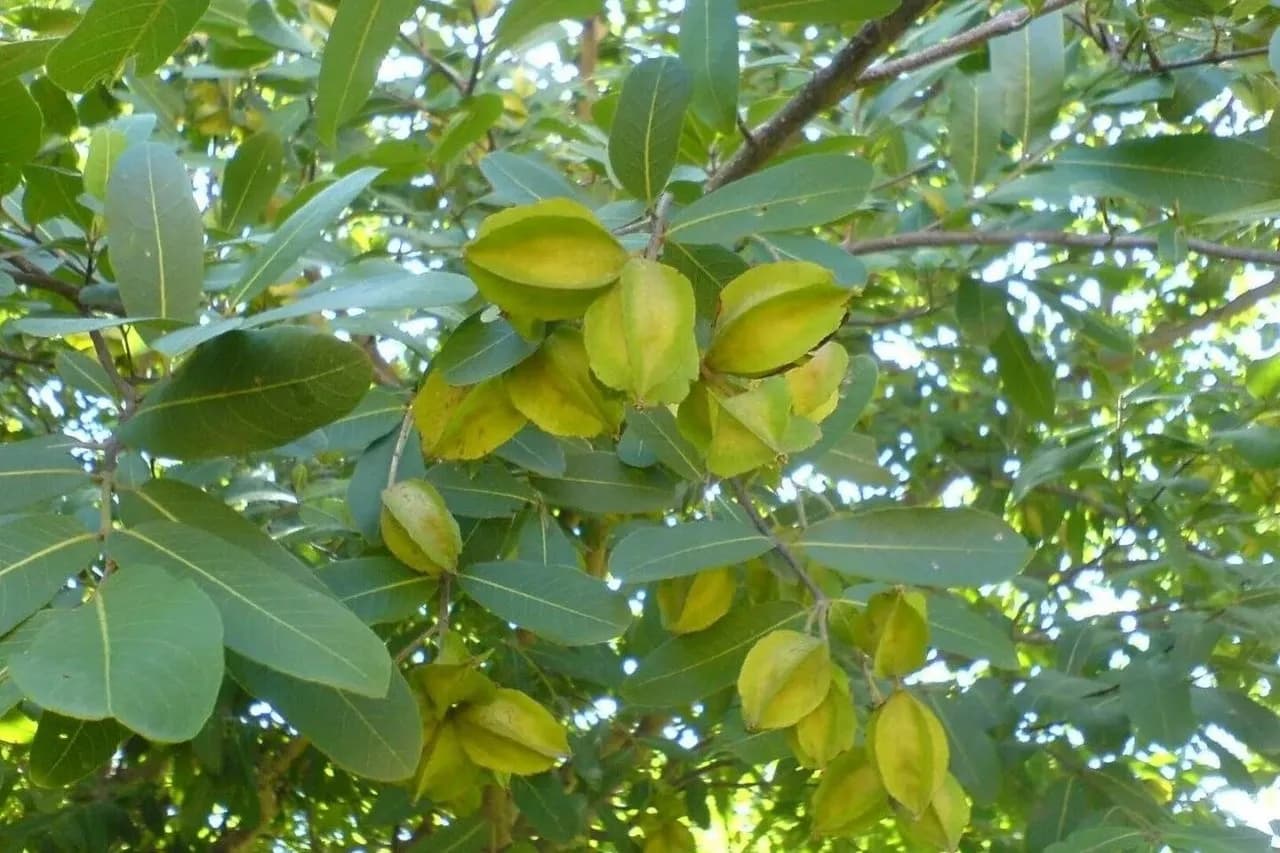
Botanists know the arjuna as Terminalia arjuna of the family Combretaceae (combretum family). It grows along the banks of rivers and streams. Its bark is what gave the tree its name: arjuna in Sanskrit means “white, bright,” and its other name, dhavala, says the same. The leaves are oblong and leathery, set almost opposite one another; after flowering, winged, ribbed fruits ripen. The arjuna is native to the Indian subcontinent and Sri Lanka, from Pakistan to Myanmar.
Arjuna in bloom
Sources
We build Vrajapedia together – with stories, verses, photographs and parikrama experience. If you know something more, tell us and it will appear on this page.


