Akash Malli
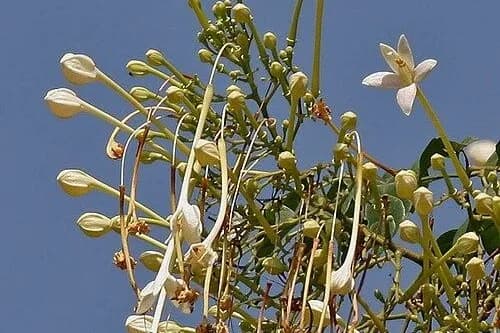
A tall, slender tree with corky bark that opens whole panicles of silvery-white tubular flowers towards night and fills the evening air with a thick sweet scent — which is how it came to be called a jasmine. A true jasmine akash malli is not: it does not belong to the jasmine genus at all, it merely resembles one. It has no pastime of its own in Vraja, but it does have a place among the eight “jasmines” of Vraja — those called jasmine not by genus but by their white fragrant flowers.
Contents
A Jasmine in Name Only
“Akash malli” means “jasmine of the sky”: malli is jasmine, akash is sky; the name was given for the white fragrant flowers that look like jasmine. In Hindi it is called nim chameli — “the jasmine with neem leaves”: the airy pinnate foliage recalls the neem, and the flower a jasmine (chameli). But behind the fine name there is no jasmine. Botanically akash malli is a tree of the bignonia family, kin to the jacaranda, and all it shares with the true jasmines of the genus Jasminum is its looks.
The poets and acharyas of Vraja have sung of many flowers: mallika, kunda, jati, malati. Of these the gopis weave garlands for Krishna, and of these they ask, in separation, whether He has passed by. All those verses are about true jasmines — that is, about other plants. Akash malli does not belong to that company: it has neither a pastime nor a verse, and in India it is a guest — in the wild the tree grows from Lower Burma to Indochina, while across Indian gardens and roadsides it is planted. Among the white fragrant flowers that open at night and fill Vraja with scent, the “jasmine of the sky” keeps a quiet place at the far edge.
Folk Medicine
Neither Charaka nor Sushruta nor the nighantu lexicons know akash malli: it has remained a tree of the folk medicine of South and Southeast Asia. The leaves and flowers are used for complaints of the lungs — bronchitis and asthma; dried, they are even smoked to relieve sinusitis and shortness of breath. The bark is held to bring down fever and to act as a diuretic. Hispidulin, an anti-inflammatory compound, has been found in the leaves, and it is credited with the tree’s reputation as an expectorant and an antimicrobial.
Botany
Akash malli is Millingtonia hortensis, the only species in its genus. The tree is tall — eighteen to twenty-five metres — slender and quick-growing, but its wood is brittle and the wind often breaks its branches. The bark is ash-grey, fissured and corky, which is what earned it the name of cork tree. It flowers twice a year: from April until the rainy season, and again in November and December. The fruits are flat capsules with winged seeds that the birds carry off.
Akash malli in bloom
Sources
We build Vrajapedia together – with stories, verses, photographs and parikrama experience. If you know something more, tell us and it will appear on this page.