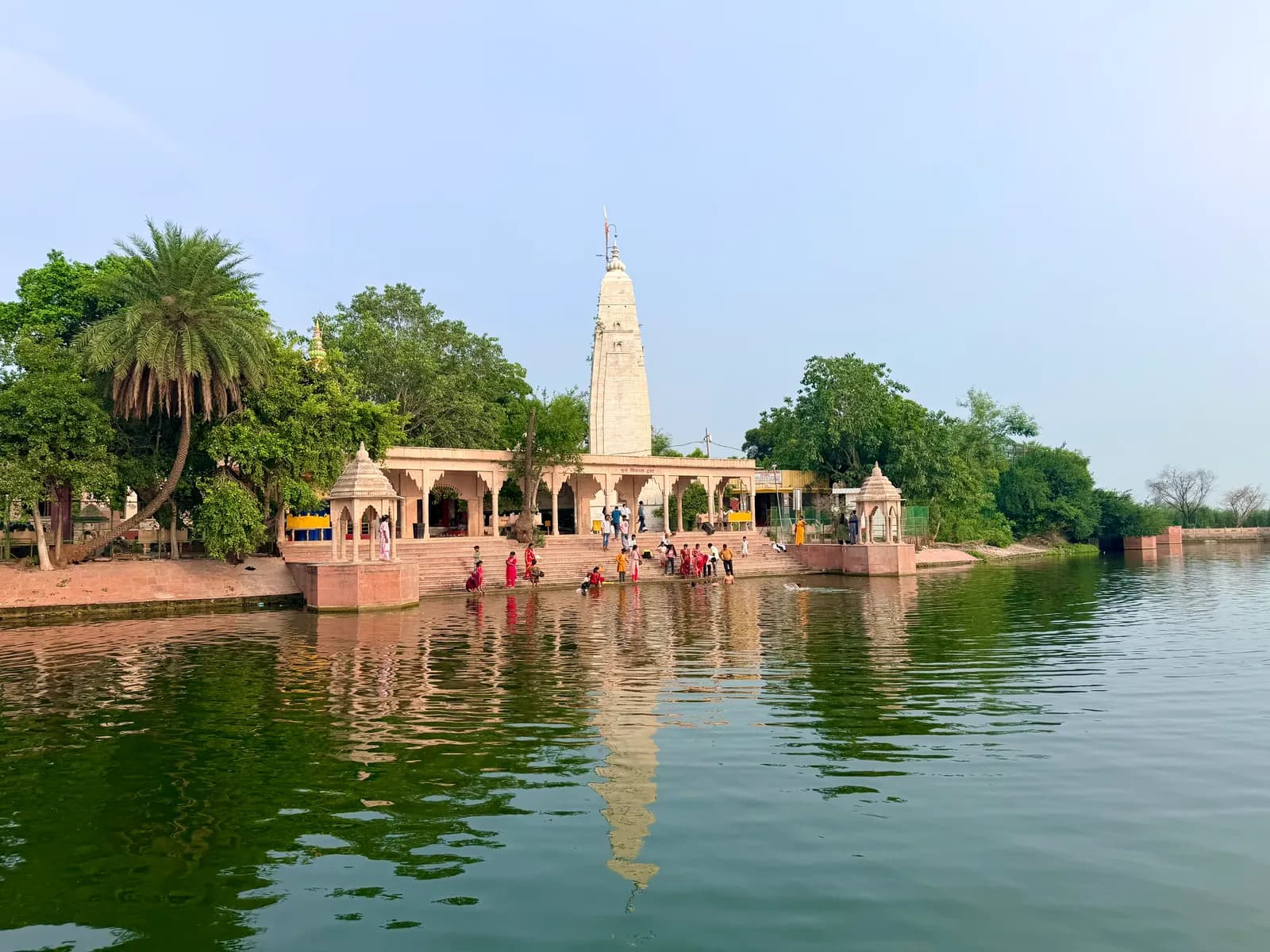
Sri Radha Gokulananda
The temple of Sri Radha Gokulananda stands in Vrindavan between Keshi Ghat and the temple of Radha Raman. It is known for a single altar that gathers the Deities of several acharyas at once: Radha-Vinoda of Srila Lokanatha Goswami, Gokulananda of Srila Vishvanatha Chakravarti Thakur, Vijaya-Govinda of Srila Baladeva Vidyabhushana, and Chaitanya Mahaprabhu, whom Srila Narottama das Thakur worshipped. Each of these Deities once had a temple of its own, until Vishvanatha Chakravarti brought Them together.
Here too a stone from Govardhan Hill is worshipped – the one Mahaprabhu Himself washed with tears of love – and four samadhis stand in the courtyard. It was in the age of renewal begun by Vishvanatha that the notion of the “Seven Temples of the Goswamis” took shape – the list of Vrindavan’s principal shrines; this temple closes it.
How the temple began
Srila Lokanatha Goswami was not among the Six Goswamis of Vrindavan, yet he came here before them all; out of respect he is often called the Seventh Goswami. Mahaprabhu blessed him in Navadvipa and told him to go to Vrindavan – to give the forgotten places of Krishna’s pastimes back their true meaning. Two set out: Lokanatha and his paternal uncle Bhugarbha Goswami, who had been given the same charge. Both reached Vrindavan around 1510.
Lokanatha did not find his Deity here. In the forest by Kishori-kunda, near the village of Umrao-gaon, Sri Radha-Vinoda appeared to him – very small. Lokanatha carried Him in a pouch at his heart and never parted with Him for a moment. Only years later, yielding to the pleas of Srila Rupa and Srila Sanatana Goswami, did he bring Radha-Vinoda to Vrindavan. At first Vinoda was worshipped alone: the Deity of Radharani was manifested in Jagannatha Puri at the bidding of Jahnava Devi and placed on the altar later.
Lokanatha spent his days in a secluded garden on the bank of the Yamuna, in meditation and in chanting the Holy Name. The temple now stands on that very spot. Here too he gave initiation to Narottama das Thakur – his first and only disciple, whose samadhi stands today in the courtyard beside his teacher’s.
How Gokulananda came to the temple
About a century passed. Srila Vishvanatha Chakravarti Thakur came to Vrindavan – the author of the commentaries on the Srimad-Bhagavatam and the Bhagavad-gita, whom the Vaishnavas recognized as the foremost acharya of Vraja after the Goswamis had departed. At first he settled at Radha-kunda, in the old bhajana-kutir of Srila Krishnadas Kaviraja Goswami, where he wrote his books and served his Deity – Gokulananda.
He came by this Deity through the will of Krishna Himself. The Lord appeared in a dream to a young brahmachari from Mathura and told him to give his small murti of Gokulananda to Vishvanatha. When the brahmachari brought the Deity, Vishvanatha refused: he was a penniless hermit and could not worship as he ought. Then Krishna appeared in a dream to Vishvanatha himself and promised: “I shall see to all the offerings Myself.” On the third day the dream came again – and Vishvanatha accepted the holy Deity.
Later Vishvanatha moved to Vrindavan and settled where Lokanatha Goswami had once performed his service. By then the old temple had fallen into disrepair, its walls crumbling. Vishvanatha rebuilt it, named it the temple of Gokulananda, and did the thing that decided the fate of this place: he gathered on one altar the Deities that had been worshipped separately, in different shrines.
The Altar
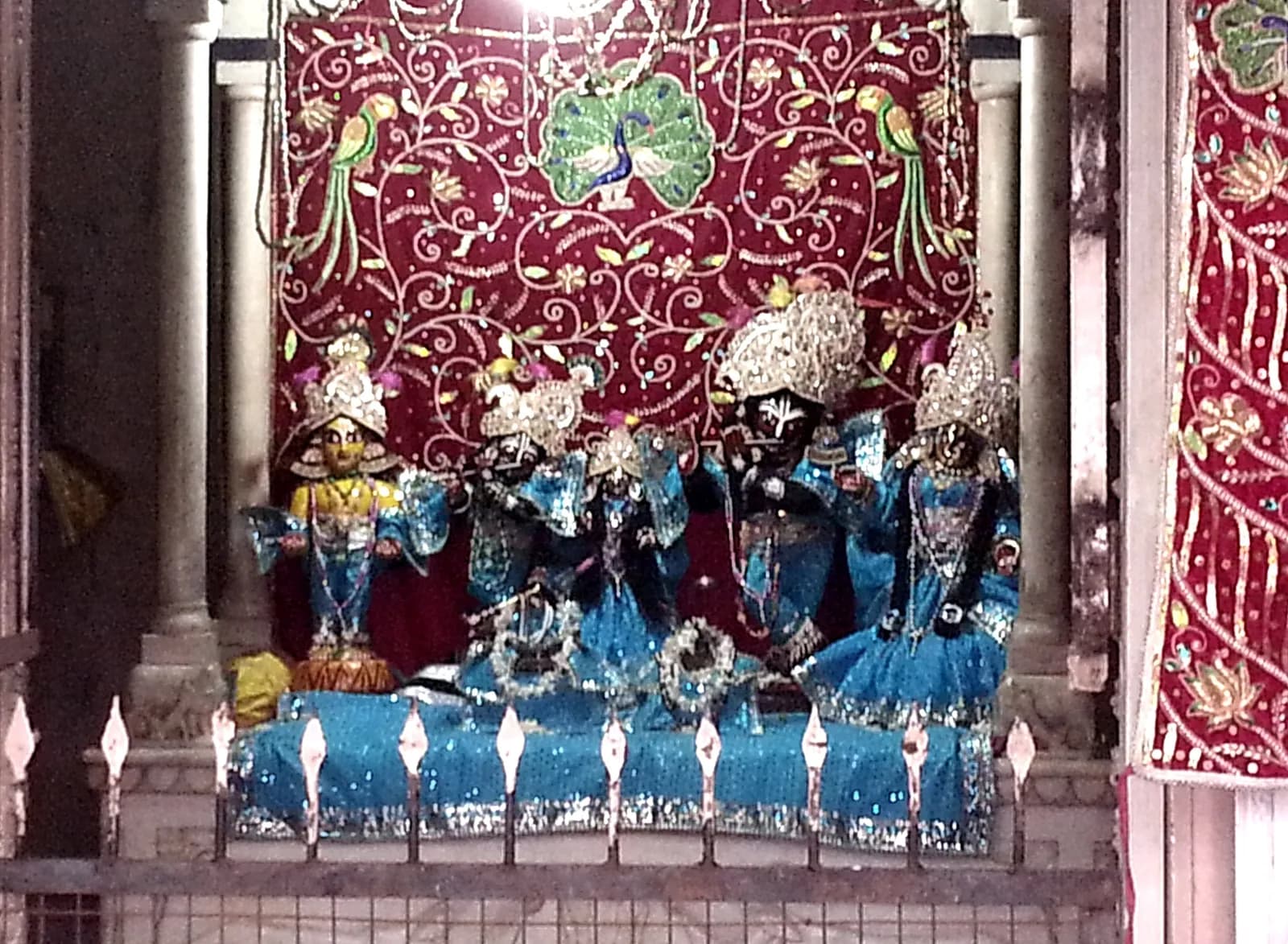
On the altar stand:
Sri Radha-Vinoda
the small Deity of Srila Lokanatha Goswami, which he carried in a pouch at his heart
Sri Radha-Gokulananda
the Deity of Srila Vishvanatha Chakravarti Thakur
Sri Vijaya-Govinda
the largest Deity on the altar; worshipped by Srila Baladeva Vidyabhushana
Sri Chaitanya Mahaprabhu and the small Deity of Krishna before Gokulananda
worshipped by Srila Narottama das Thakur
The original Deities of Radha-Vinoda, however, are no longer on this altar. In 1670, to save the holy Deities of Vrindavan from Aurangzeb, They were taken in secret to Rajasthan together with the other principal Deities. Today They are worshipped in Jaipur, and here stand pratibhu-murtis.
The fate of Gokulananda Himself is disputed to this day: some hold that the original murti of Vishvanatha Chakravarti stands in Vrindavan, others that it too was carried off to Jaipur.
The stone washed with tears
But for many pilgrims the temple’s chief treasure is the stone from Govardhan (govardhana-shila), worshipped by Sri Chaitanya Mahaprabhu Himself.
The Lord chanted the Holy Name without letting this shila out of His hands: He pressed Her to His chest, held Her up to His eyes, breathed in Her scent, laid Her on His head. From His tears the stone stayed damp almost always. Mahaprabhu said that this shila is the very body of Lord Krishna.
For three years the stone remained with Mahaprabhu. Then, pleased with the renunciation and strength of spirit of Srila Raghunatha das Goswami, the Lord gave the stone to him. On the shila the pressed imprint of His thumb remained forever.
After that the service passed from hand to hand, until the shila came to Krishna-priya Thakurani, the granddaughter of Ganganarayana Chakravarti. In her great old age she gave Her to Vishvanatha Chakravarti Thakur.
As to where She is now, accounts differ. Rajashekhara das writes that a pratibhu-murti is honoured in the temple itself, while the original stone with the imprint is kept at Bhagavata-Nivas, in the Ramana-reti quarter. Bhaktivedanta Narayana Goswami notes cautiously that the shila “was formerly here”. The pujaris of the Gokulananda temple, however, still show this holy relic to pilgrims today.
Samadhis in the courtyard
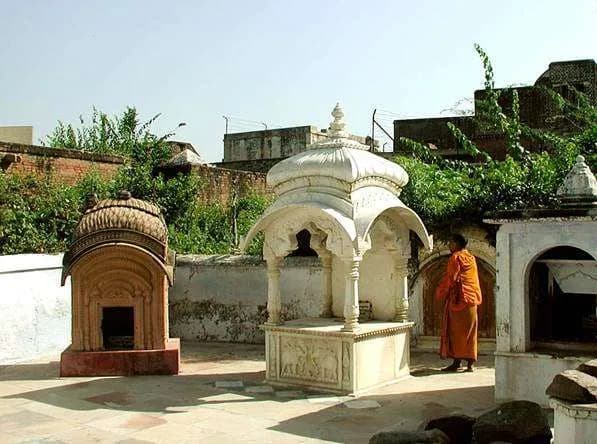
In the inner courtyard of the temple stand four samadhis (sacred tombs): those of Lokanatha Goswami, Narottama das Thakur, Vishvanatha Chakravarti Thakur and Ganganarayana Chakravarti. A whole chain of succession is set here in stone: Lokanatha was a disciple of Sri Chaitanya, Narottama the only disciple of Lokanatha, Ganganarayana a disciple of Narottama.
Srila Lokanatha Goswami left this world in 1585 (other sources give 1583 or 1588) and entered samadhi beside his temple, by the waters of the Yamuna. There is another account as well: that his samadhi lies north of the village of Umrao-gaon, by Kishori-kunda – where Radha-Vinoda first revealed Himself to him.
Narottama das Thakur left this world in Bengal in 1611, and so a pushpa-samadhi was raised for him in Vrindavan. Kept here are his garland, his upper cloth, his kaupina and the beads on which he chanted the Holy Name. Tradition holds that the samadhi was raised on the very spot where Narottama loved to sit beside his guru.
Where the notion of the “Seven Temples of the Goswamis” was born
Before Srila Vishvanatha Chakravarti Thakur there was, it seems, no single notion of “the seven principal temples of Vrindavan”. The list took shape in the age of renewal he began, when the old temples were being rebuilt and worship was brought back to the rules laid down by the Six Goswamis.
The list closes here, at the temple of Radha Gokulananda. Sivarama Swami cites a prayer in which all seven are named:
“Jaya! Jaya! Radha-Madana-mohan! Radha-Govinda! Radha-Gopinath! Radha-Damodar! Radha-Shyamasundar! Radha-Raman! Radha-Gokulananda! All glories to You! All glories to You!”
Madana-mohan, Govindadev, Gopinath, Radha-Damodar, Radha-Shyamasundar, Radha-Raman – and Sri Radha-Gokulananda, the seventh and last in this row.
Timeline
The birth of Srila Lokanatha Goswami in the village of Talakhari.
Lokanatha Goswami and his uncle Bhugarbha Goswami come to Vrindavan at Mahaprabhu’s direction.
Radha-Vinoda reveal Themselves to Lokanatha in the forest by Kishori-kunda; later he brings Them to Vrindavan.
Lokanatha Goswami enters samadhi.
The passing of Narottama das Thakur; his pushpa-samadhi is raised in Vrindavan.
Radha-Vinoda and the other principal murtis of Vrindavan are taken in secret to Rajasthan, saved from Aurangzeb.
Vishvanatha Chakravarti rebuilds the temple and unites the Deities of different acharyas on a single altar; the notion of the “Seven Temples of the Goswamis” takes shape.
Vishvanatha Chakravarti Thakur enters samadhi (some sources give 1674).
Sources
We build Vrajapedia together – with stories, verses, photographs and parikrama experience. If you know something more, tell us and it will appear on this page.