Juhi
Among the jasmines of Vraja juhi is the golden one: the shastras call it just that, svarna-yuthika. The poets made it Radha’s creeper: the yuthi twined about the dark tamala tree is Radha Herself beside Krishna, the lightning against the thundercloud. And juhi is a flower of the rains as well: it opens when the clouds gather over Vrindavan, and the bees of the whole forest fly to it.
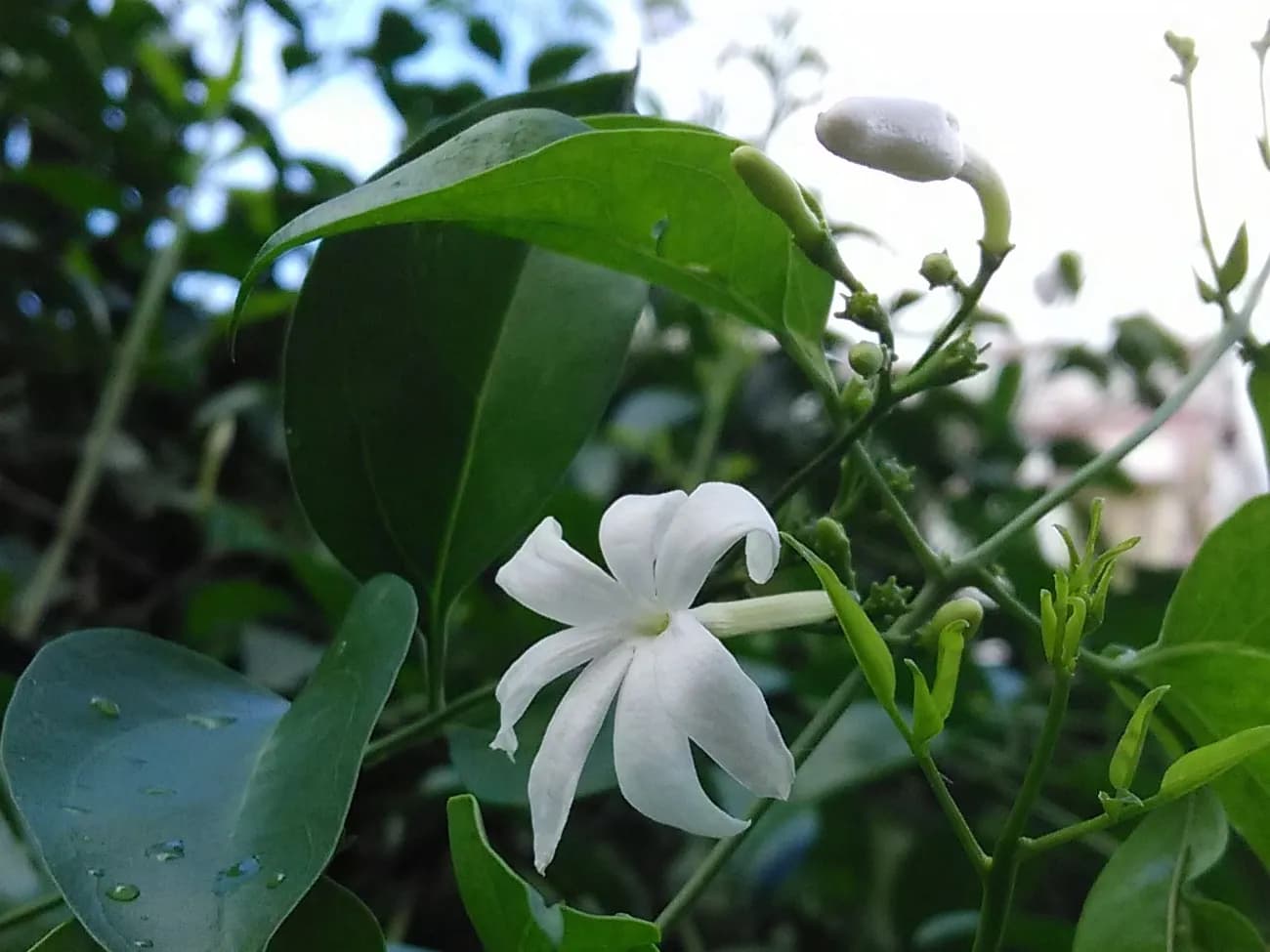
The vine in Vrindavan
In the thirtieth chapter of the Tenth Canto of the “Bhagavatam” the gopis, maddened by separation, rush about the night forest and ask every plant they meet about Krishna. Tulasi, Krishna’s favourite, keeps silent as though too proud, and then the girls turn to the jasmine bushes – to malati, mallika, jati and yuthika:
mālaty adarśi vaḥ kaccin mallike jāti-yūthike
prītiṁ vo janayan yātaḥ kara-sparśena mādhavaḥ
“O malati, O mallika, O jati and yuthika, has Madhava gone by here, giving you pleasure with the touch of His hand?”
The jasmine of the rains
The gopis call out to yuthika for a reason: the jasmines too give Krishna their best flowers, which makes them His maidservants, His sevikas, just as the girls are – companions one may confide in. The commentators read botany out of the verse as well: “the touch of the hand” is Krishna’s hand plucking the flowers, and by which bush has blossomed more richly than its season one can see which of them it touched. Yuthika stands here beside jati for a reason too: both are jasmines of the late, rainy and autumn months, and Vishvanatha Chakravarti tells them apart by their time of flowering.
Yuthika is the jasmine of the rains: its season is varsha, when the clouds gather over Vraja. Then it is the mistress of the forest. Srila Krishnadas Kaviraja Goswami in the “Govinda-lilamrita” paints the monsoon Vrindavan, lush from the downpours and covered with clouds, and draws the attention of the whole swarm of bees to a single flower – to the yuthi1. It lures the bees away from the neighbouring mallika creepers as well: its fragrance is the stronger.
But most often juhi is remembered for its colour. Yuthika comes in more than one kind: in the “Brihad-bhagavatamrita” of Srila Sanatana Goswami, where the flowers for Krishna’s garlands are listed, “two kinds of yuthika” are named2 – which kinds exactly the verse does not say. The poets of Vraja almost always mean the golden one, svarna- or kanaka-yuthika, and that is why its creeper turns up again and again beside a dark tree.
In the bowers where Radha and Krishna meet, creepers twine about the trees of which the walls and vaults are made: in the “Govinda-lilamrita” golden yuthi creepers embrace the ashokas. And in the “Krishna-bhavanamrita” of Srila Vishvanatha Chakravarti there is a whole little scene about this. Krishna points Radha to a tamala twined about with golden yuthika and teases Her: here is the shameless one – embracing a tree in full view. And the embarrassed Radha covers the creeper with the hem of Her garment.
In separation this image deceives the eye outright: in Srila Jiva Goswami’s “Gopala-champu” a gopi, seeing a tamala in the distance twined about with flowering yuthika, takes it for a moment for Krishna beside His golden companion3.
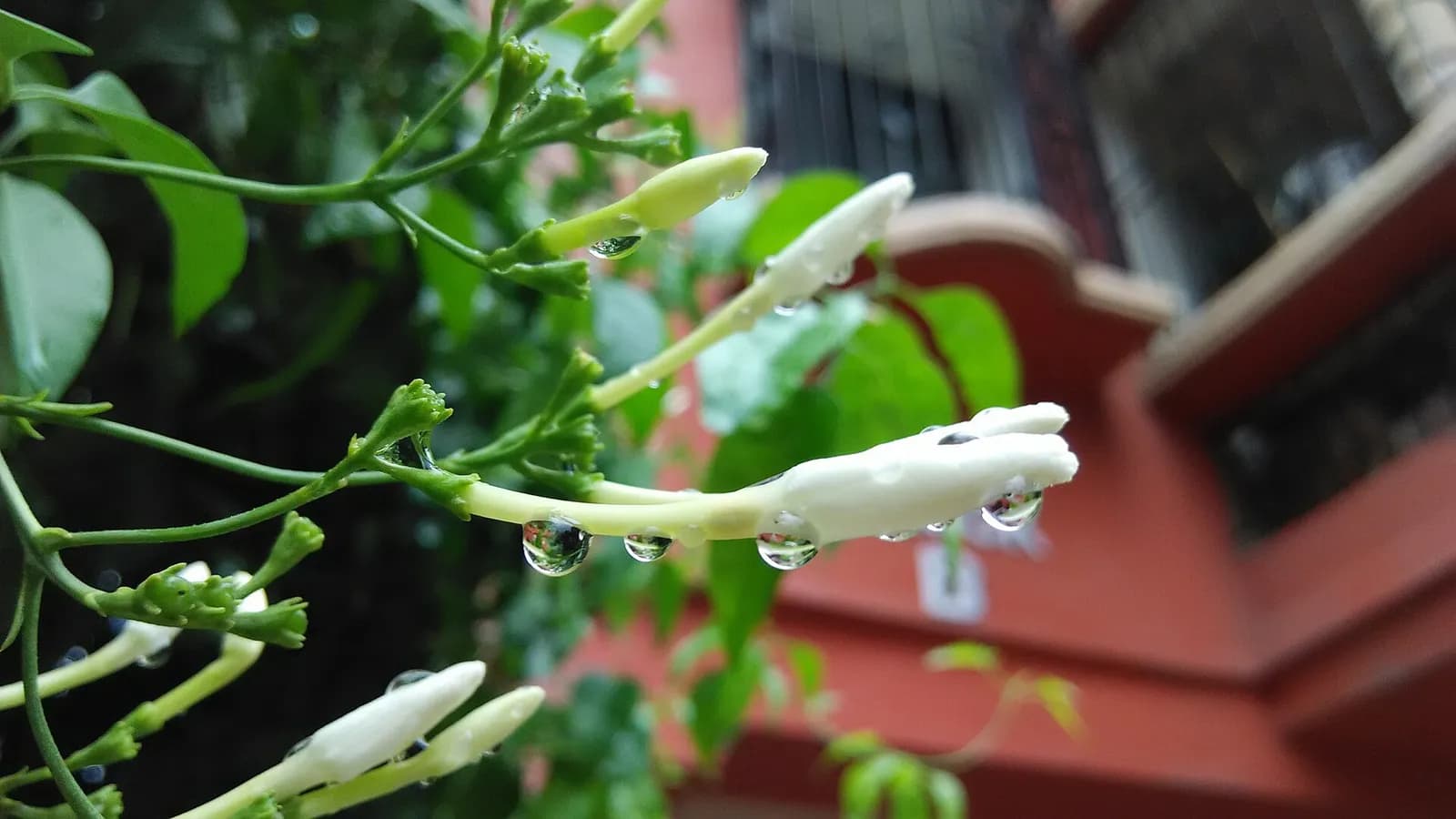
Worship
Juhi is offered to Krishna as well. Gathering the rules of service from the Puranas, Srila Sanatana Goswami cites in the “Hari-bhakti-vilasa” a list of the flowers “best for the worship of Achyuta”: yuthika stands there on a par with jati, kunda and karavira, while of the whole list only ketaki is rejected4.
But more often juhi finds its way into the hands of the manjaris – the young confidantes of Radha who weave garlands for the Divine Couple and dress Their hair. In the “Ujjvala-nilamani” of Srila Rupa Goswami, Rupa-manjari says to Rati-manjari: from today let us not pick fresh jasmine, let us look rather for yuthika and lotus petals to spread the flower bed5. Rupa-manjari’s service is to prepare the bower for Radha’s meeting with Her Beloved, and juhi comes into her hands.
Gold upon the dark
Garlands for Krishna are woven of juhi too. Srila Krishnadas Kaviraja Goswami in the “Govinda-lilamrita” paints Him in the bower like this:
navīna-jalada-dyutiḥ kanaka-pīta-paṭṭāmbaraḥ
praphulla-kamalekṣaṇaḥ kanaka-yūthikā-mālyavān
śikhaṇḍa-kṛta-śekharaḥ sphurati sādhvi kuñje hariḥ
“O pure Radha! In that bower the colour of His body is like a new thundercloud, His garments are like gold, His eyes are opened lotuses, on His neck is a garland of golden yuthika, and on His head a peacock feather: so shines Hari.”
The poets call Radha Herself such a garland: in Srila Raghunatha das Goswami’s “Stavavali” She shines “like a garland of golden yuthi” on Krishna’s chest, dark as a cloud6. And elsewhere he gives Her a name that takes in everything at once:
kṛṣṇa-mañjula-tāpiñche vilasat-svarṇa-yūthikā
govinda-navya-pāthode sthira-vidyul-latādbhutā
“She is the shining creeper of golden yuthi embracing the beautiful tamala tree of Krishna. She is the wondrous motionless lightning against the new thundercloud of Govinda.”
As the creeper is inseparable from the tree and the flash of lightning from the cloud, so Radha never leaves Krishna’s side.
Through juhi the god of love enters the verses as well. In Srila Prabodhananda Sarasvati’s “Vrindavana-mahimamrita” Radha speaks of it half in jest: what use is jealousy when there is no counting the yuthika in Vrindavan, and Kama has a bow and millions of flower arrows7.
Chaitanya Mahaprabhu
In His last years in Jagannatha Puri, Sri Chaitanya Mahaprabhu lived in the mood of Radha in separation – and that very scene from the “Bhagavatam”, where the gopis question the jasmines, was especially close to Him. The “Chaitanya-charitamrita” relates how, seized by this feeling, He repeats the gopis’ verse and then retells it in Bengali, addressing the flowers as though they were alive:
tulasi, mālati, yūthi, mādhavi, mallike
tomāra priya kṛṣṇa āilā tomāra antike?
“O tulasi! O malati! O yuthi, madhavi and mallika! Krishna is very dear to you; therefore He must have come near you.”
Yuthi stands here in one row with tulasi and mallika, and the name is uttered not by a poet looking on from outside but by the Lord Himself, seeking Krishna with the longing of Radha.
Beyond Vraja
Beyond the krishna-lila yuthika’s life is wider. Its flowers have long been offered to Devi and to Shiva: in the Anangatrayodashi vow, kept in the month of Shravana, it is yuthika that is prescribed for Shiva. It has found its way even where one would not look for flowers – into the books on mercury and on elephants: the alchemists count yuthika among the sixty-seven great substances for processing mercury, while the “Matanga-lila”, the old science of elephants, mentions its scent among the signs of an elephant’s temper.
Not a medicine but a fragrance
Neither a taste, rasa, nor a potency, virya, is fixed to yuthika, and to ascribe to it the properties of its kinswoman jati would be a stretch. A folk use it does have: the handbooks of useful tropical plants call the leaf of yuthika a remedy for mouth ulcers. But its place is not in the physician’s bag: it is a fragrant flower with which the air is freshened, the hair anointed and the Deity adorned.
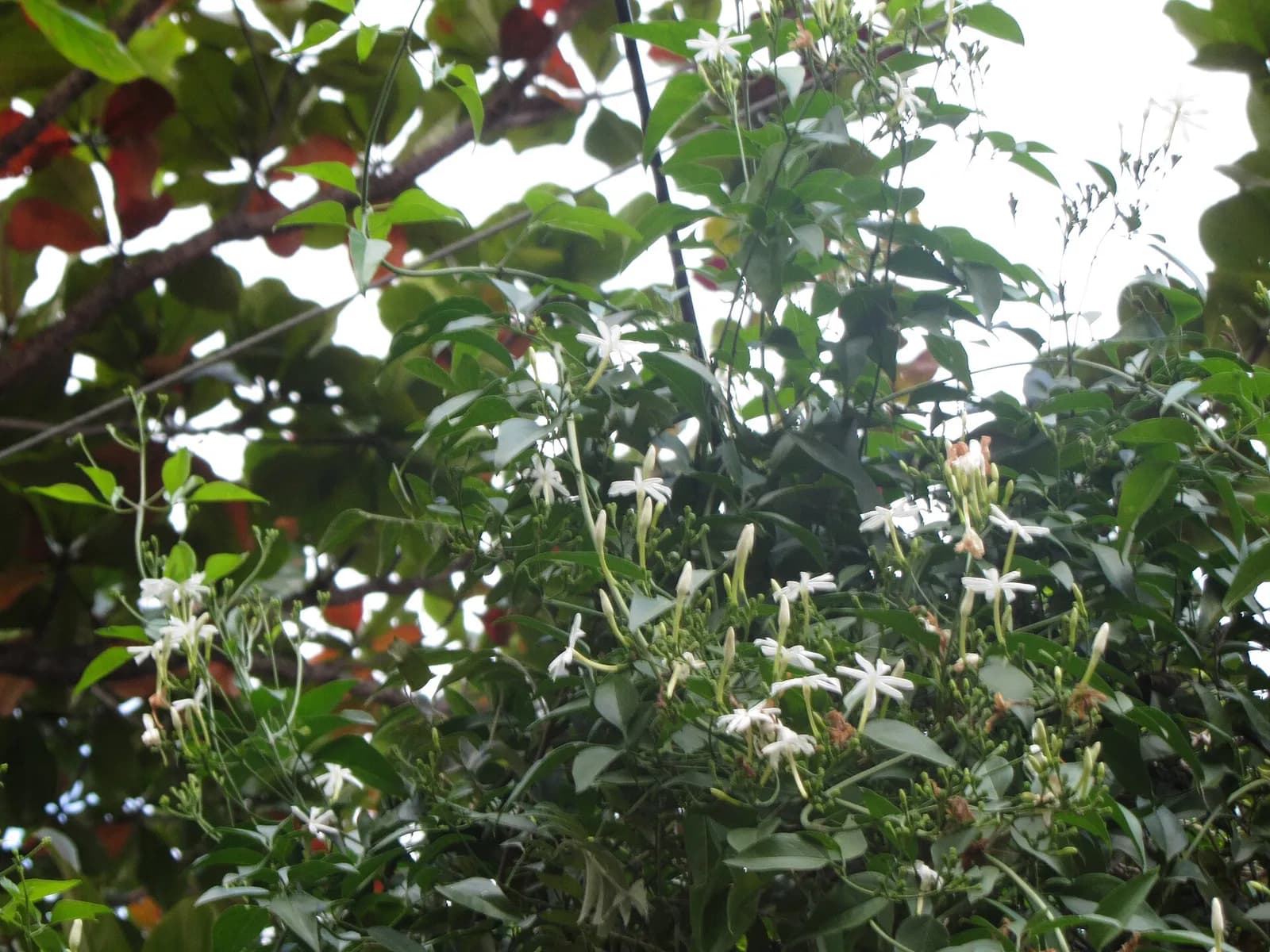
Botany
Juhi is Jasminum auriculatum, a true jasmine of the genus Jasminum. The poets call it a creeper, the botanists a climbing shrub. Its leaves are now simple, now trifoliate: the lateral leaflets are tiny, rarely wider than four millimetres, while the middle one reaches three and a half centimetres. The flowers are satiny, with a slender tube a centimetre and a half long, and they smell very heavily, almost like a gardenia. The fruit is a black globular berry about five millimetres across. Juhi flowers through the whole rainy half of the year.
The name “juhi” itself is Hindi; in Sanskrit it is yuthika and magadhi, in Tamil mullai, in Telugu virajaji. As for the golden yuthika of which the poets of Vraja speak, botany knows none in this species: in every description the flowers are white. A yellow jasmine does exist in India – Chrysojasminum humile – but it is a Himalayan one, living at a height of one and a half to four kilometres, and in Vraja it is not to be met; and in Hindi it is called “pili chameli”, “yellow chameli”, so that even by name it is kin not to juhi but to jai. What the golden yuthi of the poets was – a garden form the handbooks do not know, or a name rather than a colour – cannot be settled from the sources we have.
Juhi: leaf, fruit, vine
Sources
We build Vrajapedia together – with stories, verses, photographs and parikrama experience. If you know something more, tell us and it will appear on this page.


