Kamini
In Vrindavan, by ashrams and garden walls, one keeps coming upon a dense dark-green hedge that begins to give off scent towards evening — sweet and fresh, exactly like orange blossom. This is kamini, the “orange jasmine”: no true jasmine at all but a relative of the orange, though the white stars of its flowers and its heavy scent long ago enrolled it among the jasmines of Vraja.
Contents
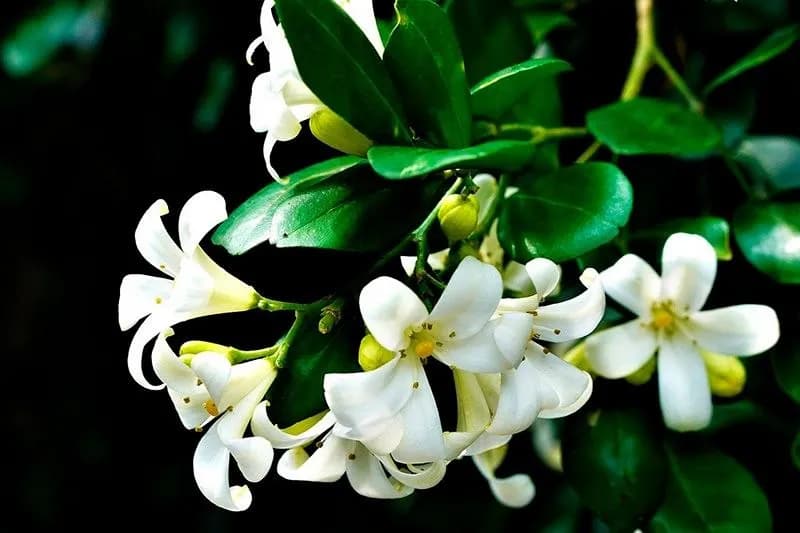
Kamini Among the Jasmines of Vraja
The scriptures name the flowers with which the Deities are adorned: mallika, kunda, yuthika, madhavi, champaka and others. Kamini is not among them. In the company of the jasmines of Vraja she stands as an adopted sister — taken in not by kinship but by likeness: the same white flowers, the same heavy scent.
Folk Medicine
Kamini never took a place in classical Ayurveda, unlike the true jasmines. In folk healing, however, every part of it is put to use. The leaves are held to be astringent and tonic: a decoction of them is given for toothache, the powder is dusted on fresh cuts, a poultice is laid on bruises, sprains and bites. The astringent bark of the stems and roots is taken for stomach upset, and the fragrant flowers are added to tea, both for the scent and as a restorative.
The small red berries are edible: sweetish in taste, with a spicy note. They are eaten a few at a time, not gathered by the handful.
Botany
Left alone, untouched by shears, kamini grows into a small tree with pale bark and an open crown. The leaves are dark green, glossy and pinnate — three to nine leaflets on a stalk — and they sit alternately on the branch. After flowering, small oval berries set and turn from green to orange-red. Kamini grows from the Indian subcontinent through southern China to Australia, and gardeners value it for being undemanding: it puts up with almost any soil.
Kamini in bloom
Sources
We build Vrajapedia together – with stories, verses, photographs and parikrama experience. If you know something more, tell us and it will appear on this page.


