Anwal
A low shrub of the dry plains, covered all over in bright yellow flowers — one of those plants that never made it into the scriptures and yet found a place in Vraja. Its Sanskrit name carmaraṅga and its English one, Tanner’s Cassia, say the same thing: the bark of this shrub is used for tanning leather. And in Vrindavan it is one of the modest flowering shrubs of the kunja — the forest bower where the manjaris, Radha’s young maidservants, prepare a meeting for Her and Krishna.
Contents
A Shrub in the Kunja
Anwal grows in the kunja of Champakalata, one of Radha’s eight principal companions (ashta-sakhi), whose name means “vine of the golden champaka.” The one who serves in that kunja is Guna Manjari, and in the pastimes of Lord Chaitanya she comes as Srila Gopala Bhatta Goswami. Anwal blooms with the same gold as the champaka that gave the mistress of the grove her name.
Ayurveda
Anwal did not enter the ancient compendia of Ayurveda: under the name avartaki it appears later, in the medieval nighantus — the lexicons of medicinal plants. It is valued above all in diabetes: in southern India the flowers and buds are still brewed as “avarai tea.”
In taste (rasa) anwal is astringent and bitter, light and dry in quality, and in potency (virya) cooling; that combination pacifies kapha and pitta. Hence the rest of its uses: weeping skin diseases, diarrhoea and dysentery, intestinal parasites, bleeding, disorders of the urinary tract. The root is taken for fever and constipation, the leaves as a mild laxative.
Botany
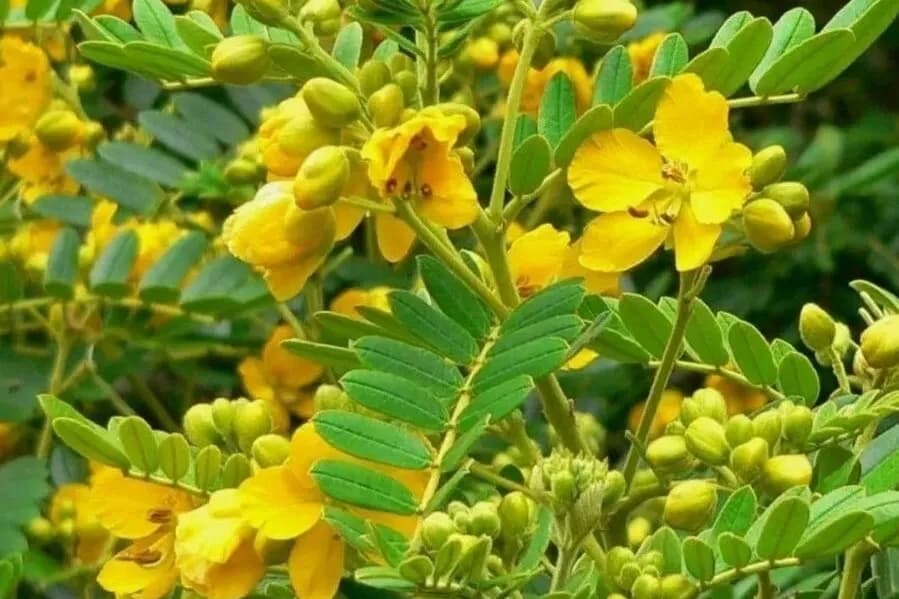
Anwal is Senna auriculata, a branching shrub a metre and a half tall, with smooth reddish-brown bark and ascending branches. The leaf is like a feather: eight to ten centimetres long, made of about ten pairs of small leaflets. The flowers are bright yellow and large — four to five centimetres — gathered in racemes at the ends of the branches. The fruit is a flat brown pod of seven to twelve centimetres. It grows in the dry districts of the Indian subcontinent and is common on waste ground.
Anwal in bloom
Sources
We build Vrajapedia together – with stories, verses, photographs and parikrama experience. If you know something more, tell us and it will appear on this page.


